We use cookies

Our website uses essential cookies and, with your consent, additional cookies to measure performance and improve our services. Cookie Policy.

You can change your choice at any time.

MMedXYNews
HomeVideos
MedXY AI/MedXY News/Section: Internal Medicine

KDIGO 2026 on Anemia in CKD: Key Recommendations and Practical Guidance for Clinicians
MedXY Editorial Team•Sep 18, 2026•Internal Medicine
iron therapyerythropoiesis-stimulating agentsKDIGO 2026anemiachronic kidney disease

Introduction and Context

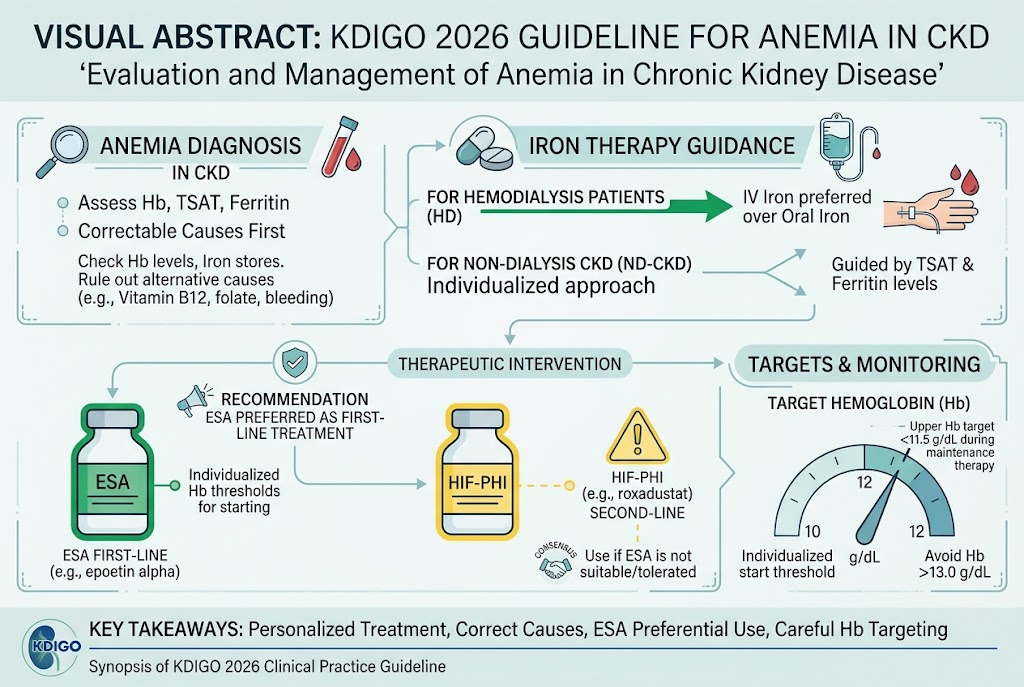
Anemia is a common and consequential complication of chronic kidney disease (CKD), contributing to fatigue, reduced quality of life, and worse cardiovascular and renal outcomes. Since the original KDIGO Clinical Practice Guideline for Anemia in CKD (2012), important new trial evidence and novel therapies (notably hypoxia‑inducible factor prolyl hydroxylase inhibitors, HIF‑PHIs) have changed the therapeutic landscape. The KDIGO 2026 guideline (Hedayati et al., Ann Intern Med. 2026) updates recommendations on diagnosis, iron management, use of erythropoiesis‑stimulating agents (ESAs), transfusion strategy, and the role and positioning of HIF‑PHIs.

Why update now? Three major developments drove the revision:
– New randomized trials clarifying risks of higher hemoglobin (Hb) targets using ESAs and the cardiovascular harms observed in earlier trials (CHOIR, TREAT) have remained influential in shaping safe Hb targets.
– Large hemodialysis iron trials (notably PIVOTAL) refined evidence about proactive intravenous (IV) iron dosing strategies and clinical outcomes.
– Introduction and proliferation of HIF‑PHIs with mixed safety signals and differing regulatory approvals prompted a need for guidance on their role relative to ESAs.

MedXY registered readers

Sign in free to continue reading

Create or use your MedXY account to unlock the complete article.

This article was created using several editorial tools, including AI, as part of the process. Human editors reviewed this content before publication.

Related articles

Open language-specific specialty feeds and department pages.

Hemoglobin Levels and Mortality Risk: Insights from a Large UK Cohort StudyA UK prospective cohort study reveals a U-shaped association between hemoglobin concentration and mortality, with both low and high levels linked to increased death risk across age and sex groups.Sep 13, 2026Finerenone in Hypertensive Non-Diabetic Chronic Kidney Disease: Evidence from the FIND-CKD Subgroup AnalysisFinerenone significantly slows kidney function decline and reduces cardiovascular risk in hypertensive non-diabetic CKD patients, with manageable safety profiles, supporting its therapeutic role beyond diabetes.Sep 3, 2026Low-Normal Hemoglobin Concentrations and Clinical Outcomes in Heart Failure: Rethinking WHO Anemia ThresholdsThis review synthesizes current evidence on hemoglobin thresholds in heart failure, highlighting that optimal prognosis is associated with hemoglobin levels higher than WHO anemia cutoffs, with clinical implications for management and iron Aug 29, 2026Rising Burden of Anemia and Iron Deficiency Among U.S. Nonpregnant Women of Reproductive Age: Insights from NHANES 1999–2023
Loading comments...
MedXY briefing

Get the free newsletter

Evidence-led clinical news, trends, and analysis—delivered to your inbox.

Ask MedXY AI

Most popular

Intimate Health
Five Benefits for Women Continuing Sexual Activity After Menopause
Intimate Health
Why Some Women Have a Strong Sex Drive—And Why Men Shouldn't Worry About It
Nursing & care
How often should a couple have sex?
Intimate Health
Classic Intimacy Recommendations: How to Help Women Reach Orgasm and Enjoy Mutual Pleasure
Intimate Health
What Makes a Woman "Physiologically Addicted" Is Never Money, But These Two Relationship Qualities
© 2026 MedXY
Contact usAbout usPrivacy PolicyMedXY story
Analysis of NHANES data reveals increasing anemia and iron deficiency anemia rates among nonpregnant U.S. women aged 20-45 from 1999 to 2023, with persistently high iron deficiency prevalence.
Aug 18, 2026
Renin-Angiotensin-Aldosterone System Inhibitors Worsen Anemia in Sickle Cell Disease: Clinical and Mechanistic InsightsRAAS inhibitors, used for kidney protection in sickle cell disease, may significantly exacerbate anemia by impairing erythropoiesis, warranting close hemoglobin monitoring in this vulnerable population.Aug 10, 2026
End-Organ Damage in Primary Hyperparathyroidism: Prevalence, Progression, and Treatment Gaps in a National CohortA nationwide cohort study reveals that two-thirds of patients with primary hyperparathyroidism exhibit end-organ damage at diagnosis or during follow-up, yet few receive parathyroidectomy, underscoring missed opportunities to reduce morbidiAug 4, 2026