We use cookies

Our website uses essential cookies and, with your consent, additional cookies to measure performance and improve our services. Cookie Policy.

You can change your choice at any time.

MMedXYNews
HomeVideos
MedXY AI/MedXY News/Section: Hematology-Oncology

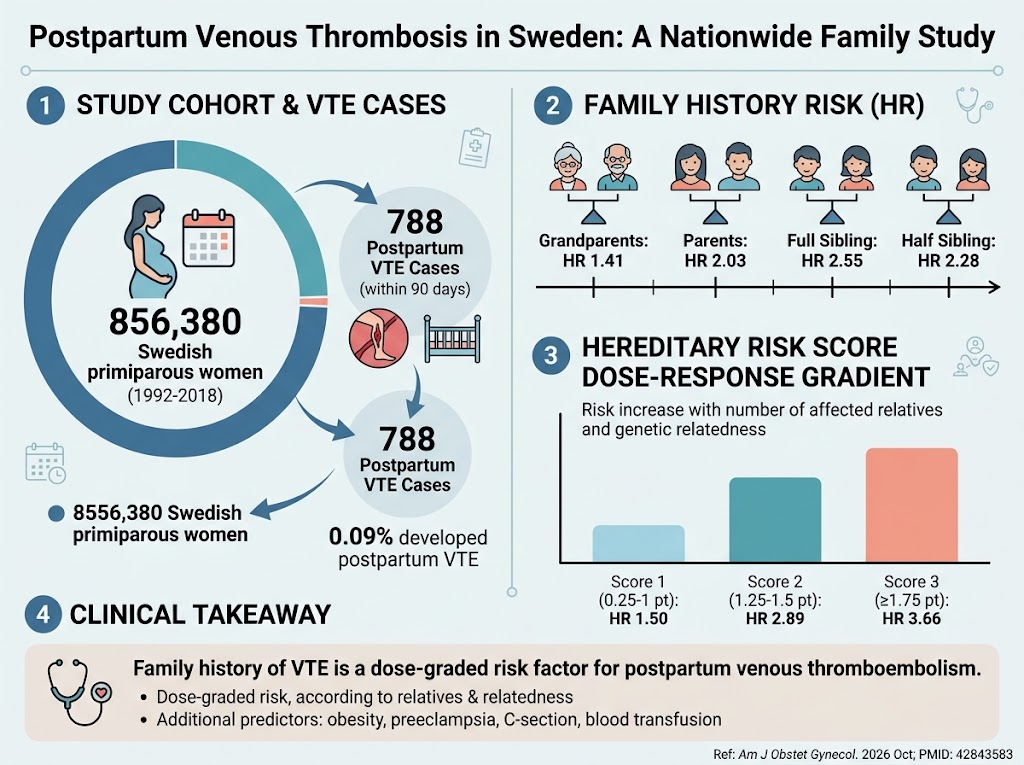
Family History as a Dose-Dependent Risk Factor for Postpartum Venous Thromboembolism: Insights from a Nationwide Swedish Cohort Study
MedXY Editorial Team•Oct 13, 2026•Hematology-Oncology
family historygenetic riskpostpartum venous thromboembolismprimiparous womenSweden

Highlight

This nationwide Swedish cohort study examined over 850,000 first-time mothers and found that a family history of venous thromboembolism (VTE) strongly influences the risk of postpartum VTE. Risk increases with closer genetic relatedness and the number of affected relatives, demonstrating a clear dose-response relationship. Other clinical factors such as obesity, autoimmune disease, and obstetric complications also independently elevate risk.

Study Background

MedXY registered readers

Sign in free to continue reading

Create or use your MedXY account to unlock the complete article.

This article was created using several editorial tools, including AI, as part of the process. Human editors reviewed this content before publication.

Related articles

Open language-specific specialty feeds and department pages.

Cholesteryl Ester Transfer Protein Inhibition: A Double-Edged Sword in Cardiovascular Health and Age-Related Macular Degeneration RiskGenetic analyses reveal that cholesteryl ester transfer protein (CETP) inhibition, while beneficial for cardiovascular disease, is associated with an increased risk of age-related macular degeneration (AMD) across European and East Asian poOct 6, 2026Evolving Genetic Contributions to ASD and ADHD: Insights from Diagnosis Trends (1994–2016)A Danish cohort study reveals decreased genetic risk profiles in recent ASD and ADHD diagnoses, supporting broader diagnostic criteria as a driver of rising incidence rates.Sep 24, 2026Reevaluating Colorectal Cancer Surveillance in Inflammatory Bowel Disease: The Role of Family History Beyond Early-Onset CasesA nationwide cohort study reveals that in IBD patients, colorectal cancer risk increases notably with multiple affected relatives, challenging current guidelines prioritizing early-onset family history for surveillance.Sep 6, 2026
Loading comments...
MedXY briefing

Get the free newsletter

Evidence-led clinical news, trends, and analysis—delivered to your inbox.

Ask MedXY AI

Most popular

Intimate Health
Five Benefits for Women Continuing Sexual Activity After Menopause
Intimate Health
Why Some Women Have a Strong Sex Drive—And Why Men Shouldn't Worry About It
Nursing & care
How often should a couple have sex?
Cardiology
Precision Medicine for Long QT Syndrome Type 2: Lumacaftor Corrects Trafficking Defects and Shortens QT Interval
General Surgery
Optimizing Postoperative Opioid Prescriptions After Intra-Abdominal Cancer Surgery: Comparing the 5x-Multiplier and 3-Tier Models
© 2026 MedXY
Contact usAbout usPrivacy PolicyMedXY story
Integrating Genetics and Measurable Residual Disease to Optimize Therapy in Philadelphia Chromosome-Negative Adult ALL
Combining genetic risk stratification with measurable residual disease enables precise treatment allocation in adult Philadelphia chromosome-negative acute lymphoblastic leukemia, improving survival outcomes and guiding the use of allogenei
Aug 24, 2026
Bridging Perspectives: Patient and Clinician Views on Postpartum Venous Thromboembolism Risk and Thromboprophylaxis UseThis qualitative study explores patient and obstetric clinician perspectives on postpartum venous thromboembolism (VTE) risk communication and pharmacologic thromboprophylaxis, highlighting education gaps and the need for individualized risAug 21, 2026
Structure of the Genetic Risks for Psychiatric Disorders in Swedish Population-Based RegistriesThis study investigates the genetic risk structure of 18 psychiatric and substance use disorders using high-quality Swedish registries, identifying six distinct genetic factors and highlighting shared and unique genetic influences among disAug 15, 2026