Evaluating Non-Enteric-Coated Pancreatic Enzyme Therapy for Pain Relief in Chronic Pancreatitis: Insights from a Robust Randomized Trial
Highlight
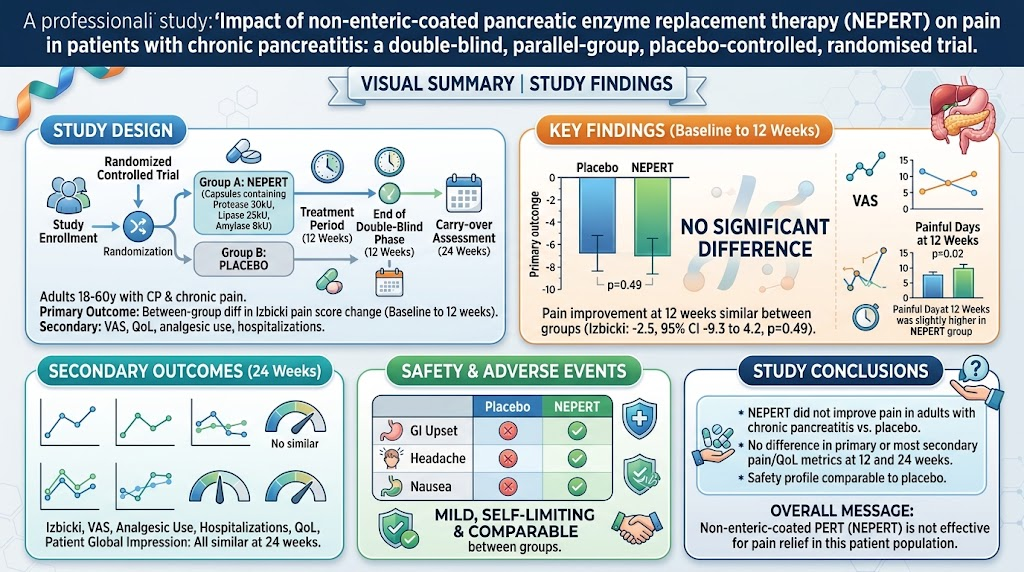
- A 24-week randomized controlled trial evaluated the effect of non-enteric-coated pancreatic enzyme replacement therapy (NEPERT) on pain in chronic pancreatitis (CP) patients.
- NEPERT did not significantly improve pain compared to placebo, as measured by the Izbicki pain score and Visual Analogue Scale at 12 and 24 weeks.
- Secondary outcomes including painful days, analgesic usage, hospitalizations, and quality of life showed no benefit with NEPERT; indeed, a higher proportion of painful days was reported at 12 weeks in the treatment group.
- The study demonstrates that NEPERT is safe but ineffective for pain relief in CP, emphasizing the need for alternative pain management approaches.
Study Background
Chronic pancreatitis (CP) is a progressive inflammatory condition of the pancreas characterized by irreversible morphological changes and chronic abdominal pain. Pain management remains a major clinical challenge, as pain is often multifactorial, involving inflammatory, neuropathic, and structural components. Pancreatic enzyme replacement therapy (PERT) is widely used to treat exocrine pancreatic insufficiency and has been hypothesized to reduce pain by suppressing pancreatic secretion, thereby potentially decreasing pancreatic stimulation and ductal hypertension. However, existing evidence about PERT’s efficacy for pain relief in CP is inconclusive, with conflicting results from prior trials, many of which had methodological limitations. This unmet need justifies rigorous studies to evaluate the true utility of PERT in alleviating pain in CP.
Study Design
This investigation was a 24-week, double-blind, parallel-group, placebo-controlled, randomized clinical trial conducted at two academic centers. Eligible participants were adults aged 18 to 60 years with a diagnosis of CP based on Mayo Clinic criteria and documented chronic abdominal pain. They were randomized in equal proportions to receive either non-enteric-coated pancreatic enzyme replacement therapy (NEPERT) capsules or placebo. Each NEPERT capsule contained protease 30,000 units, lipase 25,000 units, and amylase 8,000 units. The treatment duration was 12 weeks, followed by an additional 12 weeks of observation to assess any carry-over effects after cessation.
The primary endpoint was the between-group difference in change in the Izbicki pain score—a validated instrument sensitive to pain intensity and frequency—from baseline to 12 weeks. Secondary endpoints included pain assessments via the Visual Analogue Scale (VAS) at both 12 and 24 weeks, number of painful days, analgesic and hospitalization requirements, patient’s global impression of change, and health-related quality of life. The analysis was intention-to-treat, employing repeated-measures mixed-effects models to handle longitudinal data points.
Key Findings
A total of 107 patients were enrolled and randomized, with 54 allocated to NEPERT and 53 to placebo. The average age was 34.4 years, predominantly male (71%), and with 66% of cases classified as idiopathic CP.
At 12 weeks, the primary outcome revealed no statistically significant difference between groups in the improvement of pain scores; the mean between-group difference in Izbicki scores was -2.5 points (95% confidence interval [CI] -9.3 to 4.2; p=0.49), indicating negligible clinical benefit. Similar lack of effect persisted at 24 weeks, suggesting no sustained or delayed analgesic benefit after NEPERT discontinuation.
Secondary outcomes mirrored these results, with no significant differences in VAS scores, analgesic use, hospitalization rates, patient global assessments, or quality of life measures at both time points. Interestingly, a higher proportion of patients receiving NEPERT reported more painful days at 12 weeks compared to placebo (mean group difference -14.5 days [95% CI -26.0 to -3.0]; p=0.02), suggesting possible paradoxical exacerbation or a chance finding warranting cautious interpretation.
Safety analysis confirmed that adverse events were mild, self-limiting, and comparable between the NEPERT and placebo groups, corroborating the good tolerability of NEPERT in this population.
Expert Commentary
This rigorously conducted randomized trial significantly advances our understanding of PERT’s role in pain management for CP. The absence of analgesic benefit from NEPERT challenges the longstanding hypothesis that pancreatic enzyme supplementation can reduce pancreatic pain by suppressing pancreatic secretions or ductal pressures. Given that this study employed non-enteric-coated enzymes, which have better immediate pancreatic feedback suppression, the negative findings are more compelling and suggest a limited mechanistic role for enzyme therapy in modulating pain pathways.
Limitations include the relatively young study population and predominance of idiopathic etiologies, potentially limiting generalizability to older patients or other etiologies such as alcoholic CP. Furthermore, the dosage and enzyme composition used reflect commonly employed regimens; alternative formulations or adjunct therapies might warrant evaluation.
These findings align with current guideline recommendations that emphasize multimodal pain management strategies, including analgesics, endoscopic interventions, and neuromodulation, rather than relying solely on enzyme therapy for pain control.
Conclusion
The study demonstrates that non-enteric-coated pancreatic enzyme replacement therapy does not confer pain relief benefits in adults with chronic pancreatitis when compared to placebo. Despite its safety and tolerability, NEPERT should not be prescribed solely for pain management in CP. Clinicians should prioritize comprehensive, individualized pain management approaches and consider further research into novel interventions targeting the multifactorial nature of CP pain.
Funding and Clinical Trials Registration
This trial was registered with ClinicalTrials.gov under identifier NCT05042284. No specific funding details were provided in the publication.
References
1. Talukdar R, Rasheed A, Unnisa M, et al. Impact of non-enteric-coated pancreatic enzyme replacement therapy (NEPERT) on pain in patients with chronic pancreatitis: a double-blind, parallel-group, placebo-controlled, randomised trial. Gut. 2026 Sep 16; PMID: 42749363.
2. Whitcomb DC. Chronic pancreatitis: the role of pain and mechanisms. Gastroenterology. 2013;144(6):1281-1291.
3. Drewes AM, Bouwense SA, Campbell CM, et al. Guidelines for the understanding and management of pain in chronic pancreatitis. Pancreatology. 2017;17(5):720-731.
4. Issa Y, Mourad MM, Whitcomb DC, Yadav D. Treatment options for chronic pancreatitis. Curr Treat Options Gastroenterol. 2018;16(4):513-527.
This article was created using several editorial tools, including AI, as part of the process. Human editors reviewed this content before publication.