Harnessing Multidomain Baseline Metrics to Predict Attrition in Diabetic Foot Ulcer Offloading Trials
Highlight
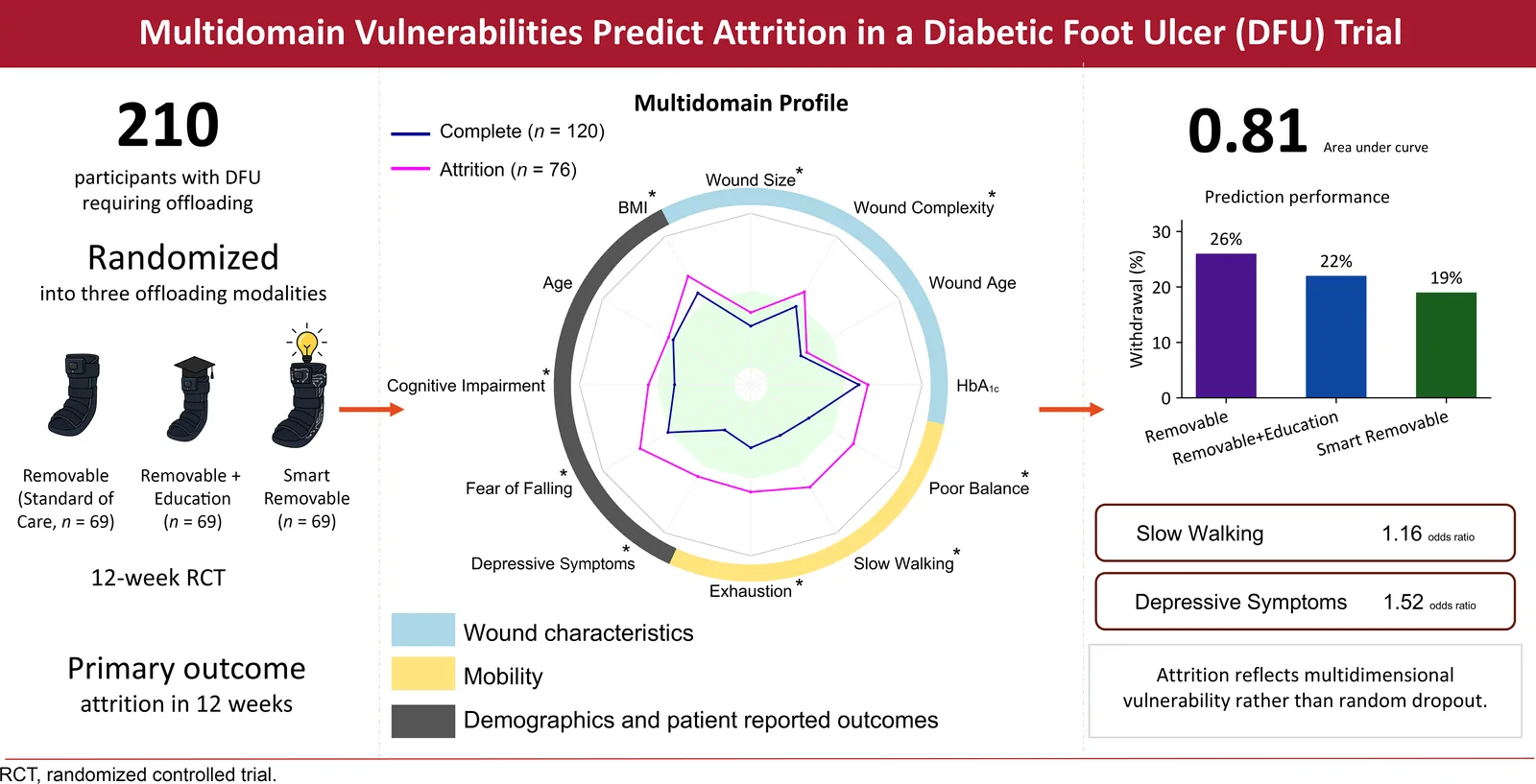
This analysis identifies slower gait speed and elevated depressive symptoms as independent predictors of attrition in RCTs involving diabetic foot ulcer offloading devices. The use of a smart removable boot with real-time adherence reminders was associated with lower withdrawal rates. Integration of multidomain baseline metrics via a risk-normalization and radar visualization framework demonstrated strong predictive discrimination (AUC 0.81), offering a novel tool for tailoring retention strategies.
Study Background
Diabetic foot ulcers (DFUs) affect approximately 6% of people with diabetes annually, imposing a major clinical and economic burden due to infection risks, lower-extremity amputation, and recurrent hospitalizations. Offloading devices remain cornerstone interventions to promote wound healing and prevent complications. Randomized controlled trials (RCTs) testing these devices face significant challenges from participant attrition, which can bias outcomes and undermine the validity of findings. Attrition may be influenced by patient-related factors including wound severity, functional limitations such as gait impairments, and psychosocial dimensions including depression, yet predictive models integrating these multidomain variables are lacking.
Study Design
The referenced 12-week RCT randomized 210 adult participants with diabetic foot ulcers to three interventions: (1) a removable offloading boot, (2) removable boot plus education, and (3) a smart removable boot equipped with feedback-enabled technology providing adherence reminders. Baseline assessments included clinical wound characteristics, functional performance metrics (notably gait speed), and psychosocial measures such as depressive symptom rating scales. The primary aim of this secondary analysis was to investigate how these baseline variables predicted trial attrition, defined as participant withdrawal or loss to follow-up before study completion.
Key Findings
Attrition occurred in 36% (76 of 210) of participants. Multivariable logistic regression revealed two independent predictors: slower gait speed (odds ratio [OR] 1.16 per decrement) and higher depressive symptoms (OR 1.52 per unit increase). These findings signify that functional impairment and mood disorders substantially increase the likelihood of dropout.
A novel aspect was the creation of a unified attrition-risk scale through normalization of measured variables and visualization in a radar plot format, where higher composite scores indicated greater risk of attrition. This integrated tool demonstrated strong discrimination ability, evidenced by a receiver operating characteristic area under the curve (AUC) of 0.81, reflecting excellent predictive performance.
Attrition was lowest in the smart boot group, suggesting that adherence reinforcement via real-time feedback may mitigate dropout. This highlights the potential of embedding behavioral supports within offloading technologies to improve trial retention and, by extension, clinical outcomes.
Expert Commentary
Attrition in DFU clinical trials is a pervasive issue that compromises statistical power and generalizability. The demonstration that objective functional measures and psychosocial assessments predict withdrawal provides actionable insights. Clinicians and trial designers could incorporate baseline gait speed and depression screening to identify high-risk participants. Customized retention interventions, like motivational interviewing or enhanced adherence feedback, could be selectively targeted.
The radar visualization approach is an innovative method for integrating multidimensional data that may facilitate individualized patient monitoring beyond clinical trials, potentially extending into routine clinical care to anticipate treatment adherence challenges.
Limitations include the secondary nature of the analysis and potential confounders unaccounted for, such as social determinants of health. Generalizability to other populations or offloading device types requires further validation.
Conclusion
Baseline multidomain metrics encompassing clinical, functional, and psychosocial factors predict participant attrition in diabetic foot ulcer offloading RCTs. Incorporating these data into a unified attrition-risk scale with radar visualization yields a robust predictive tool. The lower withdrawal rates observed in the smart boot group underscore the value of technology-enabled adherence reinforcement. These findings inform strategies to enhance retention in DFU clinical trials and suggest avenues for embedding risk assessment tools in clinical workflows to optimize patient outcomes.
Funding and ClinicalTrials.gov
Details on study funding or ClinicalTrials.gov registration were not provided in the abstract and would require further consultation of the original publication.
References
1. Khandan A, Dehghan Rouzi M, Armstrong DG, Najafi B. Predicting the Path to Attrition: Multidomain Risk Assessment in Diabetic Foot Ulcer Offloading Randomized Controlled Trials. Diabetes Care. 2026 Sep 1;49(9):1681-1685. PMID: 42411992.
2. Armstrong DG, et al. Diabetic foot ulcers and their recurrence. N Engl J Med. 2017;376(24):2367-2375.
3. Lavery LA, et al. The importance of adherence to offloading and the impact of noncompliance on foot ulcer outcomes in people with diabetes. Diabetes Metab Res Rev. 2015;31(1):129-134.
4. Redmond AC, et al. Gait impairment and disability following diabetic foot ulceration: A narrative review. J Diabetes Complications. 2020;34(7):107594.
This article was created using several editorial tools, including AI, as part of the process. Human editors reviewed this content before publication.