We use cookies

Our website uses essential cookies and, with your consent, additional cookies to measure performance and improve our services. Cookie Policy.

You can change your choice at any time.

MMedXYNews
HomeVideos
MedXY AI/MedXY News/Section: Diabetes & Endocrinology

Genetic Influences on Diabetes Outcomes After Total Pancreatectomy with Islet Autotransplantation
MedXY Editorial Team•Sep 15, 2026•Diabetes & Endocrinology
Genetic Risk Scorediabetes genetics全膵切除chronic pancreatitisIslet autotransplantation

Highlight

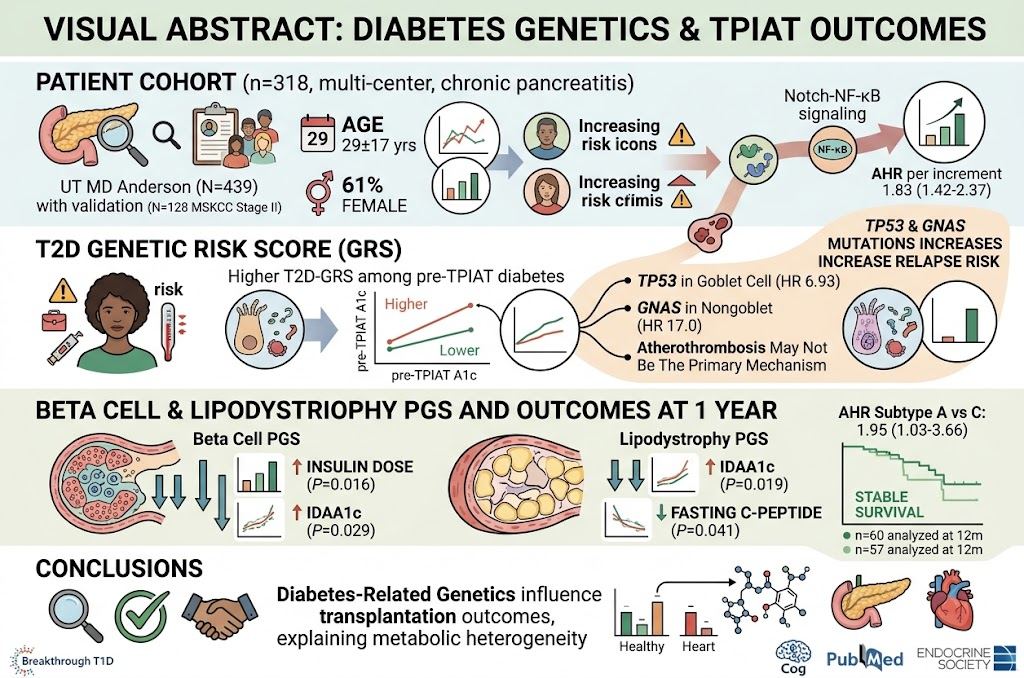
This multicenter study demonstrates that genetic risk scores (GRS) for type 2 diabetes (T2D) are associated with pre-transplant diabetes status and higher HbA1c in chronic pancreatitis patients undergoing total pancreatectomy with islet autotransplantation (TPIAT). Additionally, polygenic scores related to beta-cell function and lipodystrophy explain variability in insulin requirements and C-peptide levels one year after transplantation, highlighting the role of diabetes-related genetics in predicting post-TPIAT metabolic outcomes.

Study Background

MedXY registered readers

Sign in free to continue reading

Create or use your MedXY account to unlock the complete article.

This article was created using several editorial tools, including AI, as part of the process. Human editors reviewed this content before publication.

Related articles

Open language-specific specialty feeds and department pages.

Morphology-Based Surgery for Chronic Pancreatitis: Findings from a Europe-Wide Study and the Case for Unified, Next-Generation GuidelinesA Europe-wide prospective study shows wide variation in morphology-based surgery for chronic pancreatitis and no clear outcome advantage from current guideline concordance — underscoring the need for unified, clearer recommendations on reseSep 7, 2026Enhancing MODY Diagnosis: The Clinical Value of Type 1 Diabetes Genetic Risk Scoring in Routine Genetic TestingIncorporating a type 1 diabetes genetic risk score into MODY genetic testing helps identify misdiagnosed T1D cases, particularly in children, optimizing diagnostic accuracy and reducing unnecessary testing.Aug 19, 2026Preservation of Islet Function and Glycaemic Control After Total Pancreatectomy with Islet Autotransplantation: Insights From Continuous Glucose MonitoringThis study demonstrates that nearly half of islet secretory function is preserved following total pancreatectomy with islet autotransplantation (TPIAT), independent of preoperative glycaemic status or prior pancreatic surgery. Continuous glJun 28, 2026
Loading comments...
MedXY briefing

Get the free newsletter

Evidence-led clinical news, trends, and analysis—delivered to your inbox.

Ask MedXY AI

Most popular

Intimate Health
Five Benefits for Women Continuing Sexual Activity After Menopause
Intimate Health
Why Some Women Have a Strong Sex Drive—And Why Men Shouldn't Worry About It
Nursing & care
How often should a couple have sex?
Intimate Health
Classic Intimacy Recommendations: How to Help Women Reach Orgasm and Enjoy Mutual Pleasure
Intimate Health
What Makes a Woman "Physiologically Addicted" Is Never Money, But These Two Relationship Qualities
© 2026 MedXY
Contact usAbout usPrivacy PolicyMedXY story
Exercise May Be a Disease-Modifying Strategy in Chronic PancreatitisA new multimodal study links regular physical activity to lower chronic pancreatitis risk and identifies muscle-derived extracellular vesicles as a plausible mechanism limiting pancreatic inflammation, fibrosis, and ferroptosis.Jun 1, 2026
Therapeutic Mobilization: How Physical Activity Reprograms the Pancreatic Immune Microenvironment to Combat Chronic PancreatitisThis review synthesizes recent evidence from the UK Biobank and molecular studies demonstrating that physical activity, particularly resistance exercise, restrains chronic pancreatitis by delivering muscle-derived extracellular vesicles thaJun 1, 2026
A Blood-Based Extracellular Vesicle RNA Signature May Offer a New Way to Diagnose Chronic PancreatitisA five-RNA extracellular vesicle signature showed strong diagnostic performance for chronic pancreatitis and may also reflect acinar-to-ductal metaplasia and disease-related metabolic features.Apr 20, 2026