Evaluating Anti-VEGF Retreatment Outcomes in Diabetic Macular Edema Patients Returning After Lost to Follow-Up with Stabilized Vision
Highlight
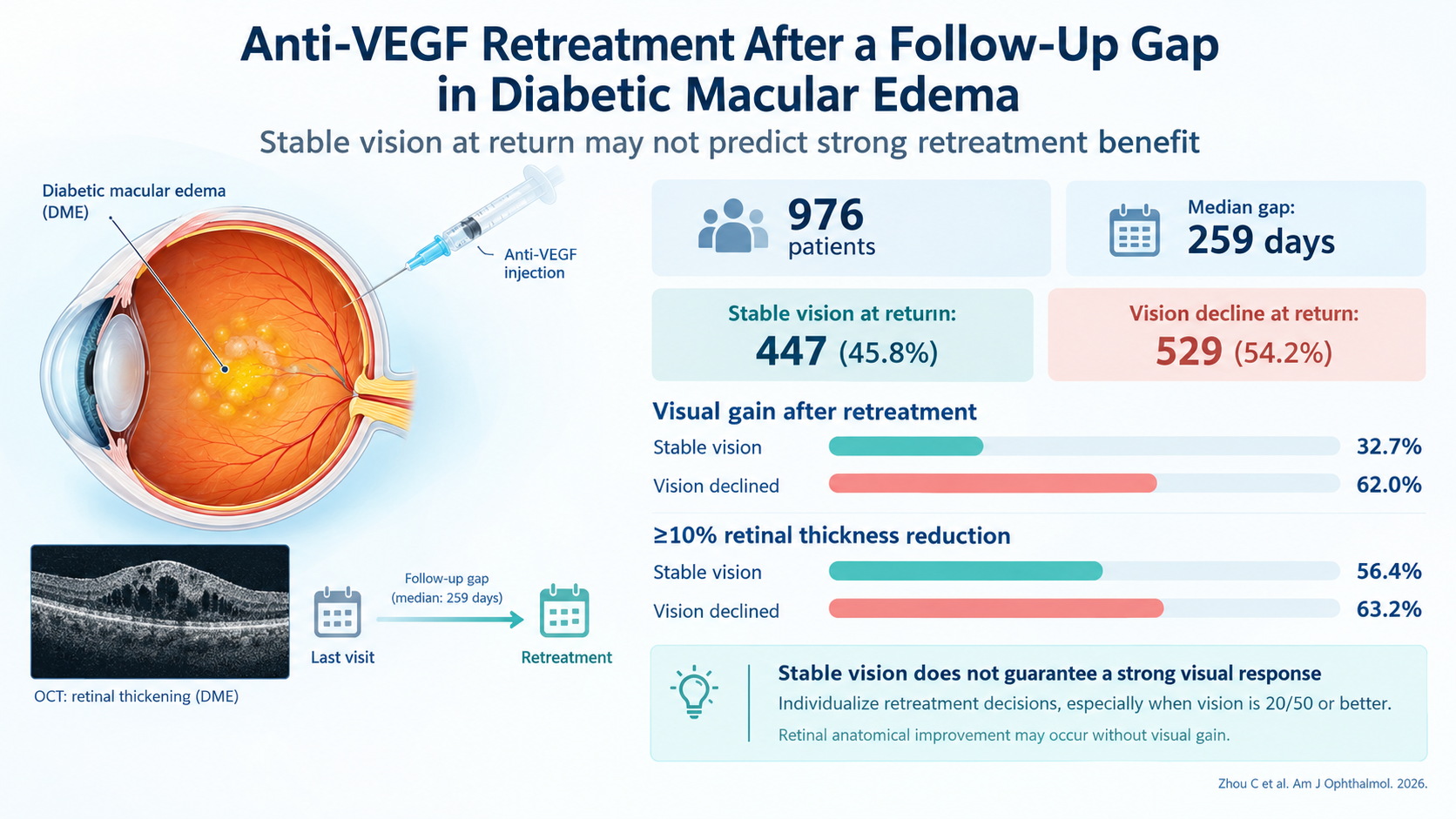
This registry-based cohort study evaluated 976 patients with diabetic macular edema (DME) who were lost to follow-up (LTFU) for at least six months and then restarted on anti-vascular endothelial growth factor (anti-VEGF) therapy. Approximately 46% returned with stabilized vision, while 54% exhibited vision decline. Visual and anatomical improvements post-retreatment were significantly lower in patients with stabilized vision, especially those with visual acuity (VA) 20/50 or better at return, suggesting limited benefit from resumed anti-VEGF therapy alone in this subgroup.
Study Background
Diabetic macular edema is a leading cause of vision impairment in patients with diabetes mellitus, characterized by retinal thickening and fluid accumulation due to vascular leakage. Anti-VEGF agents have become the cornerstone treatment, effectively reducing retinal edema and improving or stabilizing vision. However, real-world challenges such as patient non-adherence or lost to follow-up reduce treatment effectiveness, with uncertain outcomes upon retreatment. Understanding therapeutic responses in patients who return after treatment interruption, especially those with stabilized vision, is essential for guiding clinical decisions and optimizing visual prognosis.
Study Design
This retrospective nationwide registry-based cohort study included 976 eyes from patients with center-involved diabetic macular edema (CFT ≥ 250 μm) and visual acuity below 20/25 prior to being LTFU for ≥6 months. Patients’ VA and CFT were recorded at three points: before LTFU, upon return, and after restarting anti-VEGF retreatment. The cohort was stratified into two groups: (1) stabilized vision group—patients whose first VA at return was equal to or better than the last VA before LTFU and (2) vision decline group—patients whose VA declined during LTFU. The median LTFU duration was 259 days. The main endpoints included the proportion of patients achieving visual gain and anatomical improvement (≥10% CFT reduction) after anti-VEGF retreatment, with logistic regression analyses exploring predictors of clinical benefit.
Key Findings
Among returning patients, 447 (45.8%) had stabilized VA, whereas 529 (54.2%) experienced vision decline after LTFU. Both groups had comparable follow-up periods after retreatment (~360 days) and similar baseline central foveal thickness.
Visual gain following retreatment was observed in 32.7% of patients with stabilized vision, significantly lower than 62.0% in the declined vision group (P < .001). Similarly, anatomical improvement, defined as ≥10% reduction in CFT, occurred in 56.4% vs. 63.2% respectively (P = .038). Multivariate analyses demonstrated that patients who returned with stabilized vision had lower odds of visual improvement (OR = 0.29; 95% CI: 0.22–0.38; P < .001) and a trend toward lower odds of anatomical improvement (OR = 0.78; 95% CI: 0.59–1.02; P = .073). Importantly, a greater number of anti-VEGF injections during retreatment correlated positively with both visual and anatomical gains (both P < .001).
A critical finding was that patients with stabilized vision at or better than 20/50 upon return did not achieve meaningful vision gains after retreatment despite measurable anatomical improvements. This suggests a dissociation between morphological recovery and functional visual outcomes in this subgroup.
Expert Commentary
This study addresses an important and often overlooked clinical scenario: management of DME patients who interrupt anti-VEGF therapy yet return with relatively preserved vision. The findings challenge the assumption that retreatment will always confer visual benefit, underscoring the complex interplay between structural changes and visual function.
Potential explanations for suboptimal visual gains despite anatomical improvement include irreversible photoreceptor damage or neuronal loss during the untreated period and the ceiling effect in patients with already moderate-to-good vision. The data advocate for a tailored approach, questioning routine anti-VEGF reinitiation in stabilized vision cases without clear evidence of decline.
Limitations include the retrospective design and potential confounders such as systemic disease control and variability in retreatment protocols. Nevertheless, the large sample size and real-world registry data enhance generalizability.
Conclusion
This nationwide cohort study reveals that DME patients returning after LTFU with stabilized vision respond less favorably to anti-VEGF retreatment compared to those returning with vision decline. Particularly, patients with VA 20/50 or better at return exhibit limited potential for visual improvement, despite anatomical benefits. Clinicians should carefully weigh the risks and benefits of resuming anti-VEGF therapy in this population, considering alternative or adjunct treatments. Future prospective studies are warranted to refine retreatment criteria and optimize individualized patient care.
Reference
Zhou C, Shen Y, Li S, Li Y, Li X, Yang X, Xu Y, Wang X, Yang Q, Sun D, Zhang W, Li S, Zhang H, Lv H, Ma X, Yu H, Song Z, Zhang T, Yu X, Liu Y, Niu T, Yuan R, You Z, Liu Q, Song Y, Cao N, Zhu D, Sun X, Zheng Z, Liu K, Xu X. Therapeutic Response to Anti-Vascular Endothelial Growth Factor Retreatment Among Eyes With Stabilized Vision After Being Lost to Follow-Up in Diabetic Macular Edema: A Nationwide, Registry-Based Cohort Study. Am J Ophthalmol. 2026 Oct;290:192-203. doi: 10.1016/j.ajo.2026.06.035. Epub 2026 Jun 22. PMID: 42331128.
This article was created using several editorial tools, including AI, as part of the process. Human editors reviewed this content before publication.