Real-World Eligibility of Diabetic Macular Edema Patients for Anti-VEGF Trials: Implications for Clinical Practice and Health Equity
Highlight
- Approximately one quarter to over half of real-world diabetic macular edema (DME) patients are excluded from anti-VEGF clinical trials based on systemic health criteria.
- Stringent trial criteria, including limits on blood pressure, hemoglobin A1c, recent cardiovascular events, and renal disease, exclude nearly 60% of patients receiving treatment in routine practice.
- Black patients and those of other racial minorities face significantly higher exclusion rates than White patients, underscoring health disparities.
- The findings call for reconsideration of trial eligibility criteria to improve external validity and inclusiveness.
Study Background
Diabetic macular edema (DME) is a major cause of vision loss among people with diabetes, characterized by retinal swelling due to vascular leakage mediated largely by vascular endothelial growth factor (VEGF). Anti-VEGF intravitreal injections have revolutionized DME treatment, demonstrating efficacy in numerous randomized controlled trials (RCTs). However, RCT participants often meet strict systemic eligibility criteria designed to reduce confounding and adverse events, potentially limiting representativeness. This raises concerns about the generalizability of trial results to the real-world population, particularly in the context of systemic comorbidities common in diabetes such as hypertension, poor glycemic control, cardiovascular disease, and kidney failure. Furthermore, racial minorities disproportionately endure health disparities that could affect trial eligibility and ultimately access to advanced therapies.
Study Design
This cross-sectional study utilized data from the TriNetX database, a federated network encompassing electronic health records from multiple United States healthcare organizations. Patients were eligible if they had received at least one anti-VEGF injection for DME and had documented pre-injection blood pressure (BP) and hemoglobin A1c (A1c) values.
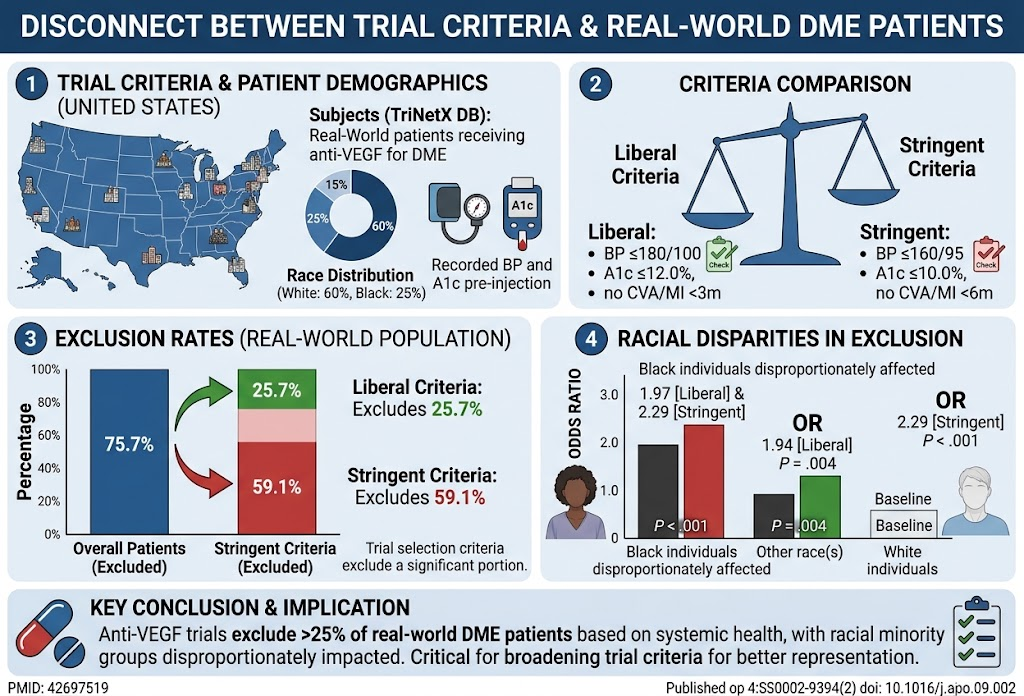
Systemic eligibility criteria were extracted from ClinicalTrials.gov for anti-VEGF DME trials and categorized into two sets: “liberal” criteria, allowing BP ≤180/100 mmHg, A1c ≤12.0%, no myocardial infarction (MI) or cerebrovascular accident (CVA) within 3 months, and no end-stage renal disease (ESRD); and “stringent” criteria, with BP ≤160/95 mmHg, A1c ≤10.0%, no MI or CVA within 6 months, and no ESRD. The main outcome was the proportion of patients excluded based on these criteria. Secondary analyses evaluated differences in exclusion rates by race.
Key Findings
Application of the liberal criteria led to exclusion of 25.7% of the cohort, while the stringent criteria excluded 59.1%, highlighting the scope of patients commonly excluded from trials despite receiving treatment clinically.
Disparities were notable by race. Black patients had nearly twice the odds of exclusion compared to White patients under liberal criteria (odds ratio [OR] 1.97; 95% CI, 1.57–2.46; P<.001), and more than double under stringent criteria (OR 2.29; 95% CI, 1.82–2.87; P<.001). Patients designated other races also faced higher exclusion odds under liberal criteria (OR 1.94; 95% CI, 1.33–2.84; P= .004). These findings suggest systemic comorbidities disproportionately burden minority groups, contributing to underrepresentation in clinical trials.
The study underscores a significant mismatch between eligibility criteria of pivotal anti-VEGF trials for DME and the characteristics of patients treated in routine practice, especially minority populations who are already vulnerable to health inequities.
Expert Commentary
The restrictive systemic criteria used in many anti-VEGF trials aim to minimize adverse cardiovascular and renal events, given that VEGF inhibition can theoretically impact vascular physiology. However, diabetes is inherently a multi-organ systemic illness with frequent comorbidities that often exceed these thresholds, presenting a dilemma for clinicians when extrapolating trial evidence to their patient population.
Experts emphasize that overly stringent inclusion criteria can jeopardize external validity and obscure the true benefit-risk balance in the broader patient population. There is an urgent need for pragmatic trials and real-world studies to validate safety and efficacy of anti-VEGF treatments in patients with hypertension, poor glycemic control, recent cardiovascular events, or advanced kidney disease. Additionally, trialists and regulatory bodies should consider inclusive criteria and sub-analyses reflecting racial and systemic diversity to foster equity.
Limitations include reliance on retrospective electronic health records that may have incomplete data. The study did not analyze visual outcomes or adverse events, which could clarify clinical impact. Nonetheless, this large database analysis offers valuable insight into the real-world applicability and equity of trial recruitment strategies.
Conclusion
This study reveals that a substantial fraction of patients receiving anti-VEGF therapy for DME in clinical practice would be excluded from clinical trials under common systemic eligibility criteria. The disproportionate exclusion of racial minority patients highlights an urgent health equity gap. To ensure the generalizability and fairness of trial findings, researchers should consider revising systemic eligibility standards and integrating real-world evidence frameworks. Ultimately, optimizing trial design and inclusiveness will better guide clinical management and improve outcomes for all patients with diabetic macular edema.
Funding and ClinicalTrials.gov
The study by Kundu et al. was published in the American Journal of Ophthalmology in 2026. Funding disclosures are not detailed in the abstract. The trial selection criteria were sourced from publicly available ClinicalTrials.gov records.
References
1. Kundu R, Goturi N, Green M, et al. Real-World Applicability of Anti-VEGF Trial Criteria for Diabetic Macular Edema. Am J Ophthalmol. 2026 Sep 4. PMID: 42697519.
2. Nguyen QD, Brown DM, Marcus DM, et al. Ranibizumab for diabetic macular edema: results from 2 phase III randomized trials: RISE and RIDE. Ophthalmology. 2012 Apr;119(4):789-801.
3. Dugel PU, Mehta S, Lee IJ, et al. The Role of Systemic Comorbidities in the Management of Diabetic Macular Edema. Retina. 2020;40(7):1311-1319.
4. Lewis K, Morgan DJ, Weinstock RS. Addressing Health Disparities in Diabetic Eye Disease. Diabetes Care. 2021 Jan;44(1):220-227.
This article was created using several editorial tools, including AI, as part of the process. Human editors reviewed this content before publication.