Long-Term Safety and Ophthalmic Outcomes of Voretigene Neparvovec-rzyl in US Clinical Practice: Interim Multicenter Observational Findings
Highlight
• Voretigene neparvovec-rzyl (VN) demonstrated a favorable long-term safety profile in a large US cohort with inherited retinal dystrophies.
• Procedure-related adverse events were common but mostly mild, with chorioretinal atrophy (CRA) occurring in about 28% of patients, typically near treatment sites.
• Sustained improvements in best-corrected visual acuity (BCVA) and full-field stimulus threshold (FST) were observed at 3 years, irrespective of CRA presence.
• Risk factors for CRA included use of automated foot pedal delivery and myopia, necessitating ongoing monitoring and technique optimization.
Study Background
Inherited retinal dystrophies (IRDs), such as biallelic RPE65 mutation-associated retinal dystrophy, represent a group of progressive and debilitating eye diseases leading to severe vision loss or blindness. Voretigene neparvovec-rzyl (VN) is the first FDA-approved in vivo gene therapy targeting RPE65-mediated retinal dystrophy, designed to restore visual function by delivering a normal RPE65 gene via subretinal injection. Although clinical trials have established the efficacy and safety of VN under controlled conditions, real-world longitudinal data assessing long-term safety and functional outcomes in diverse patient populations remain limited. This observational study aimed to address this gap by evaluating safety profiles, adverse event patterns, and exploratory visual outcomes in US patients treated with VN across multiple clinical centers.
Study Design
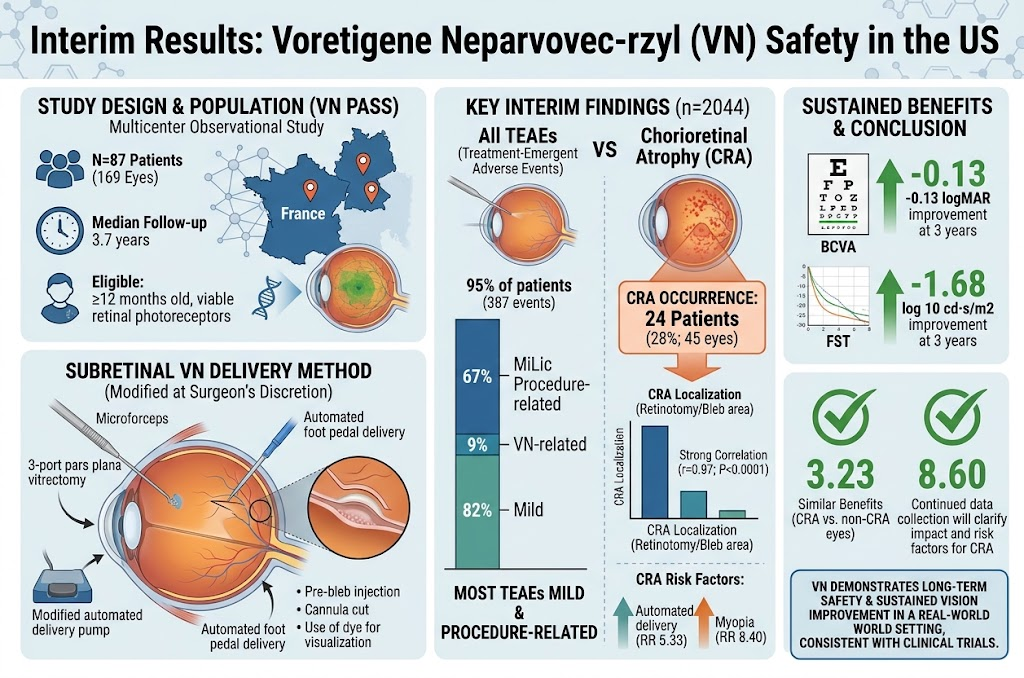
This prospective, multicenter, observational post-authorization safety study enrolled 87 patients (169 eyes) from 10 established ocular gene therapy centers in the United States. Eligible participants were at least 12 months old with viable retinal photoreceptors and received VN in one or both eyes. The delivery of VN followed a subretinal injection approach via a 3-port pars plana vitrectomy system. Surgical methods varied based on surgeon preference and included modifications such as automated foot pedal delivery, use of a pre-bleb injection, customized cannula tips, and dye-assisted visualization to optimize subretinal vector delivery.
The primary safety outcomes included treatment-emergent adverse events (TEAEs) and the occurrence of chorioretinal atrophy (CRA), defined by retinal degeneration and depigmentation noted clinically. Exploratory endpoints encompassed changes in best-corrected visual acuity (BCVA), measured in logMAR units, and full-field stimulus threshold (FST), reflecting retinal sensitivity to light stimuli. Data were analyzed descriptively, with subgroup analyses estimating relative risks (RR) for CRA by procedural and patient factors.
Key Findings
With a median follow-up of 3.7 years (range 2.9-4.9 years), 95% of patients experienced at least one TEAE, totaling 387 events. Of these, 67% were procedure-related, 9% directly attributable to VN, and the vast majority (82%) were mild in severity. Common procedure-related adverse events included transient intraocular inflammation and mild ocular irritation.
Chorioretinal atrophy developed in 24 patients (28%) affecting 45 eyes, predominantly occurring within the first year after treatment. CRA was mostly mild (80%) or moderate (20%) in severity and localized primarily to the retinotomy or bleb area created during the injection. Notably, 40% of eyes with CRA exhibited atrophy extending beyond the bleb zone. CRA development showed a strong inter-eye correlation (r=0.97, P<0.0001), suggesting patient-specific susceptibility.
Risk factor analysis indicated that automated foot pedal administration increased the relative risk of CRA by more than five-fold (RR, 5.33; 95% CI, 1.27-22.40) compared to manual delivery techniques. Additionally, patients with a history of myopia were at significantly higher risk (RR, 8.40; 95% CI, 1.16-60.69), highlighting anatomical factors influencing atrophy risk.
Functionally, treated eyes demonstrated sustained improvements in BCVA with an average gain of -0.13 logMAR at 3 years, indicative of meaningful visual enhancement. FST measurements also improved significantly by -1.68 log10 cd·s/m2, supporting enhanced retinal light sensitivity. Importantly, BCVA and FST improvements were comparable between eyes with and without CRA. Interestingly, some eyes with CRA showed even greater FST improvements at multiple time points through year 3, suggesting that mild-to-moderate CRA did not diminish the therapeutic benefit from VN.
Expert Commentary
These interim real-world results are consistent with clinical trial data validating the long-term safety and efficacy of VN therapy in inherited retinal dystrophy. The identification of CRA as a relatively common adverse event emphasizes the importance of careful surgical technique and patient selection. The association of CRA with automated foot pedal delivery may prompt reconsideration of delivery methods to minimize retinal trauma. Furthermore, the higher CRA risk in myopic eyes reinforces the need for tailored surgical approaches in such populations.
While CRA is concerning, the lack of correlation with diminished visual outcomes provides reassurance that treatment benefits outweigh the risks in current practice. However, clinicians should remain vigilant and counsel patients regarding this potential complication. Mechanistically, CRA may represent localized retinal damage from surgical manipulation or vector-driven effects, but further investigation is needed to elucidate exact pathophysiology.
Study limitations include the observational design without a control group, variability in surgical technique, and reliance on descriptive statistics. Longitudinal data with larger cohorts and mechanistic studies will be critical to better understand CRA evolution and optimize VN delivery protocols.
Conclusion
This interim analysis from a US multicenter cohort confirms that voretigene neparvovec-rzyl maintains a reassuring long-term safety profile in real-world clinical use, corroborating prior trial outcomes. Despite the appearance of chorioretinal atrophy in a subset of treated eyes, visual function improvements remained sustained at nearly 4 years follow-up. These findings support continued use of VN as a transformative therapy for RPE65-mediated retinal dystrophy, with ongoing monitoring needed to further characterize adverse event patterns and refine treatment practices for enhanced patient safety and efficacy.
Funding and ClinicalTrials.gov
Details on study funding sources were not disclosed in the interim report. This post-authorization observational safety study was conducted under regulatory guidance to monitor long-term outcomes of voretigene neparvovec-rzyl in clinical practice.
References
- Nagiel A, Russell SR, Lam BL, Comander JI, Aleman TS, Besirli CG, Sisk RA, Yang P, Weng CY, Chung DC, Thakre A, Savola JM, Rousso DL; VN PASS Study Group. Interim Results From a Multicenter Observational Safety Study of Patients Treated With Voretigene Neparvovec-rzyl in the United States. Ophthalmology. 2026 Jul 22. PMID: 42486371.
- Bainbridge JW, Smith AJ, Barker SS, et al. Effect of gene therapy on visual function in Leber’s congenital amaurosis. N Engl J Med. 2008;358(21):2231-2239.
- Russell S, Bennett J, Wellman JA, et al. Efficacy and safety of voretigene neparvovec (AAV2-hRPE65v2) in RPE65-mediated inherited retinal dystrophy: a randomized, controlled trial. Lancet. 2017;390(10097):849-860.
This article was created using several editorial tools, including AI, as part of the process. Human editors reviewed this content before publication.