We use cookies

Our website uses essential cookies and, with your consent, additional cookies to measure performance and improve our services. Cookie Policy.

You can change your choice at any time.

MMedXYNews
HomeVideos
MedXY AI/MedXY News/Section: Cardiology

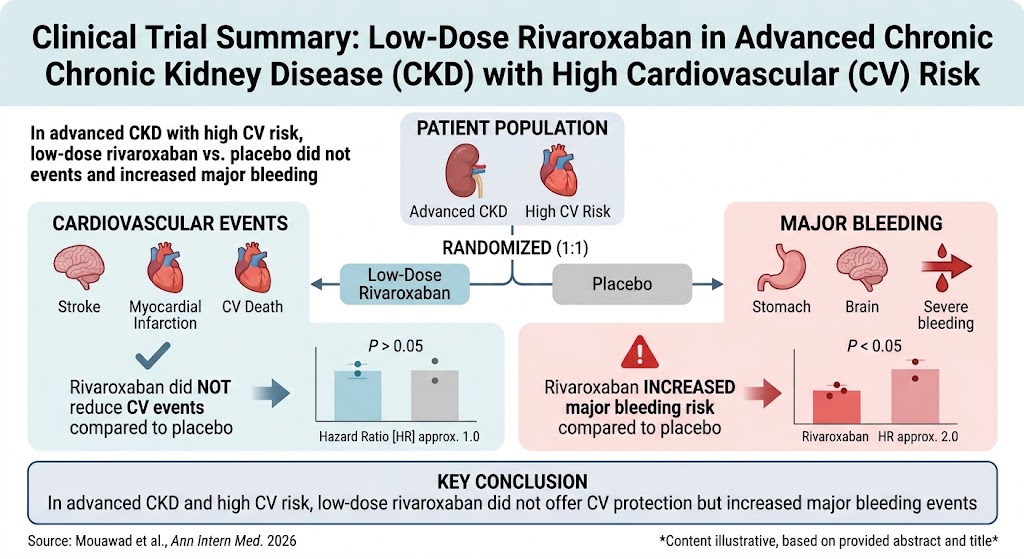
Efficacy and Safety of Low-Dose Rivaroxaban in Advanced Chronic Kidney Disease with High Cardiovascular Risk: A Comprehensive Review
MedXY Editorial Team•Sep 21, 2026•Cardiology
Rivaroxabananticoagulationcardiovascular riskbleedingchronic kidney disease

Highlights

  • Low-dose rivaroxaban does not reduce cardiovascular (CV) events in patients with advanced chronic kidney disease (CKD) at high CV risk.
  • Use of rivaroxaban in this population is associated with a significant increase in major bleeding events.
  • The balance between thrombotic risk reduction and bleeding risk remains challenging in advanced CKD.
  • Current evidence highlights the need for tailored anticoagulant strategies in advanced CKD beyond conventional approaches.

Background

MedXY registered readers

Sign in free to continue reading

Create or use your MedXY account to unlock the complete article.

This article was created using several editorial tools, including AI, as part of the process. Human editors reviewed this content before publication.

Related articles

Open language-specific specialty feeds and department pages.

Genetically Mediated LDL Cholesterol Variations and Their Limited Impact on Venous Thromboembolism RiskThis study reveals that lifelong genetic differences in LDL cholesterol levels do not significantly affect the risk of venous thromboembolism (VTE), suggesting LDL-C may not be a major causal factor in VTE development.Sep 25, 2026Enhancing Prognosis in Stable Coronary Artery Disease: Insights from a Nationwide Cohort on FFR-CTThis large nationwide study demonstrates that coronary CTA-derived FFR-CT strongly predicts future myocardial infarction, cardiovascular death, and revascularization, independent of traditional risk factors and stenosis severity, with a thrSep 25, 2026Unexpected Early Postoperative Lipid Deterioration in Cushing’s Syndrome: Implications for Cardiovascular Risk and ManagementThis study reveals that lipid profiles paradoxically worsen during the early remission phase after curative surgery for Cushing’s syndrome, highlighting a critical window for cardiovascular risk and targeted intervention.Sep 22, 2026
Loading comments...
MedXY briefing

Get the free newsletter

Evidence-led clinical news, trends, and analysis—delivered to your inbox.

Ask MedXY AI

Most popular

Intimate Health
Five Benefits for Women Continuing Sexual Activity After Menopause
Intimate Health
Why Some Women Have a Strong Sex Drive—And Why Men Shouldn't Worry About It
Nursing & care
How often should a couple have sex?
General Surgery
Optimizing Postoperative Opioid Prescriptions After Intra-Abdominal Cancer Surgery: Comparing the 5x-Multiplier and 3-Tier Models
Intimate Health
Classic Intimacy Recommendations: How to Help Women Reach Orgasm and Enjoy Mutual Pleasure
© 2026 MedXY
Contact usAbout usPrivacy PolicyMedXY story
Longitudinal Glycemic Trajectories in Adults with Type 1 Diabetes: Insights from a Three-Year Multicenter CGM Study
This study investigates three-year continuous glucose monitoring trajectories across clinical subgroups of adults with type 1 diabetes to identify factors influencing glycemic control and variability, highlighting the need for individualize
Sep 21, 2026
A Synopsis of the 2025 VA/DoD Lipid Management Guideline: What Clinicians Need to KnowConcise review of the 2025 VA/DoD lipid guideline: new risk tool (PREVENT), CAC and one-time Lp(a) for risk refinement, statins for selected primary prevention groups (including people with HIV), and intensified combination therapy for verySep 19, 2026
KDIGO 2026 on Anemia in CKD: Key Recommendations and Practical Guidance for CliniciansKDIGO 2026 updates anemia care in CKD: evidence-based thresholds for iron therapy, preference for IV iron on hemodialysis, ESA-first approach over HIF-PHIs, individualized Hb initiation, and an ESA maintenance upper Hb target <11.5 g/dL.Sep 18, 2026