Highlight
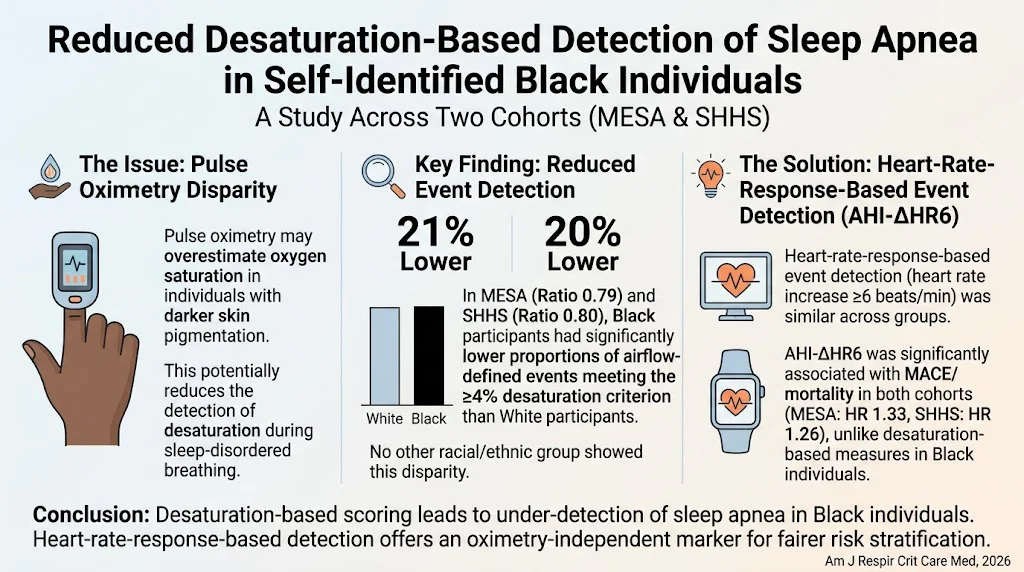
• Pulse oximetry may overestimate oxygen saturation in individuals with darker skin, leading to under-detection of sleep apnea events based on desaturation criteria.
• Self-identified Black participants had significantly fewer sleep apnea events detected by ≥4% oxygen desaturation compared to White participants, despite similar airflow-defined events.
• Heart-rate response during respiratory events (≥6 beats/min increase) detected comparable numbers of events across Black and White groups.
• Heart-rate-response-based event detection correlated with cardiovascular outcomes in both racial groups, unlike desaturation-based measures in Black individuals.
Study Background
Obstructive sleep apnea (OSA) is characterized by repeated episodes of airflow reduction or cessation during sleep, often accompanied by oxygen desaturation. Accurate detection of these events is vital for diagnosis and risk stratification because untreated OSA increases cardiovascular morbidity and mortality. Pulse oximetry is a cornerstone non-invasive technique used commonly in sleep studies to detect oxygen desaturation events as part of apnea-hypopnea index (AHI) computation. However, emerging evidence has uncovered that pulse oximeters may overestimate arterial oxygen saturation in individuals with darker skin pigmentation, potentially leading to underestimation of hypoxic events. This bias has important clinical implications, especially considering that Black populations show higher prevalence of cardiovascular diseases associated with OSA yet may be subject to diagnostic inaccuracies due to racial differences in oximetry readings. The present analysis investigates racial and ethnic disparities in detection of desaturation-based sleep apnea events and explores heart-rate response as an alternative or complementary marker independent of oximetry artifacts.
Study Design
This investigation analyzed data from two large, community-based cohorts: the Multi-Ethnic Study of Atherosclerosis (MESA) and the Sleep Heart Health Study (SHHS). Both cohorts included adult participants without baseline cardiovascular disease. Participants self-identified their race/ethnicity, with a focus on comparisons involving Black and White individuals. The study evaluated respiratory events defined by airflow reductions during sleep and assessed how often these events met the conventional criterion of oxygen desaturation ≥4%, measured via pulse oximetry. The study introduced a novel marker, AHI-ΔHR6, which counts respiratory events accompanied by a heart-rate increase of 6 beats per minute or more, posited as an oximetry-independent measure potentially more reliable across skin pigmentation differences. Statistical analysis involved modeling ratios of desaturation-based events relative to airflow-defined events and utilizing multivariable Cox proportional hazards models to assess associations of different AHI measures with a composite endpoint of major adverse cardiovascular events (MACE) or all-cause mortality.
Key Findings
Across both cohorts, Black participants exhibited approximately 20-21% lower proportions of airflow-defined sleep apnea events that met the ≥4% desaturation threshold compared with White participants. Specifically, in MESA, the ratio of desaturation-based to airflow-based AHI in Black vs. White participants was 0.79 (95% CI, 0.68-0.93; p = 0.003), and in SHHS 0.80 (95% CI, 0.68-0.94; p = 0.008). Other racial/ethnic groups did not show similar reductions. Importantly, when events were defined by heart-rate response (≥6 bpm increase during event), detection was similar between Black and White participants in both cohorts, indicating that heart-rate response is not affected by skin pigmentation in the same manner as oximetry.
Regarding clinical outcomes, desaturation-based AHI was associated with MACE/mortality in White participants in MESA but not in SHHS, and was not significantly associated with outcomes in Black participants in either cohort. By contrast, AHI defined by the heart-rate response (AHI-ΔHR6) was significantly associated with MACE/mortality in both cohorts: MESA hazard ratio 1.33 (95% CI, 1.09-1.63; p = 0.006), SHHS 1.26 (95% CI, 1.02-1.55; p = 0.033). These findings suggest that heart-rate response may be a more reliable marker for risk stratification in populations with darker skin pigmentation.
Expert Commentary
The study importantly highlights an often overlooked but consequential limitation of pulse oximetry in diverse populations—racial bias arising from optical sensor calibration optimized mainly in lighter skin tones. This can translate into clinically significant under-detection of oxygen desaturation events during sleep in Black individuals, potentially delaying diagnosis or underestimating OSA severity. The use of heart-rate response as a complementary or alternative marker warrants serious consideration, because autonomic responses to respiratory events are less influenced by skin pigmentation and correlate well with adverse cardiovascular outcomes.
However, there remain limitations. The study cohorts, though large and ethnically diverse, are observational, thus causality cannot be fully established. Differences in comorbidities, socioeconomic factors, and treatment adherence were not addressed here. Moreover, the heart-rate threshold (≥6 bpm increase) requires validation in prospective clinical studies before integration into practice guidelines. Integration of multimodal physiological metrics including airflow, oximetry, and cardiac responses may represent the future for more equitable and accurate sleep apnea diagnostics.
Conclusion
This analysis confirms that standard desaturation-based detection of sleep apnea events via pulse oximetry systematically under-identifies respiratory events in Black individuals due to pigment-related measurement bias. In contrast, heart-rate-response-based detection offers an oximetry-independent method with consistent event detection across racial groups and shows stronger associations with adverse cardiovascular outcomes. Clinicians should be aware of potential under-detection in darker-skinned patients when interpreting sleep studies reliant solely on oxygen desaturation metrics. Future guidelines should consider incorporating heart-rate response parameters or alternative measures to improve diagnostic equity and optimize cardiovascular risk prediction in diverse populations.
Reference
Azarbarzin A, Sands SA, Messineo L, Esmaeili N, Vena D, White DP, Redline S, Wellman A. Reduced desaturation-based detection of sleep apnea events in self-identified Black individuals across two cohorts. Am J Respir Crit Care Med. 2026 Nov 4:aamag573. doi: 10.1093/ajrccm/aamag573. Epub ahead of print. PMID: 42981082.