Highlights
The PROOF-HD placebo-arm post hoc analysis reveals that antidopaminergic medication (ADM) use in Huntington disease (HD) is associated with faster decline across motor, cognitive, and functional domains.
Both VMAT2 inhibitors and antipsychotics, particularly at higher doses, correlate with greater clinical deterioration compared to HD patients off ADMs.
Findings emphasize the importance of accounting for ADM exposure, class, and dose in HD clinical trial design and interpretation.
Residual confounding by disease severity remains a limitation, underscoring the need for further controlled prospective studies.
Background
Huntington disease is an autosomal dominant neurodegenerative disorder characterized by progressive motor dysfunction, cognitive decline, and psychiatric disturbances. The trinucleotide cytosine-adenine-guanine (CAG) repeat expansion in the huntingtin gene drives pathophysiology. Despite advances in understanding, therapeutic options remain limited to symptomatic management. Antidopaminergic medications (ADMs), including vesicular monoamine transporter-2 (VMAT2) inhibitors and antipsychotics, are frequently employed to mitigate hyperkinetic movements (e.g., chorea) and psychiatric symptoms. However, observational cohorts and registries have suggested that ADM use may paradoxically correlate with accelerated worsening of core clinical measures, such as the composite Unified Huntington’s Disease Rating Scale (cUHDRS) and Total Functional Capacity (TFC). This confounding association had not been examined rigorously within randomized controlled trial cohorts until recently.
Key Content
PROOF-HD Trial Context and Post Hoc Analysis
The Pridopidine’s Outcome On Function in Huntington Disease (PROOF-HD) trial (ClinicalTrials.gov: NCT04556656) was a phase 3 randomized, double-blind, placebo-controlled study evaluating pridopidine, a Sigma-1 receptor agonist, in early manifest HD patients with TFC scores of 7-13 and CAG repeats ≥36. While primary outcomes did not reach significance for pridopidine vs placebo overall, a post hoc analysis focused on the placebo arm provided a controlled context to examine ADM effects on disease progression.
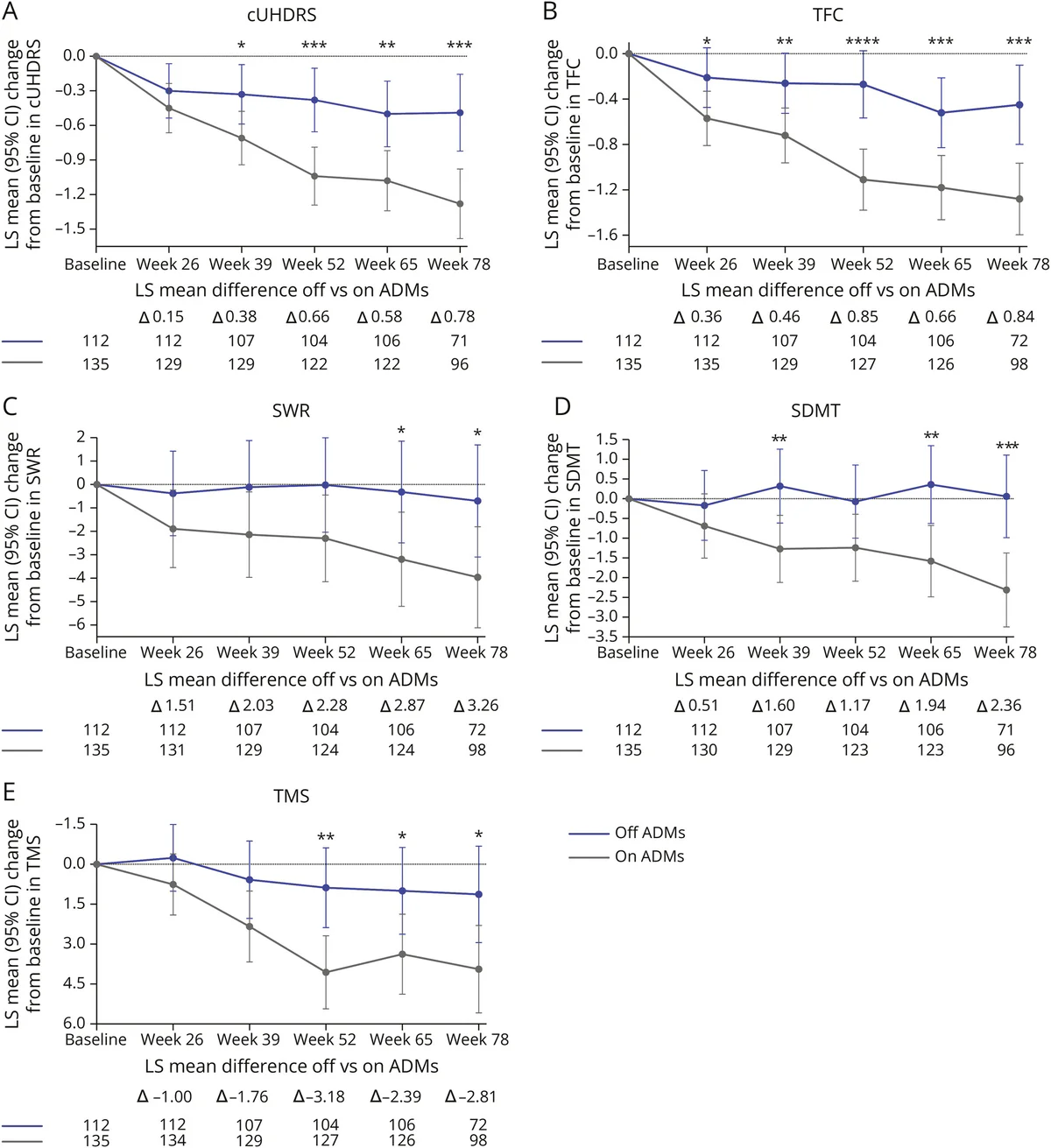
Of 247 placebo-treated participants (mean age 52.6 ± 11.4 years; 51% female), 135 (54.7%) were on ADMs and 112 (45.3%) were not. Participants were categorized based on concurrent use of VMAT2 inhibitors and/or antipsychotics throughout the study period. Longitudinal outcomes analyzed included TFC, cUHDRS, Symbol Digit Modalities Test (SDMT), Stroop Word Reading (SWR), and Total Motor Score (TMS). Mixed-effects models accounting for repeated measures were adjusted using propensity score weighting (PSW) and time-varying sensitivity analyses.
Findings on Clinical Outcomes and ADM Exposure
Overall, on-ADM participants experienced significantly faster clinical decline across multiple domains. From weeks 39 to 78, between-group differences favored off-ADM participants. At week 52, mean changes in cUHDRS and TFC were substantially better in off-ADM participants, with differences of 0.66 (95% CI 0.31-1.01; p = 0.0002) and 0.85 (95% CI 0.47-1.22; p < 0.0001), respectively. Cognitive tests (SDMT and SWR) and motor outcomes (TMS) showed either significant or directionally consistent findings favoring off-ADM participants starting at week 39 onward. Among TMS subdomains, all except chorea favored off-ADM status at all visits, suggesting a nuanced motor impact.
When stratified by ADM class, both antipsychotic-only and VMAT2 inhibitor-only users showed greater decline in cUHDRS and TFC relative to off-ADM participants. Higher ADM doses were also associated with more rapid worsening. PSW-adjusted and time-varying analyses reaffirmed these associations, mitigating concerns of confounding.
Supporting Evidence and Related Studies
The PROOF-HD placebo-arm findings align with prior observational studies that linked ADM exposure with worsened progression metrics, though those lacked the controlled clinical trial framework. The phase 3 pridopidine trial itself reported non-significant overall results, but post hoc subgroup analysis showed trends favoring pridopidine in participants not treated with ADMs, suggesting potential drug-ADM interactions.
Additional literature underscores the complexity of ADM therapy in neurodegenerative diseases. For example, antipsychotics are well-known to cause extrapyramidal side effects and may exacerbate motor decline in vulnerable populations. VMAT2 inhibitors, while effective for chorea control, modulate dopamine storage and release and might negatively influence cognitive and functional trajectories. Furthermore, pharmacological heterogeneity in ADM mechanisms and dosing complicates clinical interpretation.
Methodological Advances and Sensitivity Analyses
The PROOF-HD analysis leveraged mixed-effects models incorporating repeated measures for robust longitudinal inference. Propensity score weighting was utilized to adjust for baseline differences, reducing selection bias inherent in medication assignment due to disease severity. Time-varying sensitivity analyses accounted for ADM exposure changes over the trial course. Such methodological rigor enhances confidence in observed associations, despite residual confounding risks.
Expert Commentary
The association between ADM use and accelerated clinical decline in HD patients raises vital clinical and research considerations. While ADMs provide symptomatic relief, their potential contribution to faster deterioration necessitates a nuanced risk-benefit analysis in treatment planning. The possibility that sicker patients receive more ADMs (confounding by indication) persists despite statistical adjustments, underscoring the challenge of disentangling medication effects from disease trajectory.
Neuropathologically, dopaminergic signaling alteration affects motor, cognitive, and psychiatric pathways in HD. Dopamine antagonism may reduce chorea but impair cognitive and functional performance by exacerbating deficits in frontostriatal circuits. This biological rationale supports the observed multidomain adverse associations with ADM use.
From a clinical trial design perspective, the findings caution against neglecting ADM exposure as a confounder. Stratification or covariate adjustment for ADM class and dose should be standard practice. Moreover, interpretation of trial outcomes must consider that ADM discontinuation or initiation during trials might bias efficacy or progression assessments.
Further prospective studies are needed to clarify causality and optimal ADM regimens balancing symptom control with preservation of function and cognition. Adjunct or alternative therapeutic strategies targeting disease-modifying pathways, such as Sigma-1 receptor modulation (e.g., pridopidine), present promising avenues.
Conclusion
The PROOF-HD placebo-controlled trial’s post hoc analysis provides compelling Class II evidence linking antidopaminergic medication use in Huntington disease with accelerated worsening across global, functional, cognitive, and motor outcomes. Both VMAT2 inhibitors and antipsychotics, especially at higher doses, contribute to this decline compared to patients not receiving ADMs.
These findings underscore the imperative to systematically account for ADM exposure, class, and dosing when designing and interpreting HD clinical trials. Clinicians should carefully weigh symptomatic benefits against potential acceleration of disease progression. Future well-controlled, prospective studies are required to elucidate the mechanisms underlying these associations and optimize therapeutic strategies.
References
Anderson KE, Tan AM, Feigin A, et al; PROOF-HD study investigators. Antidopaminergic Medications and Clinical Outcomes in Huntington Disease: Evidence From the PROOF-HD Placebo-Controlled Trial. Neurology. 2026 Oct 22;107(10):e218627. doi:10.1212/WNL.0000000000218627. PMID: 42912861. https://pubmed.ncbi.nlm.nih.gov/42912861/
Reilmann R, McGarry A, Grachev ID, et al. Pridopidine in Early-Stage Manifest Huntington’s Disease: A Phase 3 Trial. Nat Med. 2025 Nov;31(11):3780-3789. doi:10.1038/s41591-025-03920-3. PMID: 40913168. https://pubmed.ncbi.nlm.nih.gov/40913168/
Mestre TA, Matias AV, Ferreira JJ, et al. Management of Motor and Psychiatric Symptoms in Huntington Disease. Mov Disord Clin Pract. 2023;10(1):1-14. doi:10.1002/mdc3.13625.
Frank S. Treatment of Huntington’s Disease Neuropsychiatric Symptoms: A Review. J Huntingtons Dis. 2014 Mar 10;3(3):235–48. doi:10.3233/JHD-140115.