Highlight
Development of a clinician-driven, markerless computer vision (CV) tool for postural assessment in acquired brain injury (ABI) rehabilitation.
Demonstrated excellent usability and feasibility in inpatient neurorehabilitation settings without adverse events.
CV metrics showed significant therapy-related improvements in posture over time and strong correlation with clinician-rated impairments.
Strong analytical validity with high agreement between CV-derived measurements and established three-dimensional motion capture.
Study Background
Acquired brain injury (ABI) often results in substantial postural abnormalities, impacting rehabilitation outcomes and functional recovery. Precise, frequent, and objective assessment of posture is fundamental for tailoring therapies and monitoring progress during inpatient neurorehabilitation. Traditional methods, such as three-dimensional motion capture systems, while accurate, are resource-intensive, requiring specialized equipment and expertise, limiting their routine clinical utility. Conversely, clinician visual assessments, though practical, can be subjective and variable. The integration of digital technologies, particularly markerless computer vision (CV), presents a promising avenue to bridge these gaps. Robust, point-of-care CV systems could facilitate accessible, reliable, and quantifiable postural assessment to improve clinical decision-making and therapy effectiveness in ABI rehabilitation.
Study Design
This investigation employed a cross-sectional and longitudinal observational design at a tertiary inpatient neurorehabilitation hospital. The study included rehabilitation clinicians (n=10), patients with ABI (n=20, 60% female, mean age 45.0 ± 17.7 years), and neurologically intact controls (n=12). The multidisciplinary team comprising occupational therapists, physical therapists, engineers, and rehabilitation scientists collaboratively developed and refined a markerless CV workflow for assessing seated and standing postural alignment.
The study evaluated the system’s usability (System Usability Scale), feasibility in clinical settings (completion rates, adverse events), sensitivity to therapy-related postural changes, analytical validity compared to gold-standard three-dimensional motion capture, and correlation with clinician-reported postural abnormalities.
Key Findings
Usability and Feasibility
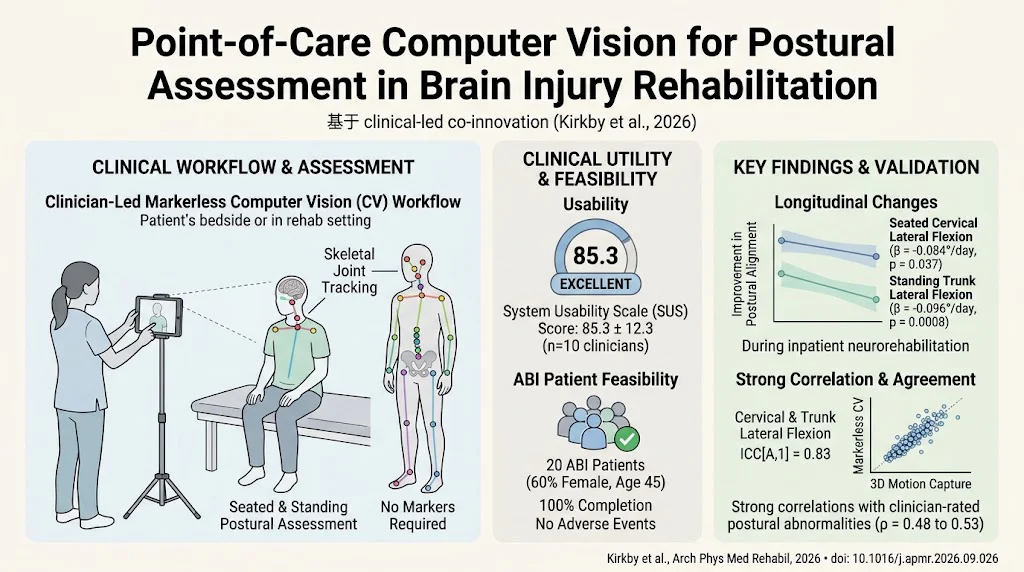
Clinicians reported excellent usability with a mean System Usability Scale score of 85.3 ± 12.3, indicating high acceptance and ease of use. All ABI patients completed postural assessments using the CV system without adverse events, and all targeted posture metrics were successfully acquired, affirming clinical feasibility.
Therapy-Related Postural Changes
Longitudinal analyses revealed statistically significant improvements in postural alignment during inpatient rehabilitation. Specifically, seated cervical lateral flexion improved with a decline of 0.084° per day (β = -0.084°/day; 95% CI: -0.163 to -0.005; p=0.037), and standing trunk lateral flexion showed a reduction of 0.096° per day (β = -0.096°/day; 95% CI: -0.152 to -0.040; p=0.0008). These incremental changes suggest enhanced postural control and alignment associated with ongoing therapy.
Correlation with Clinical Assessments
CV-derived postural deviations correlated moderately with clinician-reported postural abnormalities, including unsupported sitting trunk displacement (Spearman’s ρ=0.531; p=0.023), pelvic displacement (ρ=0.501; p=0.034), and head/neck displacement (ρ=0.482; p=0.043). These associations support the clinical relevance of the CV measurements.
Analytical Validity
Comparison with three-dimensional motion capture—the gold standard for biomechanical assessment—demonstrated strong agreement for cervical and trunk lateral flexion parameters with intraclass correlation coefficients (ICC[A,1]) of 0.83, indicating excellent analytical validity and reliability of the CV system.
Expert Commentary
This study exemplifies effective clinician-led co-innovation in integrating emerging technologies into clinical practice. The high usability and safety profile argue for its practicality in busy neurorehabilitation units. Furthermore, capturing subtle but meaningful posture changes longitudinally underscores the technology’s potential to inform personalized interventions. Nonetheless, the relatively small sample size and single-center design may limit broader generalization. Further multi-center validation with diverse ABI populations is warranted. Additionally, expanding assessments beyond lateral flexion to include other postural dimensions and dynamic conditions may enhance clinical applicability.
Mechanistically, the ability to objectively quantify postural deviations facilitates targeted therapy planning aimed at mitigating maladaptive compensations, potentially improving functional outcomes.
Conclusion
The development and preliminary evaluation of a markerless computer vision system for postural assessment in ABI rehabilitation demonstrate promising usability, feasibility, and clinical relevance. By delivering objective, reliable, and accessible postural measurements at the point of care, this tool may enhance rehabilitation monitoring and therapeutic decision-making. Future research should focus on larger validation studies, integration with multi-modal clinical data, and exploration of impact on long-term functional recovery.
Funding and Clinical Trials Registration
Funding sources and clinical trial registration details were not provided in this report.
References
Kirkby E, Burke H, Cline S, Karimpour R, Piyasena A, Travitz K, Kinney S, Whitlock A, Evans N, Willingham TB. Point-of-Care Computer Vision for Postural Assessment in Brain Injury Rehabilitation. Arch Phys Med Rehabil. 2026 Oct 25:S0003-9993(26)00982-2. doi: 10.1016/j.apmr.2026.09.026. Epub ahead of print. PMID: 42927784.