Depressive Symptoms in OBGYN Interns: Over One-Third Affected, Few Seek Help
More than one-third (35.6%) of OBGYN first-year residents screened positive for depressive symptoms during internship.
Fewer than one-third of affected residents sought mental health treatment.
Both pre-existing factors (history of depression, neuroticism, difficult early family environment) and internship-related factors (fewer sleep hours, longer work hours, medical errors) were associated with higher depressive symptoms.
Study Snapshot
Design: Prospective longitudinal cohort (Intern Health Study).
Population: 1,603 OBGYN first-year residents (86.5% women, median age 27 years); 1,271 with ≥1 internship assessment included.
Data period: 2009–2024.
Exposure/Outcome: Depressive symptoms measured by the Patient Health Questionnaire (PHQ-9) at baseline and quarterly during internship.
Primary findings: 35.6% screened positive (PHQ-9 ≥10) at least once; treatment-seeking rate among those affected was <33%.
Key predictors: History of depression, higher baseline depressive symptoms, neuroticism, difficult early family environment, not being in a committed relationship (baseline); fewer sleep hours, longer work hours, medical errors (internship-related).
Analysis: Pearson correlations, χ² tests, stepwise linear regression, generalized estimating equations (GEE) with sample weights for nonrepresentative sampling and attrition.
Why This Study Matters
Obstetrics and gynecology (OBGYN) residents face unique stressors: intense surgical training, long work hours, and the emotional demands of caring for women through pregnancy, childbirth, and gynecologic conditions. The specialty is predominantly female, and women are known to have higher rates of depression than men, with depressive symptoms rising sharply during internship. Despite workforce concerns and a projected shortage of OBGYN specialists, the mental health of trainees had not been systematically studied. This analysis of the longitudinal Intern Health Study provides the first large-scale assessment of depression prevalence, risk factors, and treatment-seeking among OBGYN first-year residents.
How the Study Was Conducted
Researchers enrolled first-year OBGYN residents from multiple U.S. programs participating in the Intern Health Study between 2009 and 2024. At baseline, participants completed surveys on demographics, medical history, personality traits, and family environment. During internship, they completed quarterly assessments that included the Patient Health Questionnaire-9 (PHQ-9) to measure depressive symptoms, along with questions about work hours, sleep, and medical errors. The analysis included 1,271 residents who completed at least one quarterly assessment (79.3% of those enrolled). Sample weights were applied to address potential bias from nonrepresentative sampling and attrition. The team used stepwise linear regression and generalized estimating equation models to identify baseline and internship-related predictors of depressive symptoms.
What the Researchers Found
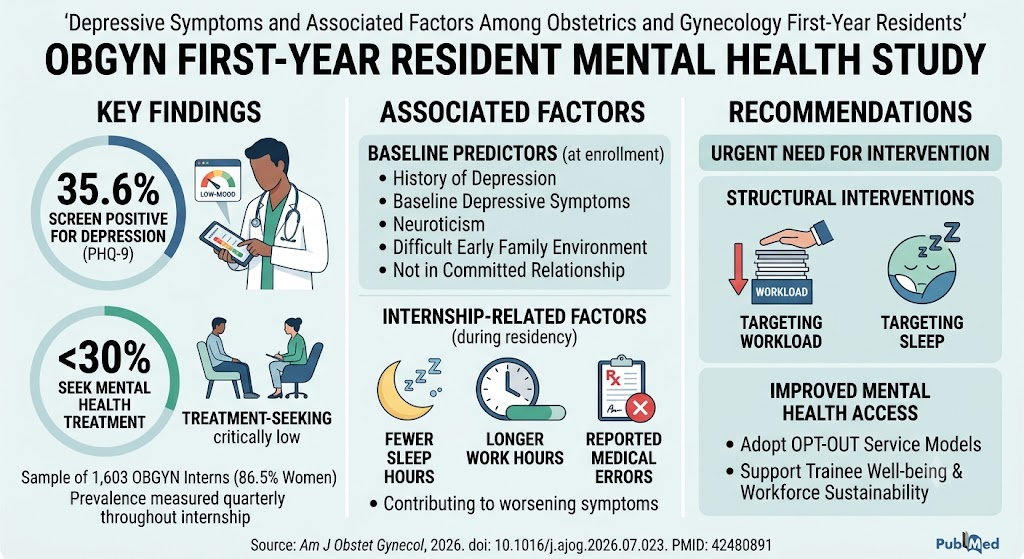
Over the internship year, 35.6% of residents screened positive for depression (PHQ-9 score ≥10) at one or more assessments. However, fewer than one-third of those who screened positive reported seeking mental health treatment. Baseline factors linked to higher depressive symptoms included a history of depression, higher baseline depressive symptoms, higher neuroticism scores, a difficult early family environment, and not being in a committed relationship. During internship, modifiable factors such as fewer hours of sleep, longer work hours, and self-reported medical errors were independently associated with worsening depression scores. The findings underscore that both pre-existing vulnerabilities and workplace conditions contribute to the mental health burden.
What the Findings May Mean
The prevalence of depressive symptoms among OBGYN interns is strikingly similar to rates reported in other surgical specialties, but the low treatment-seeking rate—below one-third—is particularly concerning given the female-predominant composition of the field and the known gender disparities in depression care. The study suggests that interventions should target both structural workplace factors (e.g., workload limits, sleep hygiene) and individual mental health support. The authors note that opt-out mental health services, where residents are automatically enrolled unless they decline, could lower barriers to care. However, as an observational study, the results show associations, not causation, and the role of unmeasured confounders (e.g., social support, program culture) cannot be ruled out.
Strengths and Limitations
Strengths include the large, multisite sample, prospective design, use of a validated depression measure (PHQ-9), and application of sample weights to reduce bias. Limitations include reliance on self-reported depressive symptoms rather than clinical interviews, potential nonresponse and attrition bias despite weighting, the restriction to a single specialty, and the inability to establish causal relationships. Additionally, the study did not report on the severity or duration of depressive episodes, the specific barriers to treatment-seeking, or the impact of the COVID-19 pandemic during the study period.
Implications for Practice and Research
The findings highlight an urgent need for systematic mental health support within OBGYN residency programs. Program directors and hospital administrators should consider implementing routine mental health screening, ensuring confidential access to mental health services, and adopting opt-out care models to normalize treatment. Structural changes—such as enforcing duty-hour limits, improving sleep accommodations, and reducing noneducational tasks—may also mitigate depressive symptoms. Future research should explore the long-term effects of internship depression on career satisfaction, patient outcomes, and workforce attrition, as well as evaluate the effectiveness of specific interventions to improve treatment-seeking and well-being.
Funding, Disclosures, and Registration
The Intern Health Study has received funding from the National Institutes of Health and other sources. The authors reported no relevant financial conflicts of interest. The study was not registered in a clinical trial registry, as it is an observational cohort.
References
Frank E, Rossi J, Zhao Z, Pereira-Lima K, Sen S, Winkel A, Morgan HK. Depressive Symptoms and Associated Factors Among Obstetrics and Gynecology First-Year Residents. American Journal of Obstetrics and Gynecology. 2026 Jul 21. PMID: 42480891.