Intramuscular Chemical Sedation in Emergency Mental Health Patients Associated with Black Race, Police Arrival, and Involuntary Holds
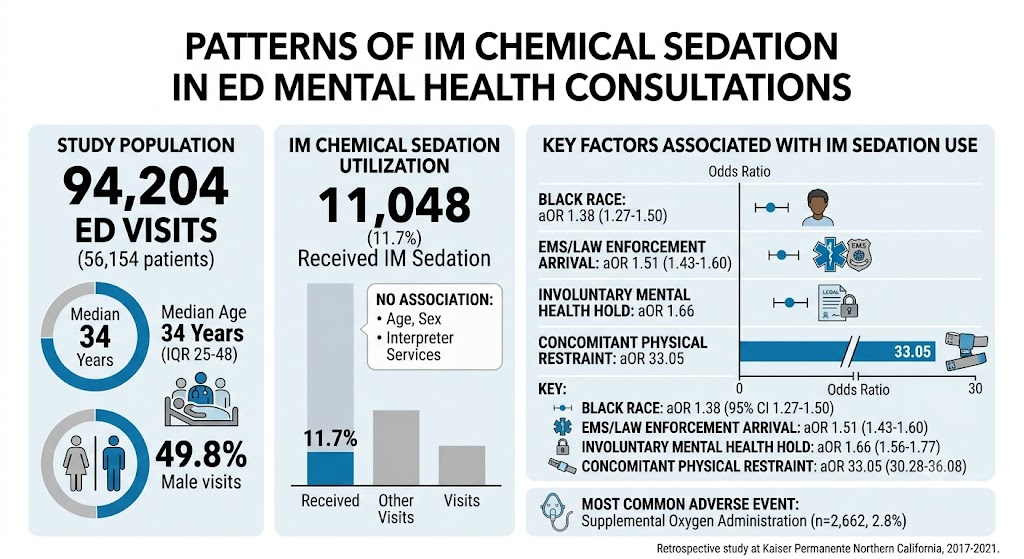
Among 94,204 emergency department visits for mental health consultations, 11.7% involved intramuscular (IM) chemical sedation.
Black race was associated with 38% higher odds of receiving IM chemical sedation after adjustment for other factors.
Arrival by EMS or law enforcement and placement on an involuntary mental health hold also significantly increased the odds of sedation.
Concomitant physical restraint was the strongest predictor (odds ratio 33).
The most common adverse event was supplemental oxygen administration, occurring in 2.8% of visits.
Study Element | Details |
|---|---|
Design | Retrospective cross-sectional study |
Setting | Kaiser Permanente Northern California, 21 emergency departments, 2017–2021 |
Population | ED patients aged 18–64 years receiving a mental health consultation (94,204 visits, 56,154 unique patients) |
Exposure/Feature | Patient demographics, arrival mode, involuntary hold status, physical restraint use |
Primary Outcome | Receipt of intramuscular chemical sedation (any sedating medication given IM) |
Key Results | IM sedation in 11.7% of visits; adjusted odds higher for Black patients (aOR 1.38, 95% CI 1.27–1.50), EMS/law enforcement arrival (aOR 1.51, 95% CI 1.43–1.60), involuntary hold (aOR 1.66, 95% CI 1.56–1.77), and physical restraint (aOR 33.05, 95% CI 30.28–36.08) |
Limitations | Retrospective design, single health system, unmeasured confounders, no medication-specific data |
Why This Study Matters
Emergency departments frequently manage patients with acute mental health crises, and sedation is sometimes needed to ensure safety. While disparities in the use of physical restraints have been documented, much less is known about whether similar inequities exist for chemical sedation—specifically, intramuscular injections of sedating medications. Understanding patterns of chemical sedation is critical for developing equitable and patient-centered emergency psychiatric care.
How the Study Was Conducted
Researchers conducted a retrospective cross-sectional analysis using electronic health records from Kaiser Permanente Northern California, covering 21 emergency departments. They included all visits by adults aged 18–64 years who received a mental health consultation between January 1, 2017, and December 31, 2021. The primary outcome was administration of any intramuscular sedating medication during the ED visit. The team used multivariable logistic regression to estimate adjusted odds ratios for patient characteristics associated with IM chemical sedation, controlling for age, sex, race/ethnicity, interpreter need, arrival mode, involuntary hold status, and physical restraint use.
What the Researchers Found
Among 94,204 eligible ED visits (56,154 unique patients), 11,048 (11.7%) involved intramuscular chemical sedation. The median patient age was 34 years, and 49.8% of visits were for male patients. After adjustment, several factors were independently associated with higher odds of receiving IM sedation:
Black race: adjusted odds ratio 1.38 (95% CI 1.27–1.50) compared with White patients.
Arrival by EMS or law enforcement: aOR 1.51 (95% CI 1.43–1.60).
Involuntary mental health hold placement: aOR 1.66 (95% CI 1.56–1.77).
Concomitant physical restraint use: aOR 33.05 (95% CI 30.28–36.08).
Age, sex, and need for interpreter services were not significantly associated with IM sedation. The most common adverse event was receipt of supplemental oxygen, documented in 2,662 visits (2.8%).
What the Findings May Mean
These results suggest that IM chemical sedation in the ED is not administered uniformly. The racial disparity observed—higher odds for Black patients even after adjusting for arrival mode and hold status—raises concerns about potential implicit bias or structural factors influencing sedation decisions. The strong association with physical restraint indicates that chemical sedation is often part of a broader coercive intervention. Arrival by EMS or police and involuntary holds may reflect greater agitation or perceived danger, but they could also signal systemic pathways that increase the likelihood of sedation.
The authors emphasize that the study cannot determine causality or explain why these disparities exist. Comorbid mental health conditions, severity of agitation, and patient preferences were not captured. The finding that Black patients had higher odds of sedation warrants further investigation into decision-making processes and potential interventions to reduce inequities.
Strengths and Limitations
Strengths include the large sample size, use of a diverse integrated health system, and adjustment for multiple confounders. However, the study is limited by its retrospective, cross-sectional design, which precludes causal inference. The data come from a single health system in Northern California, so results may not generalize to other settings, such as safety-net hospitals or rural EDs. Unmeasured confounders—including the specific psychiatric diagnosis, severity of agitation, history of violence, and prior sedation—could influence the associations. The study also did not examine the specific medications used, dosing, or routes beyond intramuscular administration. Additionally, the adverse event measure was limited to oxygen administration, which may not capture all sedation-related complications.
Implications for Practice and Research
These findings highlight the need for standardized protocols for chemical sedation in mental health emergencies that explicitly address equity. Clinicians should be aware that their decisions may be influenced by patient race and contextual factors such as police presence. Future research should include prospective assessments of agitation severity, patient-reported experiences, and qualitative studies to understand clinician reasoning. Health systems should monitor sedation rates by race and other demographic factors to identify and mitigate disparities. The study adds to the growing evidence that coercive interventions in ED mental health care are not applied equally and that system-level changes are needed to ensure fair and compassionate care.
Funding, Disclosures, and Registration
The study was supported by the Kaiser Permanente Northern California Division of Research. The authors reported no conflicts of interest. The study was not registered in a clinical trial database, consistent with its retrospective observational design.
References
Lippert SC, Xu RH, Tucker LS, DiLena DD, Rauchwerger AS, Rabbani J, Kene MV. Patterns of Intramuscular Chemical Sedation Use for Patients Receiving a Mental Health Consultation While in the Emergency Department. Annals of Emergency Medicine. 2026;88(1):26-35. PMID: 41854577.
This article was created using several editorial tools, including AI, as part of the process. Human editors reviewed this content before publication.