Circulating Exosomal microRNA Signature Enhances Preoperative Detection of Occult Liver Metastases in Pancreatic Cancer
Highlight
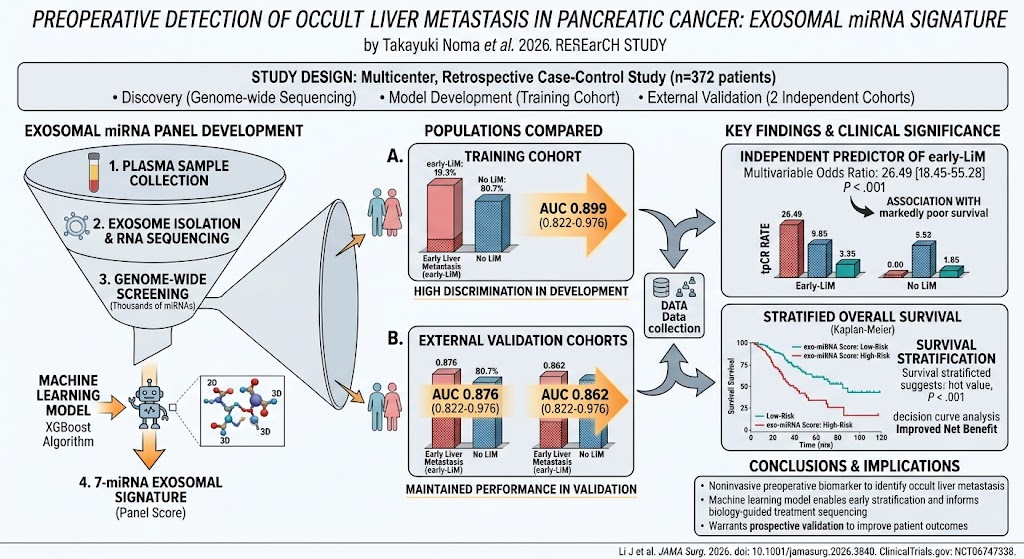
This multicenter retrospective study identified a circulating exosomal microRNA (exo-miRNA) signature capable of preoperatively detecting occult early liver metastasis (early-LiM) in pancreatic ductal adenocarcinoma (PDAC). The developed 7-exo-miRNA machine learning model demonstrated high discriminative power with robust external validation across diverse East Asian cohorts. Early-LiM was associated with markedly reduced overall survival, underscoring the clinical significance of early metastasis identification. This biomarker-driven strategy holds promise for personalized operative decision-making and treatment sequencing in PDAC.
Study Background
Pancreatic ductal adenocarcinoma (PDAC) remains one of the deadliest malignancies with poor prognosis largely attributable to frequent distant metastasis, particularly to the liver. Early liver metastasis occurring soon after pancreatectomy signifies an aggressive tumor biology and is linked to dismal survival outcomes. Current imaging modalities often fail to detect microscopic liver metastases before surgery, leading to futile surgeries and delayed systemic therapy. There is thus an urgent unmet clinical need for reliable, noninvasive, preoperative biomarkers that can identify occult hepatic micrometastasis to optimize therapeutic strategies.
Study Design
This study employed a multicenter retrospective case-control design spanning four high-volume medical centers across China, Japan, and South Korea, enrolling 372 patients with PDAC who underwent curative-intent pancreatectomy between 2011 and 2024. Patients were categorized based on early liver metastasis, defined as liver recurrence within 6 months post-surgery. The study was comprised of three sequential phases: (1) Genome-wide discovery of circulating plasma-derived exosomal miRNAs via next-generation sequencing to identify candidate biomarkers (discovery cohort); (2) Development of a predictive machine learning model using an extreme gradient boosting algorithm trained on a selected miRNA panel (training cohort); and (3) Independent external validation employing two geographically distinct cohorts to assess model generalizability and performance. Primary outcome was early-LiM status, with secondary analyses evaluating survival impact. Statistical assessments included area under the receiver operating characteristic curve (AUC), multivariable logistic regression, Kaplan-Meier survival analysis, and decision curve analysis for clinical utility.
Key Findings
Among the 372 patients (median age 67, 61.6% male), early liver metastasis occurred in a subset associated with dramatically worse median overall survival (OS) of 9.1 months, compared to 26.6–31.8 months in other recurrence patterns. The exosomal miRNA profiling identified a 7-miRNA signature that robustly predicted early-LiM. In the training cohort, the extreme gradient boosting model achieved an AUC of 0.899 (95% CI, 0.822–0.976), indicating excellent discrimination. This performance was consistently replicated in two external validation cohorts with AUCs of 0.876 (95% CI, 0.846–0.951) and 0.862 (95% CI, 0.744–0.981). Multivariate analysis confirmed the exo-miRNA panel as an independent predictor for early liver metastasis with an odds ratio of 26.49 (95% CI, 18.45–55.28, P < .001), outperforming conventional clinicopathological factors. Moreover, stratification based on the exo-miRNA score correlated strongly with overall survival differences (log-rank P < .001). Decision curve analysis demonstrated that integrating the exosomal signature increased net clinical benefit relative to existing variables, supporting potential clinical adoption.
Expert Commentary
This study provides compelling evidence that circulating exosomal miRNAs serve as a minimally invasive biomarker for detecting occult hepatic micrometastasis in PDAC, a cohort for whom early liver progression critically worsens prognosis. Exosomes, small extracellular vesicles that transport tumor-derived nucleic acids, represent an attractive reservoir of molecular information reflecting tumor biology and dissemination potential. By combining advanced machine learning with comprehensive exosomal miRNA profiling, the authors have developed a precise and externally validated tool to preemptively identify patients at high risk for early liver metastasis.
Clinicians currently face challenges in selecting candidates for surgery owing to the difficulty in visualizing microscopic metastases; this signature could help guide neoadjuvant therapy decisions and intensive metastatic surveillance. Compared to prior attempts focusing solely on serum markers or imaging, this approach leverages high dimensional data and rigorous validation, increasing confidence in its translational value.
However, the retrospective nature and geographic concentration in East Asian populations necessitate prospective trials across broader demographics. The biological functions of the seven miRNAs require further elucidation to understand mechanisms underlying early metastasis.
Conclusion
The multicenter study presents a novel circulating exosomal miRNA signature that accurately predicts occult early liver metastasis in patients with PDAC prior to surgery. This advance offers a promising biomarker for improving risk stratification, enabling biology-guided treatment sequencing, and potentially sparing patients from ineffective surgeries. Prospective multicenter validation and integration into clinical workflows will be critical next steps toward personalized management of PDAC, a disease where early metastatic detection can profoundly affect survival.
Funding and Clinical Trials
The study was supported by collaborative institutions in China, Japan, and South Korea, with analysis performed from July 2024 to November 2025. No specific funding agencies or clinical trial registration information was provided in the original publication.
References
1. Noma T, Yin J, Zhang J, et al. An Exosomal Signature for Preoperative Detection of Occult Liver Metastasis in Pancreatic Cancer. JAMA Surg. 2026 Sep 2. PMID: 42684725.
2. Huang X, Yuan T, Liang M, et al. Exosomal miRNA Profiling for Pancreatic Cancer: Implications for Diagnosis and Prognosis. Cancer Lett. 2019;461:11-20.
3. Kleeff J, Korc M, Apte M, et al. Pancreatic cancer. Nat Rev Dis Primers. 2016 Apr 21;2:16022.
4. Melo SA, Luecke LB, Kahlert C, et al. Glypican-1 identifies cancer exosomes and detects early pancreatic cancer. Nature. 2015 Jul 23;523(7559):177-82.
This article was created using several editorial tools, including AI, as part of the process. Human editors reviewed this content before publication.