Highlight
In patients with pancreatic cancer and ≤180 degrees portomesenteric vein involvement, tangential and segmental venous resections during pancreatoduodenectomy show equivalent surgical morbidity and oncological outcomes.
Risk for major complications within 30 days post-surgery is similar for both tangential and segmental portomesenteric venous resection (PVR).
Adjusted analyses demonstrate no significant difference in overall survival, recurrence-free survival, or locoregional recurrence between the two PVR approaches.
The findings suggest that surgical approach to PVR can be based on surgeon preference when both techniques are equally feasible.
Background
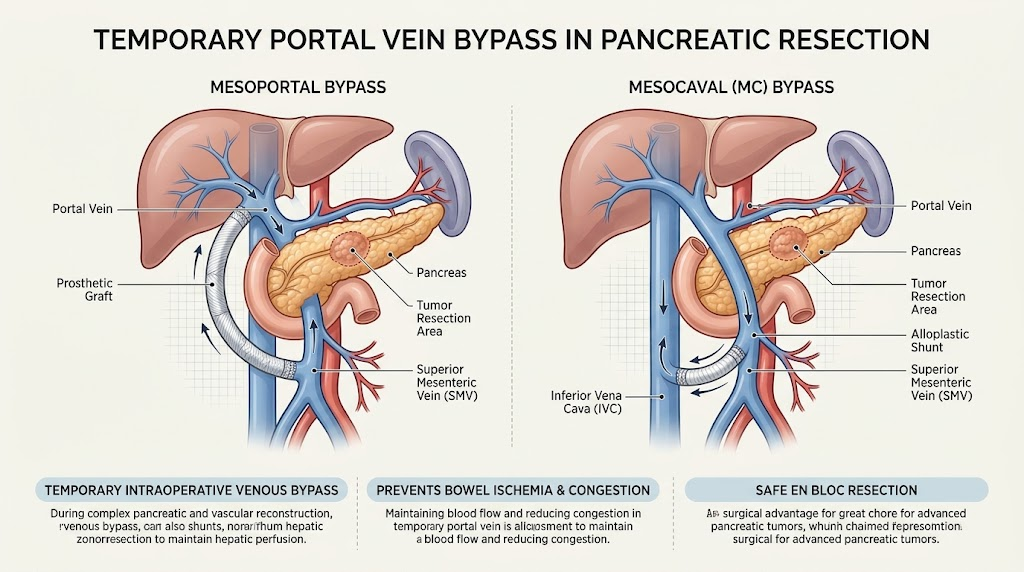
Pancreatic ductal adenocarcinoma (PDAC) remains one of the deadliest malignancies, and surgical resection offers the only potential for cure. However, many tumors involve critical vascular structures such as the portomesenteric vein (PMV), complicating resection. Involvement of the PMV is frequent due to the anatomic proximity of the pancreas to the superior mesenteric vein (SMV) and portal vein (PV). To achieve complete tumor removal, portomesenteric venous resection (PVR) is often necessary during pancreatoduodenectomy.
The surgical approach to PVR typically involves two technical variants: tangential (partial vein wall resection with direct closure or patch repair) and segmental (circumferential resection with venous reconstruction). Prior studies have reported mixed oncological and surgical outcomes comparing these approaches, but many were limited by heterogeneity in the degree of vein involvement and inclusion of cases where tangential resection was not feasible. The clinical implications for operative planning and outcomes remain unclear.
This study addresses a critical knowledge gap by restricting analysis to patients with moderate PMV involvement (≤180 degrees circumferential involvement), thereby providing clinically pertinent evidence to guide surgical decision-making between tangential and segmental resection techniques.
Study Design
The study was an international multicenter retrospective cohort analysis conducted across 10 high-volume pancreatic surgery centers spanning 5 countries, covering patients treated from 2014 to 2020. Inclusion criteria comprised all consecutive patients undergoing pancreatoduodenectomy with PVR for pancreatic cancer whose preoperative imaging demonstrated ≤180 degrees PMV involvement.
Patients were stratified based on the type of PVR performed: tangential or segmental. The primary endpoints were overall survival (OS) and recurrence-free survival (RFS). Secondary endpoints included locoregional recurrence rates and in-hospital or 30-day major morbidity (defined as complications of Clavien-Dindo grade III or higher). Cox and logistic regression models adjusted for confounders such as age, tumor size, nodal status, and adjuvant therapy.
Key Findings
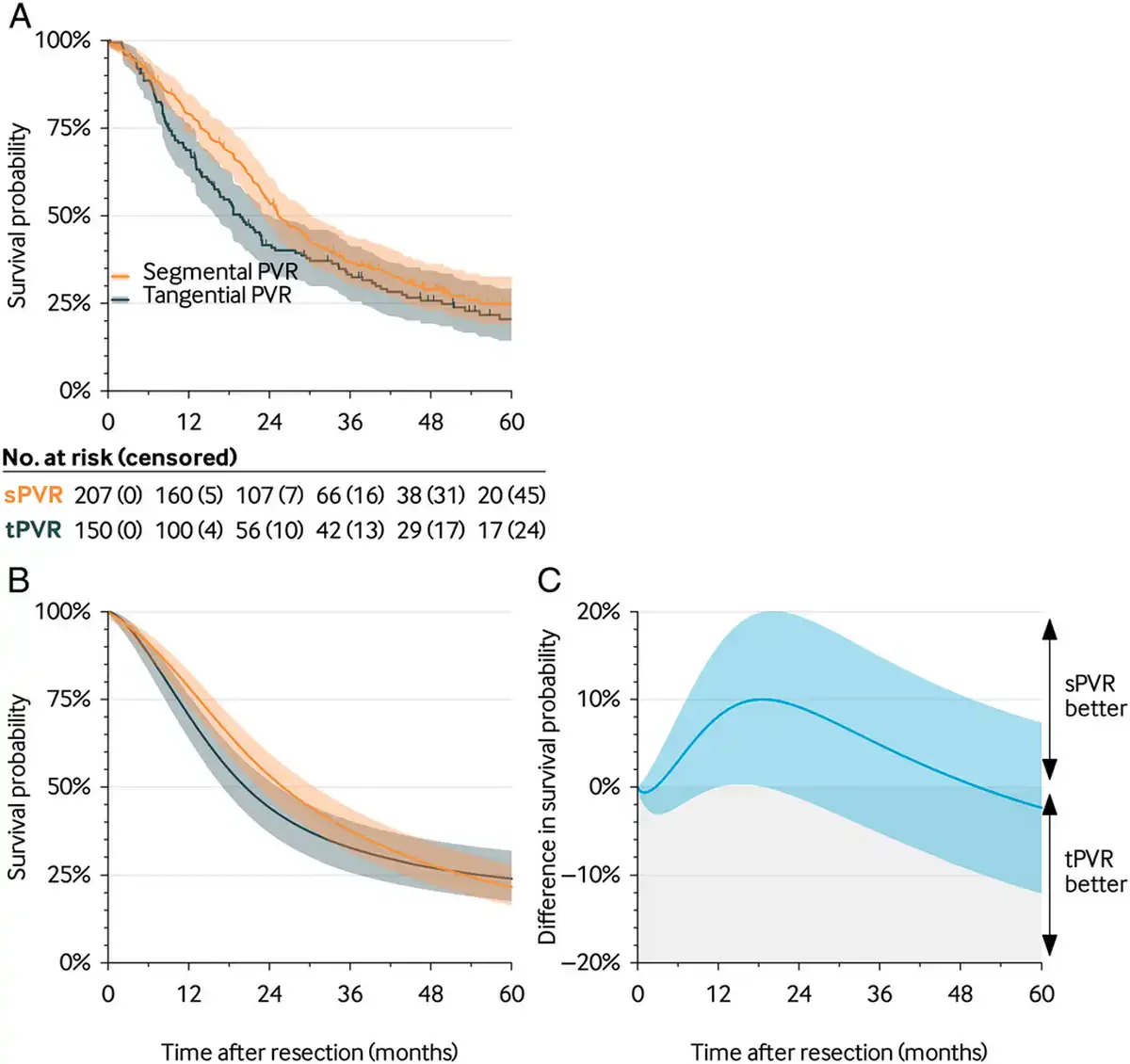
A total of 357 patients met inclusion criteria, with 42% (n=150) undergoing tangential PVR and 58% (n=207) undergoing segmental PVR.
Surgical Outcomes:
The incidence of major morbidity within the hospital admission or within 30 days postoperatively was 23% for both groups (95% confidence intervals tangential: 17–32%, segmental: 17–30%, P=0.98). This demonstrates similar perioperative safety profiles despite the more extensive venous reconstruction generally required for segmental PVR.
Oncological Outcomes:
After adjustment, there was no statistically significant difference between tangential and segmental PVR in terms of overall survival (hazard ratio [HR] 0.94, 95% CI 0.69–1.30) or recurrence-free survival (HR 0.94, 95% CI 0.69–1.28). Similarly, locoregional recurrence rates were not significantly different (odds ratio [OR] 0.76, 95% CI 0.40–1.46).
These findings indicate oncological equivalence of the two resection methods in this patient population.
Expert Commentary
This study rigorously clarifies an area of ongoing debate in complex pancreatic surgery—the optimal PVR technique when vascular involvement is limited to less than or equal to half the vessel circumference. By selecting patients amenable to both techniques, it avoids the confounding of more advanced tumor invasion that would necessitate segmental resection alone.
The equivalence in major morbidity challenges assumptions that segmental resection carries a higher surgical risk. Technological advances in vascular reconstruction and surgeon expertise have likely contributed to comparable safety.
From an oncological standpoint, the absence of survival or recurrence differences suggests that achieving negative margins and complete tumor clearance—regardless of resection type—is the key determinant of prognosis rather than the extent of venous resection per se.
Limitations include the retrospective design and potential selection bias, as surgeons might preferentially choose PVR type based on subtle intraoperative findings not captured in imaging or registry data. Prospective studies or randomized controlled trials would provide more definitive evidence but are challenging to perform in this context.
The study aligns with recent consensus guidelines endorsing personalized surgical strategies for borderline resectable pancreatic cancer based on anatomical and technical feasibility.
Conclusion
In patients with pancreatic cancer confined to ≤180 degrees portomesenteric vein involvement, tangential and segmental venous resections during pancreatoduodenectomy deliver comparable surgical morbidity and oncologic outcomes. These findings support the notion that when both procedures are technically feasible, surgeons may select the PVR approach based on preference and intraoperative considerations without compromising patient safety or survival.
This evidence informs surgical planning and multidisciplinary decision-making, emphasizing the importance of tailoring vascular resection strategies to individual patient anatomy and tumor characteristics. Future prospective research and uniform reporting standards for PVR techniques would further optimize care for this complex patient population.
Funding and Registration
The study was supported by an international collaborative group on locally advanced pancreatic cancer. Specific funding sources and clinical trial registration identifiers were not provided in the original report.
References
1. Stoop TF, Molnár A, Seelen LWF, et al. Tangential Versus Segmental Portomesenteric Venous Resection During Pancreatoduodenectomy for Pancreatic Cancer: An International Multicenter Cohort Study on Surgical and Oncological Outcome. Ann Surg. 2025;284(4):821-830. PMID: 39846439.
2. National Comprehensive Cancer Network (NCCN) Guidelines. Pancreatic Adenocarcinoma. Version 2.2024.
3. Bockhorn M, Uzunoglu FG, Adham M, et al. Borderline resectable pancreatic cancer: a consensus statement by the International Study Group of Pancreatic Surgery (ISGPS). Surgery. 2014;155(6):977-988.
4. Del Chiaro M, Valentino J, Segersvärd R, et al. Results of vascular resection during pancreatoduodenectomy for pancreatic adenocarcinoma: a systematic review and meta-analysis. HPB (Oxford). 2010;12(8):505-517.