Highlight
Temporary intraoperative portal vein bypass using mesoportal or mesocaval shunts enables safe pancreatectomy in advanced pancreatic cancer with venous involvement.
Mesoportal and mesocaval bypasses demonstrate comparable postoperative morbidity, mortality, and length of hospital stay.
Choice of bypass approach should be individualized based on tumor anatomy, particularly arterial involvement and need for arterial resection.
No postoperative liver failure was observed, underscoring the efficacy of temporary bypasses in maintaining hepatic venous flow.
Study Background
Pancreatic cancer remains one of the most challenging malignancies to treat surgically due to its aggressive nature and frequent involvement of adjacent vascular structures, notably the portal vein and superior mesenteric vein (SMV). Tumor infiltration causing long-segment involvement or complete occlusion of the mesoportal axis poses significant technical obstacles to achieving margin-negative resection. Additionally, cavernous transformation of the portal vein complicates surgical maneuvers and increases hemorrhagic risk. Traditional approaches involving prolonged portal venous clamping may result in severe bowel congestion, ischemia, and increased morbidity. Hence, innovative surgical strategies to maintain portal flow and minimize intraoperative complications are imperative for expanding resectability and improving outcomes in these advanced cases.
Study Design
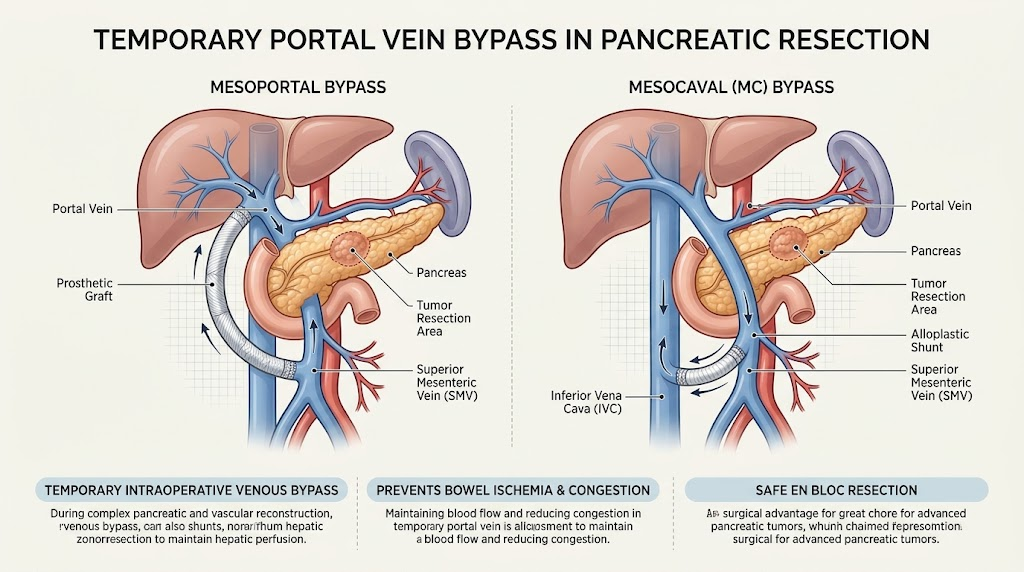
This investigation retrospectively analyzed all consecutive patients undergoing pancreatectomy with portal vein resection complemented by temporary intraoperative venous bypass grafting from a prospectively maintained database spanning 2011 to 2024. Two principal bypass techniques were utilized: the mesoportal (MP) bypass connecting the mesenteric vein to the portal vein, and the mesocaval (MC) bypass diverting mesenteric blood flow to the inferior vena cava. The MP bypass is preferred when concomitant hepatic arterial resection is anticipated, preserving portal inflow to the liver and preventing complete hepatic vascular exclusion. Alternatively, the MC bypass offers a technically simpler approach. Patient demographics, perioperative parameters, postoperative complications graded by Clavien-Dindo classification, intensive care unit (ICU) and hospital length of stay, and 90-day mortality rates were recorded and compared between the two groups.
Key Findings
The study comprised 63 patients, with 34 receiving mesoportal bypass and 29 undergoing mesocaval bypass during pancreatectomy with portal vein resection. Notable results include:
– Severe postoperative complications (Clavien-Dindo >3a) occurred in 25.4% (16 patients).
– No patients developed postoperative liver failure, indicating effective maintenance of hepatic perfusion.
– Median ICU stay was 2 days, and median hospital stay was 21 days for the overall cohort.
– The 90-day postoperative mortality rate was 6.3%, reflecting acceptable surgical risk for this complex population.
– Comparative analysis between mesoportal and mesocaval groups revealed no statistically significant differences regarding complication rates, length of ICU and hospital stay, or mortality.
These data collectively affirm that both bypass techniques offer robust perioperative safety profiles. The ability to maintain portal venous flow during prolonged vein reconstruction mitigates bowel congestion and ischemia risk. Additionally, no observed liver failures emphasize the importance of avoiding total hepatic vascular exclusion, particularly when combined arterial resections are warranted.
Expert Commentary
The surgical resection of pancreatic neoplasms invading the portal vein has evolved with improved techniques that enhance resectability without compromising safety. Temporary portal vein bypass grafting represents a strategic advancement addressing the dual challenges of hemorrhage control and visceral congestion. The mesoportal bypass’s advantage in preserving portal flow to the liver is critical when arterial resections are concomitant, which is increasingly recognized in borderline resectable or locally advanced cases. Conversely, the mesocaval bypass, while less complex technically, diverts portal flow away from the liver temporarily and must be chosen judiciously.
Limitations of the study include its retrospective nature and single-center design, which may introduce selection bias. Additionally, longer-term oncologic outcomes such as disease-free and overall survival were not addressed, which are essential in evaluating the true impact of these bypass strategies. Nevertheless, the robust perioperative outcomes presented corroborate with emerging consensus guidelines advocating vascular resections in experienced centers to improve resectability rates.
Conclusion
Temporary intraoperative venous bypass grafting via mesoportal or mesocaval shunts is a valuable and safe technique for pancreatectomy in patients with advanced pancreatic cancer involving the portal venous axis. Both approaches yield comparable postoperative morbidity and mortality, and the bypass method should be tailored to individual anatomical considerations, particularly arterial involvement and the need for arterial vascular reconstruction. Implementation of these vascular bypass techniques may broaden surgical candidacy and improve the safety profile of complex pancreatic resections, ultimately contributing to enhanced multidisciplinary management of locally advanced pancreatic cancer.
Funding and Clinical Trials
The article does not report external funding sources or clinical trial registration information.
References
1. Heckler M, Abdallah S, Kinny-Köster B, Berchtold C, Al-Saeedi M, Mehrabi A, Hackert T, Hinz U, Hank T, Michalski CW, Büchler MW, Loos M. Temporary Portal Vein Bypass for Resection of Pancreatic Neoplasms. Ann Surg. 2026 Oct 1;284(4):e73-e78. doi: 10.1097/SLA.0000000000006662. Epub 2025 Feb 10. PMID: 39925251.