Blood-Based DNA Methylation Models May Improve Cardiovascular Risk Prediction in Type 2 Diabetes
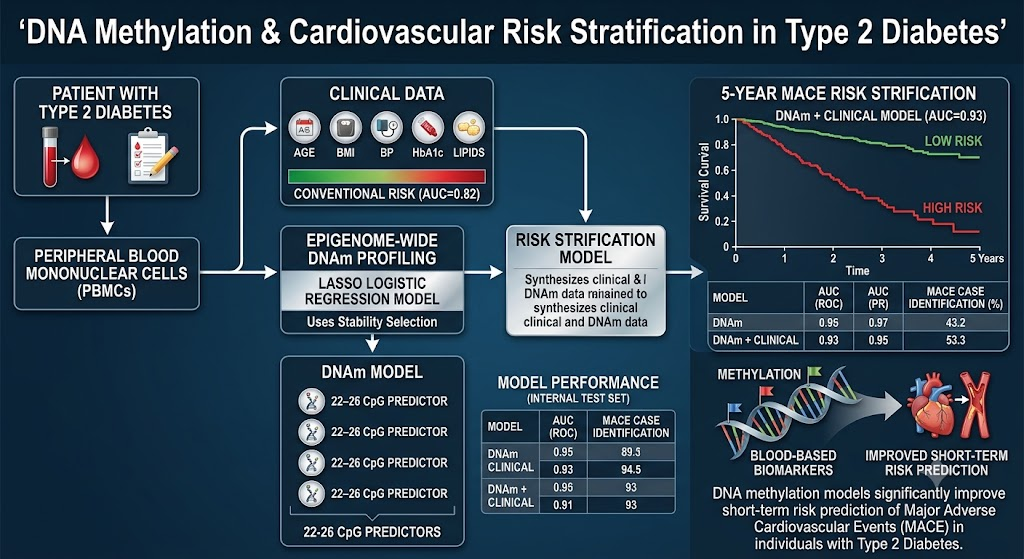
DNA methylation markers in peripheral blood mononuclear cells were used to build risk models for major adverse cardiovascular events (MACE) in type 2 diabetes.
Five analytical frameworks produced models with area under the curve (AUC) values ranging from 0.915 to 0.937 in an internal test set.
Each model retained 22–26 CpG sites; 12 CpGs were consistently selected across all five frameworks.
Results are promising but require external validation and further standardization before clinical use.
Study Snapshot
Design: Nested case-control analysis within the TOSCA.IT trial
Population: 305 adults with type 2 diabetes (81 MACE cases, 224 controls)
Exposure: Genome-wide DNA methylation in peripheral blood mononuclear cells at baseline
Outcome: Major adverse cardiovascular events within 5 years
Analysis: LASSO logistic regression with stability selection, five covariate-adjustment frameworks
Key Results: AUC 0.915–0.937; AUPRC 0.866–0.940 in internal test set
Limitations: Small sample, no external validation, potential residual confounding
Why This Study Matters
Cardiovascular complications remain the leading cause of death among individuals with type 2 diabetes (T2DM). Although conventional risk factors such as hypertension, dyslipidemia, and glycemic control are routinely assessed, they do not fully capture interindividual variation in cardiovascular risk. Epigenetic modifications, particularly DNA methylation (DNAm), reflect both genetic and environmental influences and may serve as sensitive biomarkers for short-term risk stratification. This study investigated whether blood-based DNAm patterns could improve prediction of major adverse cardiovascular events (MACE) beyond traditional clinical factors in a well-characterized T2DM cohort.
How the Study Was Conducted
The researchers profiled epigenome-wide DNA methylation in peripheral blood mononuclear cells (PBMCs) obtained at baseline from 305 participants of the Thiazolidinediones Or Sulphonylureas and Cardiovascular Accidents Intervention Trial (TOSCA.IT). Among these participants, 81 experienced a MACE (myocardial infarction, stroke, or cardiovascular death) within 5 years (cases), and 224 did not (controls). The population was randomly divided into a training set and an internal test set for model development and evaluation.
Differential methylation analysis was performed under five analytic frameworks that differed in the degree of covariate adjustment (e.g., age, sex, BMI, HbA1c, smoking, lipid-lowering therapy). To build predictive models, binomial least absolute shrinkage and selection operator (LASSO) logistic regression was applied, and stability selection was used to retain only the most robust CpG predictors. The models were then tested in the internal test cohort, with performance measured by receiver operating characteristic area under the curve (AUC) and area under the precision-recall curve (AUPRC).
What the Researchers Found
Differential methylation analysis identified thousands of CpG sites associated with incident MACE, with the number varying by adjustment framework (from 7,101 to 23,839 CpGs at nominal significance). After LASSO regression with stability selection, each of the five final models retained 22–26 CpG predictors. In the internal test set, all five models demonstrated high discriminative performance:
AUC values ranged from 0.915 to 0.937
AUPRC values ranged from 0.866 to 0.940
Notably, 12 CpG sites were consistently selected across all five models, suggesting these loci may represent robust epigenetic markers of cardiovascular risk independent of covariate adjustment. Some CpGs were associated with increased risk, while others were protective.
What the Findings May Mean
The study provides proof-of-concept that blood-derived DNA methylation patterns can stratify short-term cardiovascular risk in individuals with T2DM with high accuracy. If validated externally, such epigenetic models could complement traditional risk scores and identify high-risk patients who might benefit from more aggressive preventive therapies. However, the authors caution that these findings are preliminary and that the models require prospective validation in larger, independent cohorts. The 12 consistently selected CpGs warrant further functional investigation to understand their biological roles in cardiovascular disease.
Strengths and Limitations
Strengths include the use of a well-phenotyped clinical trial cohort, rigorous statistical methods (LASSO with stability selection), and exploration of multiple adjustment frameworks to reduce confounding. However, the study has important limitations. The sample size is relatively small (305 individuals, 81 MACE events), which may limit statistical power and increase the risk of overfitting, despite the use of internal validation. No external validation cohort was included. DNA methylation was measured in PBMCs, not in target tissues, and cell-type heterogeneity was not explicitly adjusted for. Additionally, the analysis was retrospective within a clinical trial, and the results may not generalize to broader, unselected populations. The models' clinical utility—whether their use improves patient outcomes—remains unknown.
Implications for Practice and Research
At this stage, the DNA methylation models are not ready for clinical application. Replication in larger, diverse, and prospectively collected cohorts is essential. Researchers should also examine whether the CpG signatures are specific to T2DM or applicable to the general population. If confirmed, the 12 cross-model CpG sites could be developed into a targeted epigenetic test for point-of-care risk assessment. Future work should also evaluate whether adding DNAm information to existing risk scores (e.g., UKPDS, RECODe) improves net reclassification. Mechanistic studies linking the identified CpGs to gene expression and vascular biology could reveal new therapeutic targets.
Funding, Disclosures, and Registration
The authors reported funding from the Italian Ministry of Health and other sources. Competing interests were not detailed in the abstract. The TOSCA.IT trial is registered in ClinicalTrials.gov (NCT00700856). The present epigenetic analysis is a substudy of that trial.
References
Longo M, Desiderio A, Masulli M, et al. Blood-Based DNA Methylation Models Improve Short-term Cardiovascular Risk Stratification in Individuals With Type 2 Diabetes. Diabetes Care. 2026 Jul 16. PMID: 42461785.
This article was created using several editorial tools, including AI, as part of the process. Human editors reviewed this content before publication.