We use cookies

Our website uses essential cookies and, with your consent, additional cookies to measure performance and improve our services. Cookie Policy.

You can change your choice at any time.

MMedXYNews
HomeVideos
MedXY AI/MedXY News/Section: Cardiology

Advancements in Heart Failure Management: Insights from the JROADHF and JROADHF-NEXT Registries
MedXY Editorial Team•Aug 22, 2026•Cardiology
Phục hồi chức năng timGuideline therapyheart failurepatient educationclinical outcomes

Highlight

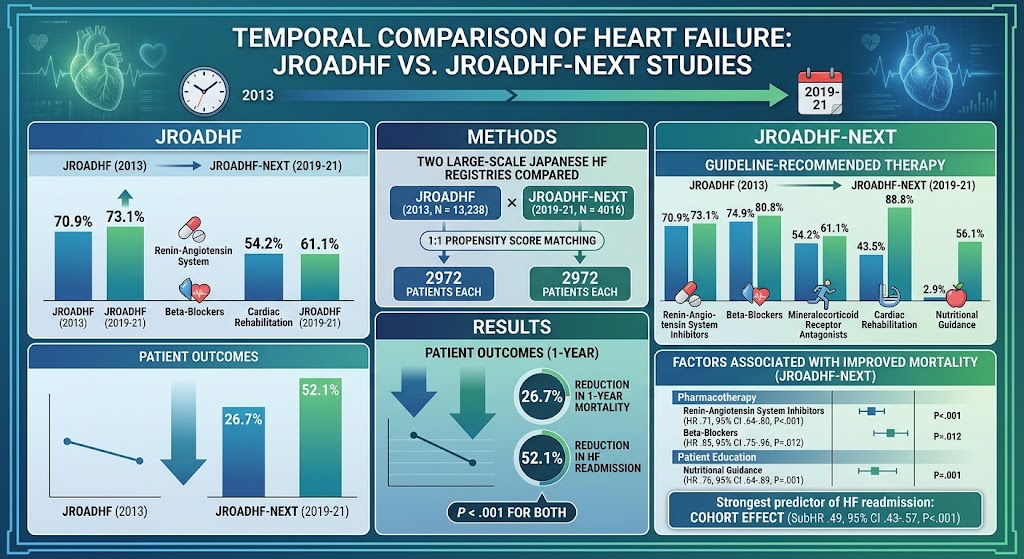
This comparative study of Japanese heart failure (HF) registries demonstrated significant temporal improvements in clinical practice and patient outcomes from 2013 to 2019-21. Key highlights include increased use of guideline-recommended pharmacotherapies such as renin-angiotensin system inhibitors and beta-blockers, expanded implementation of cardiac rehabilitation and nutritional guidance, and notable reductions in 1-year mortality and HF readmission rates.

Study Background

MedXY registered readers

Sign in free to continue reading

Create or use your MedXY account to unlock the complete article.

This article was created using several editorial tools, including AI, as part of the process. Human editors reviewed this content before publication.

Related articles

Open language-specific specialty feeds and department pages.

Innovative Early Discharge with Subcutaneous Furosemide for Heart Failure: Enhancing Recovery and Reducing Hospital StayA subcutaneous furosemide minipump-enabled early discharge strategy improves days alive and out of hospital in heart failure patients, reducing inpatient stay without increasing serious adverse events significantly.Oct 19, 2026Prominent V Waves in Heart Failure with Preserved Ejection Fraction: Unveiling Their Impact on Right Ventricular Afterload and Pulmonary Vascular AssessmentProminent left atrial V waves in heart failure with preserved ejection fraction significantly increase right ventricular afterload independent of pulmonary vascular disease, challenging current hemodynamic assessments and impacting patientOct 17, 2026Quality indicators for lupus nephritis care: implementing the 2025 EULAR recommendations — development, adherence, and impact on outcomesA validated set of 17 quality indicators (QIs) for lupus nephritis, derived from the 2025 EULAR recommendations, shows variable adherence in practice and an association between higher adherence and lower damage accrual in a tertiary-care coOct 16, 2026
Loading comments...
MedXY briefing

Get the free newsletter

Evidence-led clinical news, trends, and analysis—delivered to your inbox.

Ask MedXY AI

Most popular

Intimate Health
Five Benefits for Women Continuing Sexual Activity After Menopause
Intimate Health
Why Some Women Have a Strong Sex Drive—And Why Men Shouldn't Worry About It
Nursing & care
How often should a couple have sex?
Cardiology
Precision Medicine for Long QT Syndrome Type 2: Lumacaftor Corrects Trafficking Defects and Shortens QT Interval
General Surgery
Optimizing Postoperative Opioid Prescriptions After Intra-Abdominal Cancer Surgery: Comparing the 5x-Multiplier and 3-Tier Models
© 2026 MedXY
Contact usAbout usPrivacy PolicyMedXY story
Enhancing Informed Consents in Tubal Sterilization: Impact of a Patient-Centered Educational Website
A randomized trial demonstrates that a patient-facing educational website improves contraceptive knowledge and perceived access more effectively than standard federal consent materials among individuals considering tubal sterilization.
Oct 16, 2026
Hematoma Location as a Key Modifier of Intensive Blood Pressure Lowering Outcomes in Acute Intracerebral HemorrhageThis pooled analysis of INTERACT and ATACH-II trials reveals that intensive blood pressure lowering significantly improves outcomes only in patients with deep intracerebral hemorrhage, highlighting hematoma location as crucial for personaliOct 16, 2026
Palmitic Acid and Cardiac Hypertrophy: Unveiling the Epigenetic Memory Driving Heart FailureThis article explores how palmitic acid induces a pro-hypertrophic memory in cardiomyocytes through epigenetic regulation involving KDM5A and H3K4me3 modifications, driving cardiac hypertrophy and heart failure, and highlights potential theOct 16, 2026