Prominent V Waves in Heart Failure with Preserved Ejection Fraction: Unveiling Their Impact on Right Ventricular Afterload and Pulmonary Vascular Assessment
Highlight
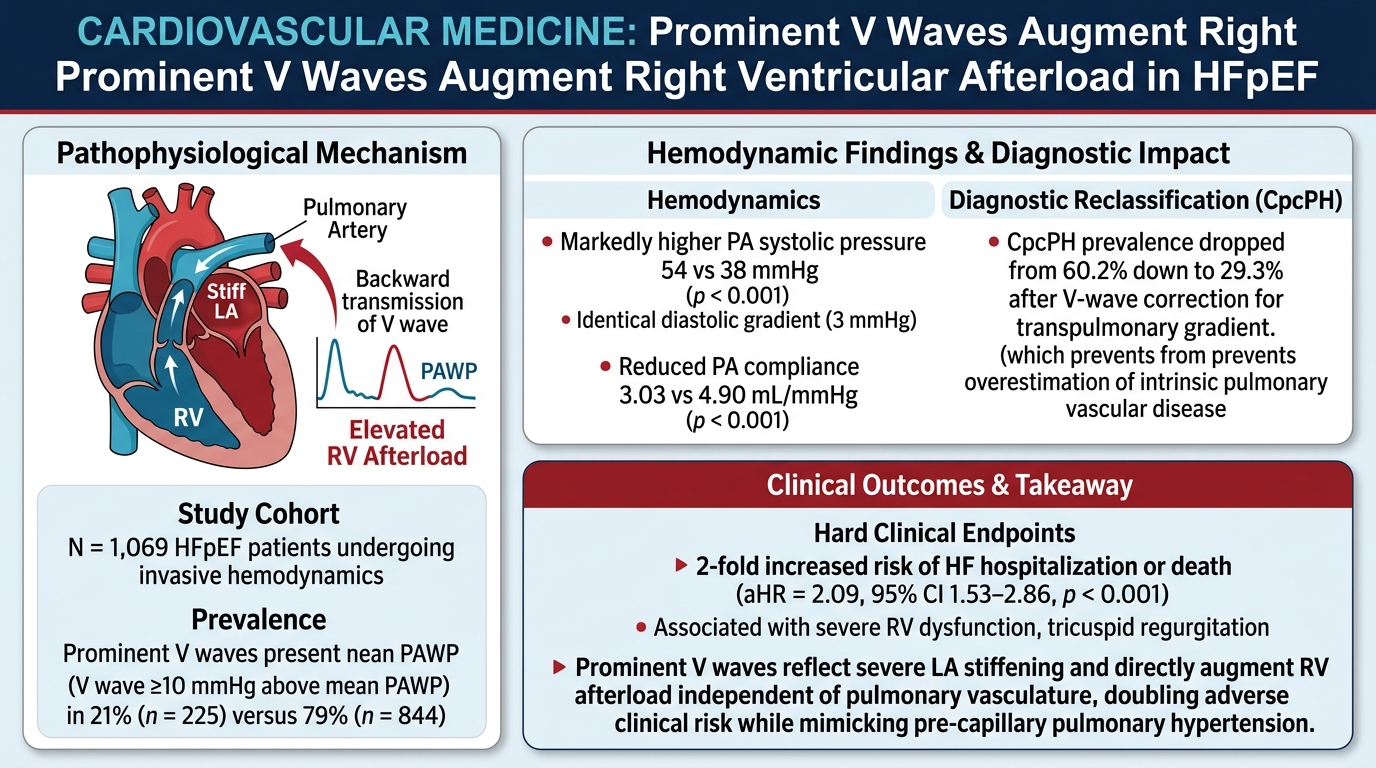
1. Prominent left atrial V waves occur in over 20% of heart failure with preserved ejection fraction (HFpEF) patients and reflect atrial myopathy with increased stiffness.
2. These V waves augment right ventricular afterload by backward transmission of pressure independent of pulmonary vascular resistance.
3. Conventional hemodynamic assessments risk overestimating pulmonary vascular disease severity without accounting for the prominent V wave.
4. Recognition of V wave influence is critical for accurate diagnosis, risk stratification, and management in HFpEF patients.
Study Background
Heart failure with preserved ejection fraction (HFpEF) represents a significant clinical burden with complex pathophysiology involving left heart and pulmonary circulation abnormalities. Pulmonary hypertension often complicates HFpEF and adversely affects right ventricular function and patient prognosis. However, the mechanisms by which left atrial (LA) dysfunction influences right ventricular (RV) afterload and pulmonary vascular assessment remain incompletely understood. Notably, LA stiffening augments the LA V wave, which can elevate pulmonary artery (PA) pressures disproportionately to left ventricular end-diastolic pressure (LVEDP). This phenomenon challenges traditional interpretations of pulmonary hemodynamics and may confound differentiation between pulmonary vascular disease and left heart disease contributions to pulmonary hypertension.
Study Design
The study by Chaikijurajai et al. employed a retrospective cohort design involving 1069 patients with HFpEF and mild or less mitral regurgitation undergoing invasive hemodynamic exercise testing. Patients were stratified based on the presence of prominent PA wedge pressure (PAWP) V waves defined as a V wave exceeding mean PAWP by ≥10 mm Hg, indicating heightened operative LA stiffness. Hemodynamic parameters including PA pressures, PAWP waveform analysis, and transpulmonary gradients were collected alongside echocardiographic assessments of LA volume, strain, and RV function. The study also validated an existing formula for V wave-corrected PAWP against pressure-time integral measurements to evaluate its accuracy in accounting for the V wave’s impact.
Key Findings
Prevalence and Clinical Characteristics: Approximately 21% of the cohort exhibited prominent V waves. These patients were older, predominantly female, and displayed more severe atrial myopathy evidenced by increased LA volume index (42.2±15.0 vs. 32.5±13.0 mL/m2, P < 0.001), reduced LA reservoir strain (16.4±7.5% vs. 23.2±8.3%, P < 0.001), and higher rates of atrial fibrillation (61.3% vs. 22.9%, P < 0.001). Operant LA reservoir stiffness was substantially increased (0.59±0.25 vs. 0.23±0.24 mm Hg/mL, P < 0.001).
Hemodynamic Impact of Prominent V Waves: Patients with prominent V waves had significantly elevated PA systolic pressure (54±16 vs. 38±12 mm Hg, P < 0.001) despite similar end-diastolic PAWP–PA pressure gradients, suggesting the elevated pressures were driven by the V wave rather than increased pulmonary vascular resistance.
Incorporating the V wave into PAWP estimation improved correlation with PAWP pressure-time integral (R2=0.96 vs. R2=0.86, P < 0.001) indicating enhanced hemodynamic accuracy when correcting for the V wave.
After V wave correction, the prevalence of combined pre- and postcapillary pulmonary hypertension significantly decreased from 60.2% to 29.3%, demonstrating that uncorrected measures overestimate pulmonary vascular disease severity.
PA compliance was markedly lower in patients with prominent V waves (3.03±1.56 vs. 4.90±2.27 mL/mm Hg, P < 0.001), increasing RV afterload independent of vascular resistance.
Right Ventricular Function and Clinical Outcomes: The presence of prominent V waves correlated with more severe RV dysfunction and tricuspid regurgitation. Cardiopulmonary exercise capacity was also diminished in this group.
Importantly, prominent V waves were associated with a more than twofold increased adjusted risk of heart failure hospitalization or death (hazard ratio 2.09; 95% CI, 1.53–2.86; P < 0.001), underscoring prognostic significance.
Expert Commentary
This study provides compelling evidence that elevated LA V waves, reflecting atrial stiffening, contribute independently to elevated right heart afterload and RV dysfunction in HFpEF. The backward transmission of pressure waves augments PA systolic pressures beyond what is explained by pulmonary vascular remodeling or resistance alone. These findings highlight a crucial mechanism by which left heart pathology influences pulmonary hemodynamics and challenge current diagnostic paradigms that rely heavily on end-diastolic PAWP and transpulmonary gradients without V wave correction.
Recognizing the impact of prominent V waves enables more accurate differentiation between pulmonary vascular disease and left atrial dysfunction, guiding optimal therapeutic strategies. The study also underscores the need for comprehensive echocardiographic and invasive assessments that include analysis of LA function and pressure waveforms. This integrates pathophysiologic insights into clinical practice, which is particularly important given the poor prognosis associated with RV involvement in HFpEF.
Limitations include the retrospective design and potential selection bias inherent in referral for invasive testing. Additionally, mechanisms underlying LA stiffening and V wave prominence deserve further mechanistic exploration, including their modulation by atrial fibrillation and interactions with mitral valve pathology.
Conclusion
Prominent V waves are present in over one-fifth of HFpEF patients and signify advanced LA myopathy with increased operant stiffness. These V waves substantially increase right ventricular afterload independently of pulmonary vascular resistance by boosting PA systolic pressures through backward pressure transmission. Failure to account for these V waves during hemodynamic assessment leads to overestimation of pulmonary vascular disease severity and misclassification of pulmonary hypertension subtypes.
Correcting PAWP for prominent V waves improves diagnostic accuracy, better stratifies risk, and clarifies the pathophysiology of right heart failure in this population. Clinicians and researchers should incorporate V wave analysis in comprehensive cardiopulmonary evaluation to refine diagnosis and tailor management strategies for patients with HFpEF.
Funding and ClinicalTrials.gov
The original study details funding sources not specified in the abstract. The clinical trial registry identifier, if applicable, was not provided in the source article.
References
Chaikijurajai T, Reddy YNV, Harada T, et al. Prominent V Waves Augment Right Ventricular Afterload Independent of the Lung Vessels in Heart Failure: Implications for Clinical Assessment of Pulmonary Vascular Disease. Circulation. 2026 Oct 11. PMID: 42860037.
Borlaug BA, Kass DA. Pulmonary hypertension due to left heart disease: pulmonary vascular disease or not? Circulation. 2021;143(13):1294-1308.
Reddy YNV, Anstrom KJ, Redfield MM, et al. Relationship of right ventricular function to outcomes in heart failure with preserved ejection fraction: insights from the RELAX and NEAT-HFpEF trials. Circulation. 2018;137(5):442-454.
This article was created using several editorial tools, including AI, as part of the process. Human editors reviewed this content before publication.