Persistent Gender Disparities in Emergency Medicine: A 20-Year Scoping Review
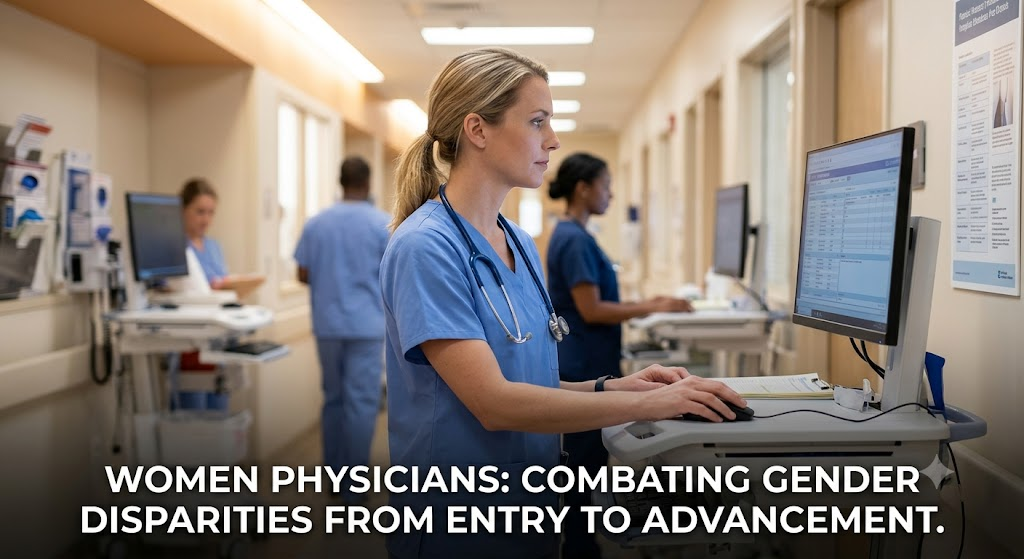
Gender disparities persist across multiple domains of emergency medicine practice and academia, with little change in some areas over two decades.
Women emergency physicians are consistently paid less and are underrepresented in leadership, senior academic rank, editorial boards, and major awards.
Harassment, bias, and lack of support for childbearing remain prevalent, while interventions to address these issues are largely absent from the literature.
Future research must move from documenting disparities to developing and testing effective corrective interventions, with attention to intersectional factors.
Overview of the Scoping Review | |
Scope | Gender disparities in the North American emergency medicine workforce, 2003–2024 |
|---|---|
Search Sources | MEDLINE, Embase, Cochrane Central Register of Controlled Trials, Scopus |
Included Studies | 191 (99% observational; 81% cross-sectional) |
Domains Mapped | Recruitment & Retention, Culture & Environment, Academic Scholarship, Recognition & Promotion, Clinical Care |
Key Finding | Persistent disparities with little improvement in compensation, leadership, academic rank, and editorial board membership |
Key Limitation | Limited intersectional data; no interventional studies evaluating solutions |
Background
Despite decades of advocacy for gender equity in medicine, disparities persist across specialties. In emergency medicine (EM), women now represent over one-third of residents and academic faculty, yet numerical representation has not translated into equitable outcomes in compensation, leadership, or professional recognition. To comprehensively assess the state of gender disparities among women emergency physicians, Sethuraman et al. conducted a scoping review covering two decades of published research (2003 to 2024). Their analysis, published in Annals of Emergency Medicine, included 191 studies and mapped evidence across five domains: recruitment and retention, culture and environment, academic scholarship, recognition and promotion, and clinical care. The review reveals a landscape where some disparities have narrowed, but systemic inequities in pay, power, and prestige have proven remarkably resistant to change.
Key Advances
Recruitment and Retention
The proportion of women EM residents decreased from 38.6% in 2007 to 35.1% in 2017, while women academic faculty increased from 16% in 1990 to 36–41% by 2018–2020. In clinical practice, the share of women physicians rose modestly from 22% (2008) to 28% (2020). Attrition rates were similar by gender, but women left practice at significantly younger ages (mean 10.5 vs. 17.5 years for men). Parental leave policies were consistently reported as inadequate across four studies, and no investigations evaluated interventions to improve recruitment or retention of women in EM.
Culture and Environment
This domain was the most studied, with 88 publications. Bias and mistreatment (32 studies) dominated the literature, with women reporting higher rates of misidentification, microaggressions, bullying, and sexual harassment. Underreporting was common due to fear of retaliation. Narrative evaluations contained more stereotype-driven feedback questioning women’s competence and leadership. Professional development groups were valued by participants but lacked objective evidence of reducing disparities. Despite institutional policies, no effective interventions were identified to curb harassment or bias.
Academic Scholarship
Women’s first authorship in EM journals increased from 9% in 1985 to 28–38% by 2019–2020; senior authorship rose from 9% to 22–29%. However, editorial board membership remained static at 9.4–22.5% women, and only 3.6–17.2% of editors-in-chief were women. Research grant data were sparse and showed similar rates of early career awards but no clear trends for larger grants or total funding. Women’s representation as invited speakers varied widely by conference (22–42%) and was only 16% among podcast speakers (2011–2021).
Recognition and Promotion
Women received 19–28% of EM awards overall, with improvements over time (10% in 2001–2005 to 35% in 2018). However, they were more likely to receive early-career, education, and advocacy awards, while men dominated leadership and lifetime achievement awards. Women were well-represented in chief resident, program director, and clerkship director roles, but severely underrepresented in chair, executive, and national leadership positions—with little change from 2002 to 2022. All studies of academic rank found women underrepresented at higher ranks, and all studies of compensation—across academic and community settings—found women paid less than men, even after adjusting for hours, rank, and leadership roles.
Clinical Care and Decision-Making
Thirteen studies addressed clinical care and operational outcomes, but evidence was insufficient for firm conclusions. Some studies suggested that women physicians may use more collaborative decision-making styles and face different patient expectations, but patient outcome data were largely absent. This remains a critical research gap.
Expert Commentary
The review’s strengths include its comprehensive search strategy, thematic organization, and clear mapping of evidence gaps. However, the quality of underlying studies is a major limitation: 99% were observational, the majority cross-sectional, and many used name-to-gender classification software rather than self-report, introducing potential misclassification. Only 21 studies reported intersectional race or ethnicity data, and none provided stratified outcome data by race or LGBTQIA+ status. Most important, the review identified no interventional studies testing policies or programs to reduce disparities.
These findings align with broader evidence from academic medicine but underscore a particularly stubborn pattern in EM. The persistence of pay inequity and leadership underrepresentation after 20 years of study calls into question the assumption that simply increasing numbers will drive equity. The authors argue convincingly that the field must transition from descriptive documentation to rigorous evaluation of interventions—including salary transparency, structured mentorship, flexible scheduling, and bias training—paired with accountability metrics.
Clinical and Translational Implications
For emergency department leaders and institutional policymakers, the review provides a clear evidence base for action. Key priorities include revising parental leave policies, establishing transparent compensation models, creating equitable pathways to leadership, and enforcing anti-harassment protections. Professional societies and journal editorial boards should continue to audit their own diversity metrics and set benchmarks for improvement. Researchers should prioritize prospective studies and natural experiments that measure the impact of specific equity initiatives, and must collect and report intersectional data to capture the full scope of disparities.
Conclusion
Gender disparities disadvantaging women emergency physicians are pervasive and, in areas such as compensation, leadership, and editorial board representation, have shown little improvement over two decades. While progress has been made in authorship, awards, and early-career representation, the pace is slow and uneven. The evidence base now requires a deliberate shift from documenting the problem to solving it through well-designed, intervention-focused research. Without such efforts, the goal of gender equity in emergency medicine will remain aspirational.
References
Sethuraman KN, Lall MD, Gorman EF, Zeidan AJ, Agrawal P, Raukar NP, Cooper RJ. Women emergency physicians and gender disparities from entry to advancement. Ann Emerg Med. 2026. PMID: 42383959.
This article was created using several editorial tools, including AI, as part of the process. Human editors reviewed this content before publication.