We use cookies

Our website uses essential cookies and, with your consent, additional cookies to measure performance and improve our services. Cookie Policy.

You can change your choice at any time.

MMedXYNews
HomeVideos
MedXY AI/MedXY News/Section: Emergency Medicine

Evaluating the Impact of Relative Value Unit-Based Compensation on Emergency Physician Performance and Operational Outcomes
MedXY Editorial Team•Sep 18, 2026•Emergency Medicine
Healthcare OperationsPhysician CompensationRelative Value Unitsemergency medicine

Highlight

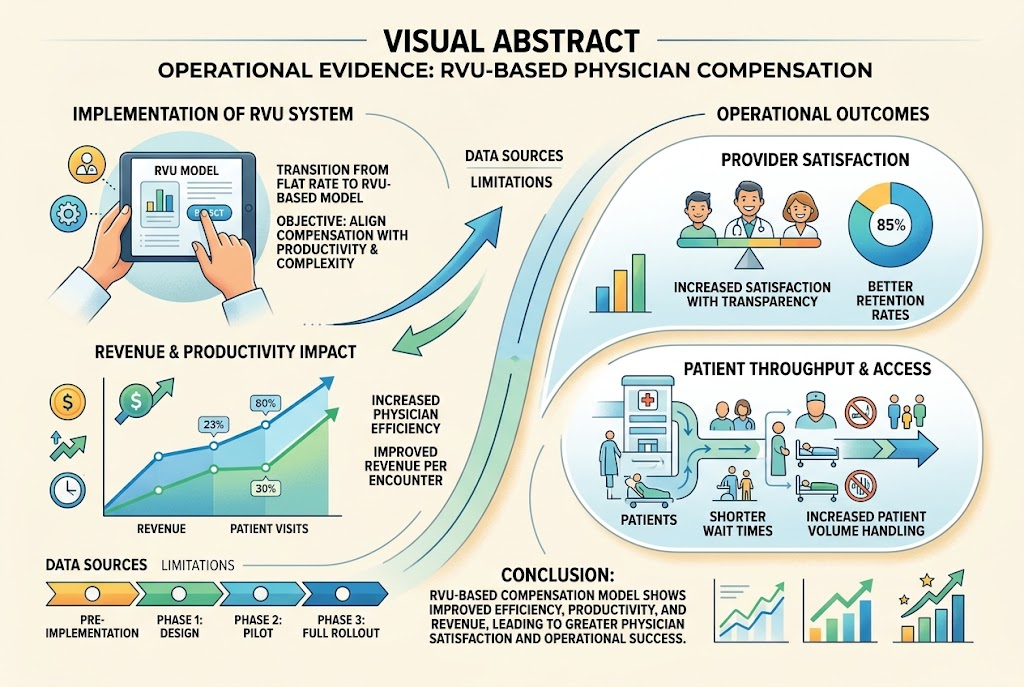
  • Transitioning from hourly to RVU-based compensation does not significantly affect emergency department productivity or billing intensity.
  • No appreciable change was observed in key operational outcomes such as patient left without being seen rates or length of stay.
  • Advanced practice provider hours increased relative to physician hours in some models after transitioning to RVU compensation.
  • Clinician satisfaction and safety indicators, including clinician attrition and 72-hour return admissions, remained stable across compensation models.

Study Background

MedXY registered readers

Sign in free to continue reading

Create or use your MedXY account to unlock the complete article.

This article was created using several editorial tools, including AI, as part of the process. Human editors reviewed this content before publication.

Related articles

Open language-specific specialty feeds and department pages.

Harnessing AI for Pediatric Emergency Care: ChatGPT-Driven Early Medical History Retrieval Pilot StudyA pilot study demonstrates that ChatGPT-4 can feasibly collect accurate and satisfactory medical histories from pediatric emergency patients, streamlining triage and reducing documentation burden.Aug 5, 2026Language Barriers and Emergency Department Crowding: Uncovering Disparities in Wait Times at an Academic Medical CenterNon-English-speaking patients experience significantly longer emergency department wait times, especially during crowding, highlighting healthcare inequities that warrant system-level policy responses.Aug 4, 2026Persistent Gender Disparities in Emergency Medicine: A 20-Year Scoping ReviewA comprehensive scoping review of 191 studies confirms widespread gender disparities disadvantaging women emergency physicians in compensation, leadership, and recognition, with little improvement over time.Jul 27, 2026Lidocaine vs Amiodarone for Shockable Out-of-Hospital Cardiac Arrest: No Significant Difference, but Lidocaine Shows Possible Benefit
Loading comments...
MedXY briefing

Get the free newsletter

Evidence-led clinical news, trends, and analysis—delivered to your inbox.

Ask MedXY AI

Most popular

Intimate Health
Five Benefits for Women Continuing Sexual Activity After Menopause
Intimate Health
Why Some Women Have a Strong Sex Drive—And Why Men Shouldn't Worry About It
Nursing & care
How often should a couple have sex?
Intimate Health
Classic Intimacy Recommendations: How to Help Women Reach Orgasm and Enjoy Mutual Pleasure
Intimate Health
What Makes a Woman "Physiologically Addicted" Is Never Money, But These Two Relationship Qualities
© 2026 MedXY
Contact usAbout usPrivacy PolicyMedXY story
A target trial emulation using data from the Resuscitation Outcomes Consortium found no statistically significant difference in survival to hospital discharge or favorable neurologic outcome between lidocaine and amiodarone in patients with shockable out-of-hospital cardiac arrest. However, point estimates and wide confidence intervals suggest a potential survival benefit with lidocaine that warrants further investigation.
Jul 24, 2026
Lidocaine Shows No Significant Benefit Over Amiodarone for Shockable Out-of-Hospital Cardiac Arrest, but Trend Favors LidocaineA target trial emulation analysis of over 2,400 patients with shockable out-of-hospital cardiac arrest found no statistically significant difference between lidocaine and amiodarone in survival to discharge or favorable neurologic outcome, though point estimates favored lidocaine. The study confirms findings from prior randomized trials but leaves room for clinically meaningful benefit.Jul 24, 2026
Resuscitation From Out-of-Hospital Cardiac Arrest: Reliable Association of EtCO2 with ROSCThis study examines the duration of end-tidal CO2 monitoring needed to distinguish return of spontaneous circulation (ROSC) during out-of-hospital cardiac arrest resuscitation, finding 7 to 21 minutes depending on witness status and initialJul 18, 2026