Validating VasCog-2-WSO Criteria: Early MRI Detection of Vascular Cognitive Impairment and Mortality Risk in Stroke- and Dementia-Free Adults
Highlight
The VasCog-2-WSO criteria identify MRI-based vascular cognitive impairment and dysfunction spectrum in adults without dementia or stroke.
Neuroimaging markers detected early vascular brain injury even before cognitive symptoms manifest, facilitating preclinical diagnosis.
Participants meeting preclinical VCID criteria show significantly higher 10-year cardiovascular risk scores and elevated mortality risk.
A graded relationship exists between VCID severity on MRI and all-cause mortality over nearly a decade follow-up.
Study Background
Vascular cognitive impairment and dementia (VCID) represents a complex spectrum of cognitive decline attributable to cerebrovascular pathology and is a leading contributor to dementia globally. Despite its clinical relevance, VCID remains underrecognized partly due to a lack of universally accepted diagnostic criteria, resulting in variable identification and management in clinical practice. The VasCog Society in conjunction with the World Stroke Organization (WSO) recently proposed the VasCog-2-WSO criteria, which integrate neuroimaging as a central element to facilitate early vascular cognitive diagnosis. However, these criteria had yet to be validated in large, community-based, dementia- and stroke-free populations, which is crucial to confirm their applicability for early detection and risk stratification. This study aimed to assess the VasCog-2-WSO criteria in a prospective community cohort to elucidate their associations with vascular burden and long-term mortality outcomes.
Study Design
The study utilized data from the I-Lan Longitudinal Aging Study, enrolling 1,236 adults aged 50 years and older who were free from prior stroke and dementia. Participants underwent standardized brain magnetic resonance imaging (MRI) with sequences optimized to detect cerebrovascular lesions, including white matter hyperintensities and lacunes, coupled with comprehensive neuropsychological evaluations. Using a neuroimaging-first approach, individuals were classified per the VasCog-2-WSO schema into non-VCID, preclinical VCID (with or without objective cognitive impairment), and vascular mild cognitive impairment (vaMCI). Baseline cardiovascular risk was quantified with the 10-year Framingham cardiovascular disease risk score. The primary outcome measured was all-cause mortality, tracked over a mean of 9.4 years. Analytical methods included multivariable Cox proportional hazards models and Poisson regressions to adjust for confounders and delineate mortality risk across VCID categories.
Key Findings
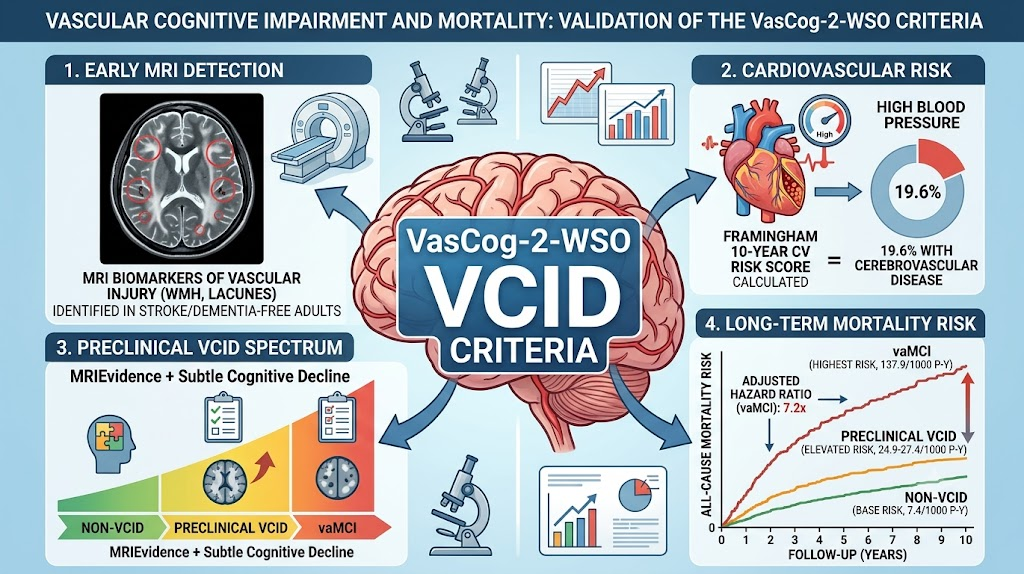
Of the included 1,236 participants (mean age 62.7 ± 8.8 years; 52.9% female), 19.6% exhibited MRI evidence of cerebrovascular disease. Within the cohort, 19.2% met criteria for preclinical VCID, and 0.4% qualified as having vaMCI. Both preclinical VCID groups and vaMCI participants demonstrated significantly poorer performance on cognitive assessments compared to non-VCID individuals. Importantly, the 10-year Framingham cardiovascular risk scores were markedly elevated in neuroimaging-positive groups, indicating increased vascular burden.
Mortality rates progressively increased with advancing VCID severity: 7.4 deaths (95% CI 5.7-9.4) per 1,000 person-years in the non-VCID group, rising to 24.9 (16.0-37.1) and 27.4 (18.2-39.6) in preclinical VCID subgroups, and 137.9 (37.6-353.2) in vaMCI. Adjusted Cox proportional hazards models revealed that preclinical VCID was associated with a 1.5 to 1.7-fold increased mortality risk, while vaMCI was linked to a 7.2-fold higher risk (95% CI 2.4-21.1), illustrating a significant graded trend (p for trend < 0.001).
The findings underscore that MRI-detected vascular brain injury, even before clear cognitive impairment manifests, portends elevated cardiovascular risk and mortality, substantiating the clinical relevance of the VasCog-2-WSO criteria for early vascular cognitive vulnerability identification.
Expert Commentary
This study represents a pivotal validation of state-of-the-art diagnostic criteria for vascular cognitive impairment, bridging neuroimaging biomarkers and clinical outcomes in a community-based, cognitively intact population. The neuroimaging-first approach of the VasCog-2-WSO framework enables detection of latent cerebrovascular pathology, offering a window for preventive interventions before symptomatic cognitive decline emerges. The graded association of vascular vulnerability with mortality highlights the systemic implications of cerebral small vessel disease beyond cognition, reflecting widespread vascular health.
Nonetheless, key limitations warrant consideration. The study did not incorporate Alzheimer disease biomarkers or genetic profiling, which restricts assessment of mixed etiologies that commonly coexist with vascular lesions. This precludes comprehensive evaluation of the criteria’s specificity amid heterogeneous dementia subtypes. Furthermore, the low prevalence of vaMCI indicates the need for larger or more diverse cohorts to fully characterize this spectrum. Despite these constraints, the findings robustly support the utility of VasCog-2-WSO for community screening and risk stratification.
Mechanistically, the results align with accumulating evidence linking cerebral microvascular damage to neurodegeneration and systemic vascular risk, advocating for integrated cerebral and cardiovascular risk management.
Conclusion
The VasCog-2-WSO criteria effectively identify a spectrum of vascular cognitive vulnerability detectable by MRI in asymptomatic adults, correlating with increased cardiovascular risk and mortality over nearly a decade. Early neuroimaging evidence of cerebrovascular disease portends adverse outcomes even prior to overt cognitive decline. These results affirm the criteria’s potential for earlier diagnosis and risk stratification in community settings, promoting timely preventive strategies. Future studies incorporating multimodal biomarkers and exploring intervention impacts are essential to refine and extend clinical applicability.
Funding and ClinicalTrials.gov
The study by Lin et al. did not disclose specific funding sources in the abstract. Details regarding clinical trial registration were not provided.
References
1. Lin YR, Lee WJ, Lee PL, Lin CP, Wang PN, Chen LK, Chung CP. Validation of the VasCog-2-WSO VCID Criteria in a Dementia-Free and Stroke-Free Community Cohort: Cardiovascular Risk and Mortality. Neurology. 2026 Jul 30;107(4):e218311. doi:10.1212/WNL.0000000000002183. PMID: 42531538.
2. Gorelick PB, Scuteri A, Black SE, et al. Vascular contributions to cognitive impairment and dementia: a statement for healthcare professionals from the American Heart Association/American Stroke Association. Stroke. 2011 Sep;42(9):2672-713. doi:10.1161/STR.0b013e3182299496.
3. O’Brien JT, Thomas A. Vascular dementia. Lancet. 2015 Feb 21;386(10004):1698-706. doi:10.1016/S0140-6736(15)00463-8.
4. Debette S, Schilling S, Duperron MG, Larsson SC, Markus HS. Clinical Significance of Magnetic Resonance Imaging Markers of Vascular Brain Injury: A Systematic Review and Meta-Analysis. JAMA Neurol. 2019 Jan 1;76(1):81-94. doi:10.1001/jamaneurol.2018.2505.
This article was created using several editorial tools, including AI, as part of the process. Human editors reviewed this content before publication.