We use cookies

Our website uses essential cookies and, with your consent, additional cookies to measure performance and improve our services. Cookie Policy.

You can change your choice at any time.

MMedXYNews
HomeVideos
MedXY AI/MedXY News/Section: Gastroenterology

Validating Liver Stiffness Measurement as a Prognostic Tool in Primary Sclerosing Cholangitis: Insights from the Prospective FICUS Cohort

MedXY Editorial Team•Aug 13, 2026•Gastroenterology
transplant-free survivalviêm ống mật xơ cứng nguyên phátliver stiffness measurementprognosisFibroscan
Highlight

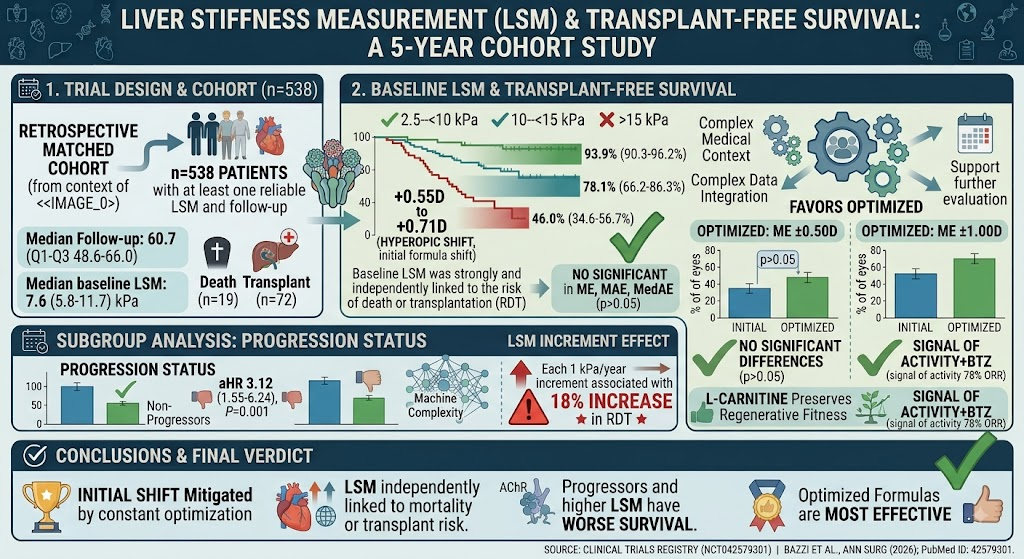
• Liver stiffness measurement (LSM) by Fibroscan® robustly predicts transplant-free survival in PSC.
• Stratification into Baveno-VII classes (<10, 10–<15, ≥15 kPa) correlates strongly with outcome.
• Dynamic LSM changes over time independently add prognostic value beyond baseline measures.
• Incremental LSM progression corresponds to a significant increase in risk of death or transplantation.

Study Background

MedXY registered readers

Sign in free to continue reading

Create or use your MedXY account to unlock the complete article.

This article was created using several editorial tools, including AI, as part of the process. Human editors reviewed this content before publication.

Related articles

Open language-specific specialty feeds and department pages.

COMPASS-SCC: A Novel Prognostic and Staging System Enhancing Risk Stratification in Cutaneous Squamous Cell CarcinomaThe COMPASS-SCC, developed from a large international cohort, offers improved prognostic accuracy for cutaneous squamous cell carcinoma compared to existing AJCC8 and BWH staging systems, aiding clinical decision-making for metastasis and mOct 17, 2026Impact of Primary Melanoma Stage on Survival Outcomes in Advanced Disease: Insights from the Spanish Melanoma Registry GEM1801Systemic relapse after stage I melanoma, though rare, portends higher tumor burden and poorer survival compared with relapse after stage II/III disease, as evidenced by data from 365 metastatic melanoma patients in the Spanish Melanoma RegiOct 13, 2026Prognostic Significance of Telomere Length in Chronic Lymphocytic Leukemia Under Venetoclax-Based First-Line TherapyTelomere length serves as an independent prognostic marker for progression-free survival in chronic lymphocytic leukemia patients treated with venetoclax-based regimens, highlighting its role in risk stratification during the modern targeteOct 11, 2026
Loading comments...
MedXY briefing

Get the free newsletter

Evidence-led clinical news, trends, and analysis—delivered to your inbox.

Ask MedXY AI

Most popular

Intimate Health
Five Benefits for Women Continuing Sexual Activity After Menopause
Intimate Health
Why Some Women Have a Strong Sex Drive—And Why Men Shouldn't Worry About It
Nursing &amp; care
How often should a couple have sex?
Cardiology
Precision Medicine for Long QT Syndrome Type 2: Lumacaftor Corrects Trafficking Defects and Shortens QT Interval
General Surgery
Optimizing Postoperative Opioid Prescriptions After Intra-Abdominal Cancer Surgery: Comparing the 5x-Multiplier and 3-Tier Models
© 2026 MedXY
Contact usAbout usPrivacy PolicyMedXY story
Age-Adjusted Whole Genome Sequencing Telomere Length in Idiopathic Pulmonary Fibrosis: Enhancing Diagnostic and Prognostic Precision
Age-adjusted WGS-estimated telomere length improves identification of pathologically short telomeres and detection of telomere-related variants in IPF, associating with survival outcomes but offering limited survival prediction beyond clini
Oct 11, 2026
Polygenic Risk Score Enhances Diagnosis and Prognostic Stratification in Idiopathic Pulmonary FibrosisA polygenic risk score (PRS) significantly associates with IPF diagnosis and mortality, demonstrating potential for improving clinical risk stratification using real-world biobank data.Oct 8, 2026
Harnessing Circulating Tumour DNA for Minimal Residual Disease Detection in Colorectal Cancer: Insights from the INTERCEPT ProgrammeThe INTERCEPT study demonstrates that longitudinal ctDNA testing effectively detects minimal residual disease post-curative treatment in colorectal cancer, enhancing recurrence prediction and refining risk stratification to guide future intOct 5, 2026