Highlight
Mitapivat, an oral pyruvate kinase activator, significantly improves hemoglobin in sickle cell disease patients compared to placebo.
The therapy targets abnormal red blood cell metabolism to reduce hemolysis, a central pathogenic mechanism in sickle cell disease.
Although the reduction in pain crises was not statistically significant, mitapivat demonstrated a favorable safety profile with fewer serious adverse events than placebo.
RISE UP, a global phase 3 randomized trial, provides robust evidence supporting mitapivat as a promising disease-modifying option for adults with sickle cell disease.
Study Background
Sickle cell disease (SCD) is a hereditary hemoglobinopathy characterized by chronic hemolytic anemia and recurrent vaso-occlusive crises caused primarily by polymerization of sickle hemoglobin leading to red blood cell (RBC) sickling. This pathophysiology drives significant morbidity including pain episodes, organ damage, and premature mortality. Despite advances, therapeutic options targeting the underlying metabolic defects of sickled RBCs remain limited. Current treatments such as hydroxyurea and voxelotor partially improve anemia or reduce crisis frequency but do not fully address disease mechanisms or are limited by tolerability.
Mitapivat, an oral allosteric activator of pyruvate kinase in RBCs, enhances ATP production and reduces the levels of 2,3-diphosphoglycerate (2,3-DPG), a molecule that modulates oxygen affinity and promotes sickling. By improving RBC metabolism and stability, mitapivat offers a novel mechanistic approach to ameliorate hemolytic anemia and potentially decrease sickling-related complications in SCD. The RISE UP trial was designed to evaluate mitapivat’s clinical efficacy and safety in this patient population.
Study Design
RISE UP is a multicenter, double-blind, randomized, placebo-controlled phase 3 trial conducted across 69 sites in 15 countries. The study enrolled patients aged over 16 years with confirmed sickle cell disease (including HbSS and related genotypes), persistent anemia, and a history of recurrent sickle cell pain crises. Participants were randomized in a 2:1 ratio to receive either mitapivat 100 mg orally twice daily or matching placebo, stratified by treatment center using permuted-block randomization.
The co-primary endpoints were:
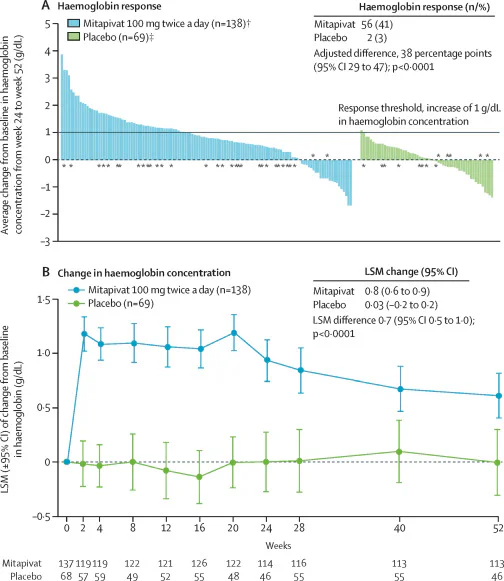
– A hemoglobin response defined as a ≥1.0 g/dL increase in average hemoglobin concentration from weeks 24 to 52 compared with baseline.
– The annualized rate of sickle cell pain crises requiring medical intervention over the study period.
Secondary outcomes included safety assessments, frequency of vaso-occlusive episodes, and other hematological and patient-reported measures. An open-label extension is ongoing to evaluate long-term outcomes.
Key Findings
A total of 207 patients were randomized (138 to mitapivat and 69 to placebo). Baseline characteristics across groups were balanced.
Hemoglobin Response
The trial met its primary hematologic endpoint robustly: 41% (56/138) of patients receiving mitapivat achieved a clinically meaningful hemoglobin increase of ≥1.0 g/dL from baseline to the average of weeks 24 to 52, compared with only 3% (2/69) in the placebo group (adjusted absolute difference 38%; 95% confidence interval 29-47; p<0.0001). This indicates a significant and sustained improvement in anemia among mitapivat-treated patients.
Sickle Cell Pain Crises
The annualized rate of vaso-occlusive crises was numerically lower in the mitapivat group at 2.6 crises per year (95% CI 2.3–3.0) versus 3.1 (2.6–3.6) in placebo; however, this difference did not reach statistical significance (p=0.1213). Although promising, these data suggest that larger or longer studies may be required to clarify mitapivat’s effect on pain frequency.
Safety Profile
Mitapivat was well tolerated, with serious adverse events reported in 20% of patients on mitapivat compared to 29% on placebo. Treatment-related serious adverse events were rare (1% mitapivat; none placebo). Common side effects were mild to moderate, consistent with the mechanism of action and prior studies of mitapivat in other hemolytic anemias. Importantly, mitapivat did not increase vaso-occlusive events or other serious complications.
Additional Observations
Mitapivat’s modulation of red cell metabolism via pyruvate kinase activation reduces 2,3-DPG, a glycolytic intermediate that lowers hemoglobin oxygen affinity and facilitates deoxygenation-induced sickling. Increased ATP availability improves RBC membrane integrity and lifespan. These mechanistic insights explain the observed improvements in anemia and potential stabilization of sickle red cells, supporting the clinical findings.
Expert Commentary
The RISE UP trial addresses a critical gap by introducing a metabolic-targeted oral therapy that improves hemolytic anemia in individuals with sickle cell disease. While current standards of care reduce crisis frequency or increase fetal hemoglobin, mitapivat’s novel approach to RBC energy metabolism represents a paradigm shift with potential to improve multiple disease facets.
Limitations include the lack of statistically significant reduction in pain crises, which may reflect the multifactorial nature of vaso-occlusion and the trial’s duration. Longer-term data from open-label extensions will be important to assess durability and broader clinical benefits. Moreover, studies involving pediatric populations and combination regimens with established therapies will expand applicability.
This trial’s global, diverse cohort enhances generalizability. The safety profile compares favorably to other SCD therapeutics, reinforcing mitapivat as a convenient, oral, and well-tolerated option.
Conclusion
The phase 3 RISE UP trial demonstrates that mitapivat effectively improves hemoglobin levels in people with sickle cell disease, addressing anemia through a novel metabolic mechanism. Although effects on pain crises require further clarification, mitapivat’s safety and hematologic benefits highlight its potential as a disease-modifying therapy. These results warrant integration of mitapivat into clinical practice pending regulatory approval and continued study, marking an important advancement in SCD management.
Funding and ClinicalTrials.gov
This study was funded by Agios Pharmaceuticals. The trial is registered at ClinicalTrials.gov (NCT05031780). An open-label extension study is ongoing to further evaluate long-term safety and efficacy.
References
1. Andemariam B, Kuo KHM, Algahtani FH, et al. Efficacy and safety of mitapivat in patients with sickle cell disease (RISE UP): a phase 3, double-blind, global, randomised, placebo-controlled trial. Lancet. 2026 Oct 24;408(10565):1705-1716. doi:10.1016/S0140-6736(26)00428-1.
2. Ataga KI, Kutlar A, Kanter J, et al. Crizanlizumab for the Prevention of Pain Crises in Sickle Cell Disease. N Engl J Med. 2017;376(5):429-439. doi:10.1056/NEJMoa1611770.
3. Vichinsky EP, Hoppe CC, Ataga KI, et al. A Phase 3 Trial of Voxelotor in Sickle Cell Disease. N Engl J Med. 2019;381(6):509-519. doi:10.1056/NEJMoa1903212.
4. Bender M, van Beers EJ, Minniti CP. Novel drugs targeting red cell metabolism for sickle cell disease: current perspectives. Ther Adv Hematol. 2022;13:20406207221084314. doi:10.1177/20406207221084314.