Unraveling the Predictors of Peak Weight Loss with Semaglutide in Cardiovascular Patients: Insights from the SELECT Trial
Highlight
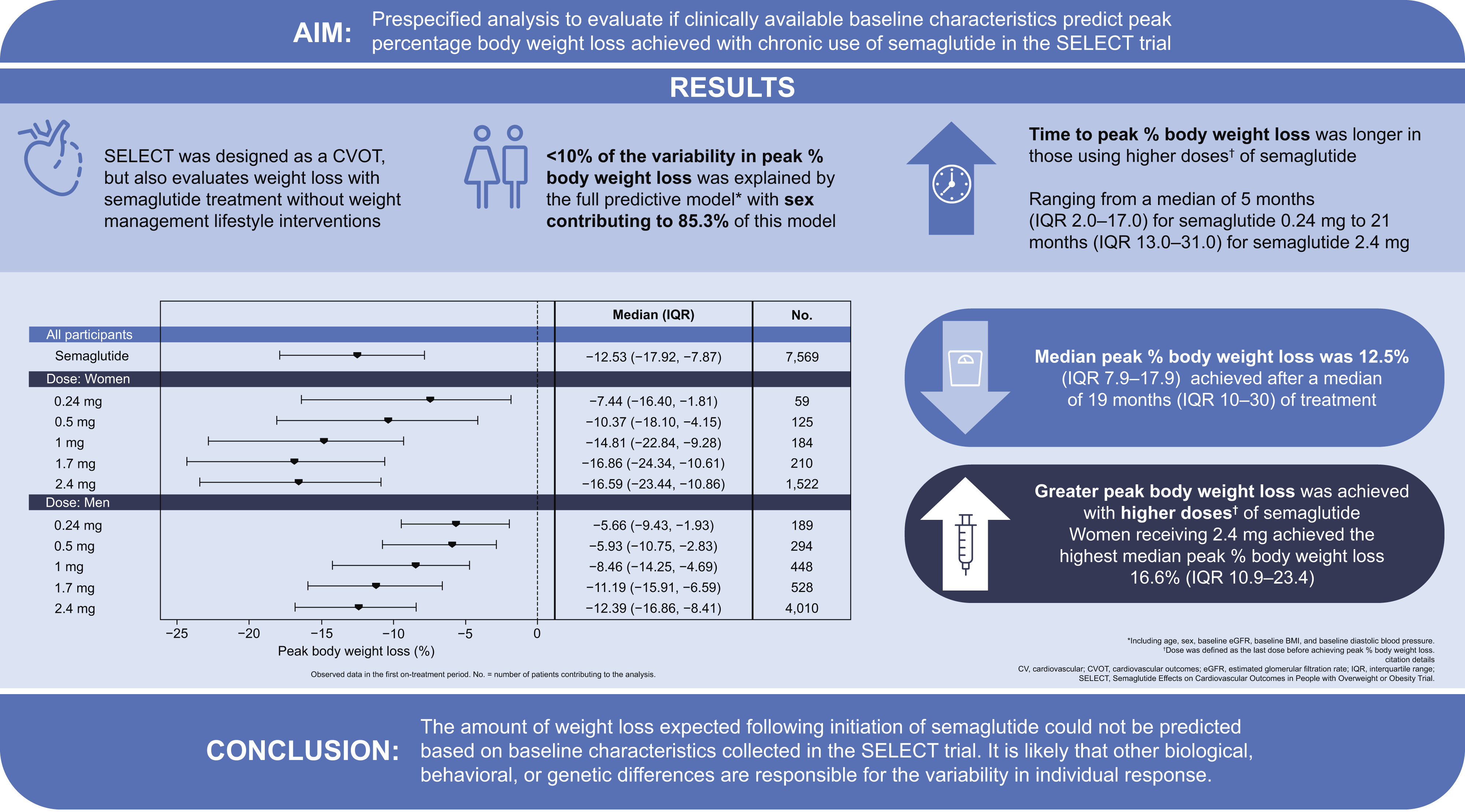
- The SELECT trial found median peak body weight loss of 12.5% after at least one year of semaglutide treatment in patients with overweight or obesity and cardiovascular disease but no diabetes.
- Baseline demographics, medical history, and clinical parameters poorly predicted magnitude of weight loss; female sex and higher semaglutide dose correlated with greater weight loss.
- Unexplained biological, behavioral, or genetic factors likely drive substantial interindividual variability in response to semaglutide.
Study Background
Obesity significantly contributes to cardiovascular morbidity and mortality worldwide. Pharmacologic interventions that achieve substantial and sustained weight reduction are instrumental in managing cardiovascular risk in overweight and obese patients. Semaglutide, a glucagon-like peptide-1 (GLP-1) receptor agonist, has demonstrated pronounced efficacy for weight loss and cardiovascular event reduction. However, weight loss response varies markedly among individuals, complicating personalized treatment approaches. Understanding predictors of semaglutide-induced weight loss is critical for optimizing patient selection and managing expectations.
Study Design
The SELECT trial was a randomized, placebo-controlled cardiovascular outcomes study examining the effects of semaglutide in adults with overweight or obesity (mean age 62 years, 72% male) who had established atherosclerotic cardiovascular disease but no diabetes. This prespecified, secondary analysis included 7,594 participants randomized to semaglutide who maintained treatment for at least one year. Peak percentage body weight loss (%BWL) was evaluated using a general linear model incorporating baseline clinical variables such as demographics, medical history, laboratory values, and dosage. The model employed ordinary least squares regression to identify predictors of peak %BWL.
Key Findings
Among patients on semaglutide continuously for ≥1 year, median peak %BWL was 12.5% (IQR 7.9-17.9), typically achieved after a median treatment duration of 19 months (IQR 10-30). Despite the large sample and extensive baseline data, the predictive model explained less than 10% of the variability in peak %BWL. Within this model, female sex accounted for 85.3% of the explained variance, equating to about 8% of overall variability, indicating women experienced greater weight loss than men.
Dose of semaglutide was also significantly associated with weight loss. Participants reaching the maximum dose of 2.4 mg had a median peak %BWL of 13.3% (IQR 9.0-18.4), compared to 6.0% (IQR 1.9-10.9) for those on lower doses, demonstrating a clear dose-response relationship.
Women on the highest dose achieved the greatest median peak weight loss of 16.6% (IQR 10.9-23.4) compared with 12.4% (IQR 8.4-16.9) in men. Other baseline factors such as age, baseline weight, blood pressure, lipid profile, and medical comorbidities did not meaningfully predict weight loss outcomes.
Expert Commentary
The SELECT trial’s secondary analysis highlights the challenge of predicting individual response to semaglutide solely from routine clinical variables. While women and those achieving the highest dose experienced larger weight loss, the overall unexplained variability suggests additional determinants are at play. Potential contributors include genetic polymorphisms affecting GLP-1 receptor signaling, behavioral adherence and lifestyle factors, metabolic differences, and gut microbiome profiles. These findings emphasize the need for further research incorporating biomarkers and personalized medicine approaches to refine weight loss prediction.
Moreover, the differential response observed by sex warrants exploration of sex-specific pharmacodynamics or hormonal influences on GLP-1 receptor agonist efficacy. Current clinical guidelines do not stratify obesity pharmacotherapy by sex; emerging data like these may inform future individualized treatment strategies.
Limitations include the trial population’s limited ethnic diversity and the high prevalence of males, which may temper generalizability. Additionally, the observational nature of this subanalysis precludes causal inferences regarding predictors.
Conclusion
In adults with overweight or obesity and established atherosclerotic cardiovascular disease without diabetes, semaglutide produces substantial weight loss, with peak median loss exceeding 12%. However, baseline clinical characteristics available in usual practice poorly predict peak treatment response, except for sex and dose effects. Unmeasured biologic, behavioral, or genetic factors likely underlie heterogeneity in weight loss response. Clinicians should counsel patients on the expected variability and titrate semaglutide dosing to maximize efficacy, particularly in women who may derive greater benefit. Further research integrating multi-omic and behavioral data is needed to enable precision medicine in obesity pharmacotherapy.
Funding and Clinical Trial Registration
The SELECT trial was funded by Novo Nordisk A/S. ClinicalTrials.gov identifier: NCT03574597.
References
1. Lingvay I, Kushner RF, Kaul U, et al. Predictors of Peak Body Weight Loss With Semaglutide in the SELECT Trial. Diabetes Care. 2026 Sep 24; PMID: 42782193.
2. Wilding JPH, Batterham RL, Calanna S, et al. Once-weekly semaglutide in adults with overweight or obesity. N Engl J Med. 2021;384(11):989-1002.
3. Kristensen SL, Rørth R, Jhund PS, et al. Cardiovascular, mortality, and kidney outcomes with GLP-1 receptor agonists in patients with type 2 diabetes: a systematic review and meta-analysis of cardiovascular outcome trials. Lancet Diabetes Endocrinol. 2019;7(10):776-785.
4. Pratley RE. GLP-1 receptor agonists: differentiation within the class. Lancet Diabetes Endocrinol. 2017;5(6):441-442.
This article was created using several editorial tools, including AI, as part of the process. Human editors reviewed this content before publication.