Highlights
Ziltivekimab robustly lowers inflammatory biomarkers including free interleukin-6 and high-sensitivity C-reactive protein (hsCRP) in patients with atherosclerosis and chronic kidney disease (CKD).
Phase 2 trials (RESCUE and RESCUE-2) demonstrated dose-dependent biomarker reductions, improvements in neutrophil-lymphocyte ratio (NLR), and a favorable safety profile.
The pivotal ZEUS trial involving 6376 patients revealed that despite profound biomarker suppression, ziltivekimab did not reduce major adverse cardiovascular events (MACE) compared with placebo.
The dissociation between biomarker modulation and clinical events underscores current knowledge gaps in targeting IL-6 for cardiovascular risk reduction and nuances of residual inflammatory risk.
Background
Atherosclerotic cardiovascular disease (ASCVD) remains a principal cause of morbidity and mortality worldwide. While lipid-lowering therapies have substantially reduced cardiovascular events, residual risk persists, partly attributed to chronic vascular inflammation. Interleukin-6 (IL-6) is a pleiotropic inflammatory cytokine centrally implicated in atherogenesis and thrombosis cascades. Elevated IL-6 and downstream biomarkers like hsCRP predict higher cardiovascular event rates, especially in patients with comorbid chronic kidney disease (CKD), who endure amplified inflammation and poor prognosis.
Interleukin-6 blockade emerged as a promising therapeutic avenue targeting this inflammatory axis. Ziltivekimab, a fully human monoclonal antibody that neutralizes the IL-6 ligand, has been developed to test this hypothesis. Prior evidence indicated that IL-1β inhibition (upstream of IL-6) with canakinumab reduced cardiovascular events in the CANTOS study, validating inflammation as a modifiable target. Whether direct IL-6 inhibition could achieve similar or superior clinical benefits remained to be clarified.
Key Content
Chronological Development of Clinical Evidence
Phase 2 Trials: Biomarker and Safety Profile
Multiple phase 2 studies elucidated ziltivekimab’s biological effects and safety in patients at high atherosclerotic risk with CKD and elevated hsCRP.
The RESCUE trial (Ridker et al., Lancet 2021; PMID: 34015342) enrolled 264 participants with moderate to severe CKD and hsCRP ≥2 mg/L. Randomized to placebo or ziltivekimab (7.5 mg, 15 mg, 30 mg) every four weeks, the trial demonstrated dose-dependent reductions in median hsCRP by 77% to 92% at 12 weeks compared with a 4% reduction with placebo (p90% at 12 weeks versus 27% with placebo, with concurrent declines in serum amyloid A and fibrinogen. Lipid profiles remained largely unchanged except for a slight triglyceride increase.
Large-Scale Outcome Trial: ZEUS
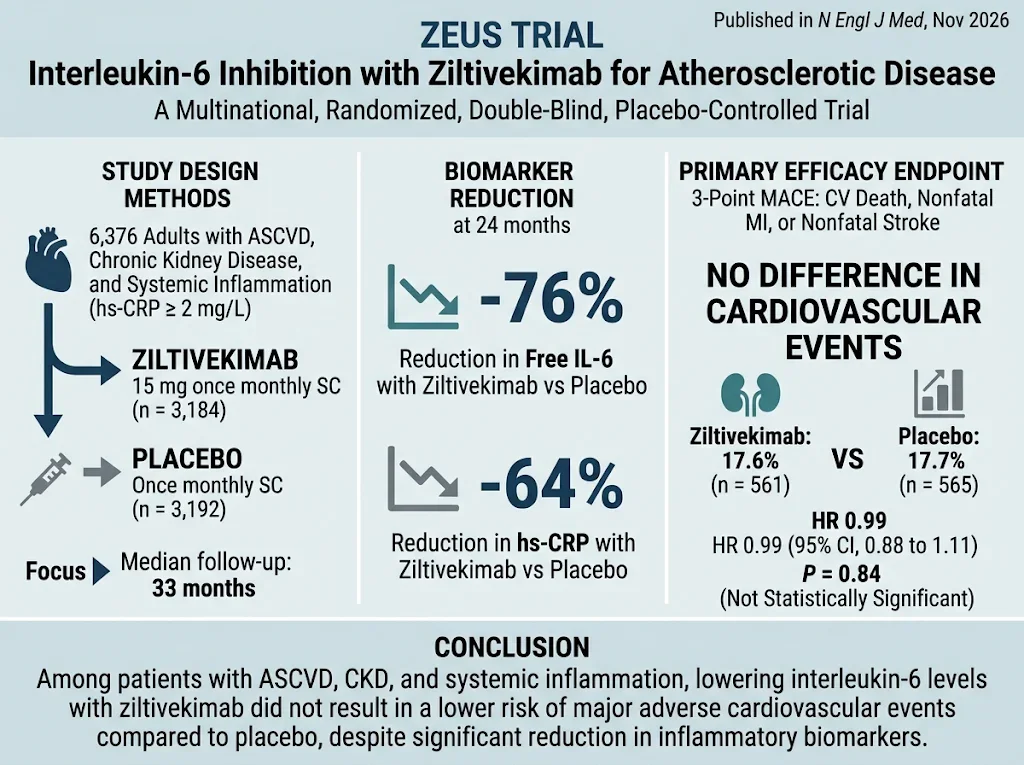
The ZEUS trial (Ridker et al., N Engl J Med 2026; PMID: 43001751) was a multinational, double-blind, randomized, placebo-controlled phase 3 trial enrolling 6376 adults with established ASCVD, CKD, and hsCRP ≥2 mg/L. Patients received subcutaneous ziltivekimab 15 mg monthly or placebo, and were followed for a median of 33 months.
Ziltivekimab achieved substantial reductions in free IL-6 (-76 percentage points) and hsCRP (-64 percentage points) relative to placebo at 24 months. Despite these biomarker improvements, the primary composite endpoint of major adverse cardiovascular events (MACE: cardiovascular death, nonfatal myocardial infarction, or nonfatal stroke) occurred with near-identical incidence in ziltivekimab (17.6%) and placebo (17.7%) groups (hazard ratio 0.99, 95% CI 0.88-1.11, p=0.84). Serious adverse events, including infections, were comparable between groups.
Biological and Translational Insights
IL-6 acts downstream of IL-1 in the inflammatory cascade and influences multiple cell types involved in atherosclerosis, including endothelial cells, macrophages, and myeloid cells. Suppressing IL-6 ligand markedly decreases hsCRP and other acute phase reactants, confirming effective target engagement.
The reduction in NLR correlates with attenuation of myeloid cell-driven inflammation pathways, potentially implicating ziltivekimab’s multi-dimensional immunomodulation as demonstrated in phase 2 analyses.
However, the neutral results in ZEUS highlight a gap between biomarker modulation and clinical event reduction, suggesting that merely lowering IL-6 and inflammation may not suffice, or that the timing, patient selection, or dosing require optimization. Alternative explanations include complex redundancies in inflammatory pathways or opposing effects on homeostasis and infection risk.
Expert Commentary
Targeting inflammatory pathways in ASCVD is a validated concept after CANTOS showed IL-1β inhibition reduces recurrent events. IL-6 inhibition appeared a logical next step due to its central role in inflammatory signaling. Ziltivekimab’s potent suppression of IL-6 and downstream biomarkers underscores its mechanistic validity.
Nonetheless, ZEUS revealed no clinical event benefit, contrasting with the biological promise. This divergence invites reconsideration of the inflammatory hypothesis, necessitating further dissecting which inflammatory mediators and cellular mechanisms truly drive residual risk amenable to intervention.
The safety profile remains acceptable, though slightly increased serious infections warrant vigilance.
Limitations include the studied population—patients with advanced CKD and established ASCVD may have irreversible vascular damage less amenable to anti-inflammatory therapy. Moreover, the 15 mg monthly dosing, though biologically effective, might not optimally balance efficacy and safety. Comparative evaluation versus other inflammatory targets or combination approaches may be needed.
Guidelines currently advocate anti-inflammatory therapies selectively; ziltivekimab has yet to demonstrate clinical event reduction to alter practice. Biomarker reductions and NLR changes suggest potential utility in monitoring and risk stratification but await validation.
Conclusion
Ziltivekimab, a monoclonal antibody targeting IL-6 ligand, effectively lowers systemic inflammatory biomarkers and modulates immunologic indices relevant to atherosclerotic disease and CKD. However, the pivotal ZEUS trial indicates that this biomarker suppression does not translate into reductions in major adverse cardiovascular events.
This outcome underscores the complexity of inflammation in atherosclerosis and the need for refined approaches to identify which patients might benefit from IL-6 inhibition, the appropriate timing, or combination therapies. Further research targeting mechanistic pathways and longer follow-up or different dosing regimens is warranted.
In clinical practice, IL-6 inhibition with ziltivekimab remains investigational, and current standards emphasize established cardiovascular risk mitigation strategies. Future translational efforts should integrate biomarker-guided patient selection and mechanistic biomarkers to optimize inflammatory intervention.
References
Ridker PM et al. Interleukin-6 Inhibition with Ziltivekimab for Atherosclerotic Disease. N Engl J Med. 2026 Nov 7; PMID: 43001751.
Ridker PM et al. IL-6 inhibition with ziltivekimab in patients at high atherosclerotic risk (RESCUE): a double-blind, randomised, placebo-controlled, phase 2 trial. Lancet. 2021 May 29;397(10289):2060-2069. PMID: 34015342.
Patel P et al. Association of Interleukin 6 Inhibition With Ziltivekimab and the Neutrophil-Lymphocyte Ratio: A Secondary Analysis of the RESCUE Clinical Trial. JAMA Cardiol. 2023 Feb 1;8(2):177-181. PMID: 36449307.
Yamaguchi J et al. Efficacy and safety of interleukin-6 inhibition with ziltivekimab in patients at high risk of atherosclerotic events in Japan (RESCUE-2): A randomized, double-blind, placebo-controlled, phase 2 trial. J Cardiol. 2023 Oct;82(4):279-285. PMID: 37211246.