Bicistronic CD19/CD22 CAR T-Cell Therapy: A Breakthrough for Pediatric Relapsed/Refractory B-Cell Acute Lymphoblastic Leukemia
Highlight
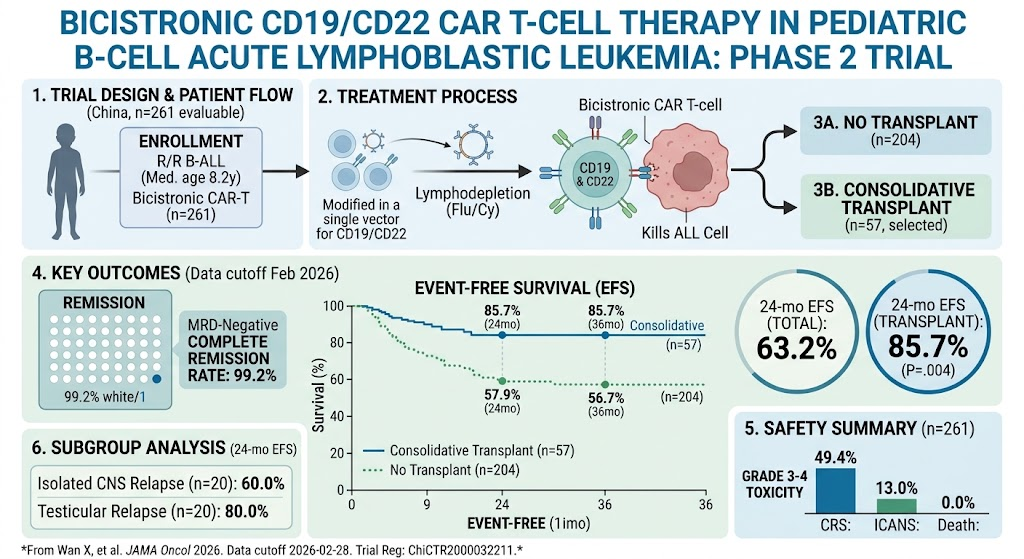
This phase 2 multicenter trial demonstrated that bicistronic CD19/CD22 CAR T-cell therapy achieves remarkable minimal residual disease-negative complete remission in 99.2% of pediatric patients with relapsed or refractory B-ALL. Event-free survival at 3 years exceeded 60%, with improved outcomes observed in patients receiving consolidative hematopoietic stem cell transplantation. The dual-targeting strategy addresses the challenge of antigen loss that limits durability of remission with single-antigen CAR T therapies. Safety was manageable, although nearly half of patients experienced grade 3-4 cytokine release syndrome.
Study Background
B-cell acute lymphoblastic leukemia (B-ALL) is the most common pediatric leukemia, with high cure rates in frontline treatment. However, relapsed or refractory B-ALL remains a significant clinical challenge with poor prognosis. CD19-directed chimeric antigen receptor (CAR) T-cell therapy has transformed treatment paradigms by inducing high remission rates in relapsed/refractory B-ALL. Despite initial success, relapse due to antigen escape, notably loss or downregulation of CD19, limits long-term efficacy.
To overcome this, dual-targeting CAR T-cell approaches engaging both CD19 and CD22, another B-cell antigen, have been increasingly investigated. The rationale is to reduce antigen-negative relapse and improve remission durability by targeting two independent B-cell markers simultaneously. The present trial evaluates a bicistronic CAR construct encoding both anti-CD19 and anti-CD22 CARs in pediatric patients with relapsed/refractory B-ALL.
Study Design
This open-label, multicenter phase 2 nonrandomized clinical trial was conducted at five major medical centers in China from January 2022 to August 2024, with follow-up extending to February 2026. Of 346 patients screened, 308 were eligible and 261 proceeded to infusion.
Eligible patients were pediatric (mean age 8.2 years) with relapsed or refractory B-ALL, including cohorts with refractory disease, hematologic relapse, or isolated extramedullary relapse such as central nervous system or testicular involvement. CD3-positive T cells were isolated and transduced with a bicistronic lentiviral vector encoding anti-CD19 and anti-CD22 CARs, then infused fresh after 5 to 7 days of culture. Prior lymphodepleting chemotherapy included fludarabine and cyclophosphamide.
Patients with KMT2A- or ZNF384-rearranged leukemia were considered for consolidative hematopoietic stem cell transplant following remission to further improve outcomes. Primary endpoints were safety, recommended phase 2 dose, event-free survival (EFS), and toxicity profiles.
Key Findings
Among 261 infused patients, 259 (99.2%) achieved complete remission with negative minimal residual disease (MRD), highlighting a highly efficacious induction of deep remission. Event-free survival was 70.9% at 12 months, 63.2% at 24 months, and 61.7% at 36 months, demonstrating durable disease control.
Patients who received consolidative transplant had significantly better EFS compared with those who did not (85.7% vs 57.9% at 24 months, P = .004). This supports the strategy of consolidative transplantation in select high-risk patients after CAR T-cell therapy.
Among patients with isolated extramedullary relapse, EFS at 24 months was 60.0% for isolated central nervous system relapse and 80.0% for testicular relapse cohorts, indicating efficacy in sanctuary sites often difficult to treat.
Safety events included grade 3 to 4 cytokine release syndrome (CRS) in 49.4% of patients and immune effector cell-associated neurotoxicity syndrome (ICANS) in 13.0%. While these rates underscore considerable toxicity risks, adverse effects were manageable within experienced centers.
Expert Commentary
This study adds compelling evidence supporting dual-antigen targeting in pediatric B-ALL to overcome relapse driven by antigen escape. The bicistronic vector encoding both CD19 and CD22 CARs offers a simplified manufacturing approach compared with separate CAR products and may improve persistence and breadth of leukemia targeting.
The remarkably high MRD-negative remission rate and durable EFS outcomes represent a significant advance over single-target CD19 CAR therapies, which are limited by CD19-negative relapses. The benefit seen with subsequent transplant aligns with current strategies aiming to consolidate remission in high-risk subsets, although optimal patient selection and timing warrant further prospective validation.
Limitations include the nonrandomized design and the lack of a direct comparator arm; however, the large cohort, mature follow-up, and inclusion of extramedullary relapse patients strengthen the generalizability. Future randomized controlled trials should clarify relative performance and long-term safety, including late toxicities.
Conclusion
The bicistronic CD19/CD22 CAR T-cell therapy demonstrates an impressive safety and efficacy profile in pediatric patients with relapsed or refractory B-ALL. This dual-targeting approach addresses antigen loss relapse and achieves unprecedented remission durability, particularly when combined with consolidative transplantation in select patients. These results support further investigation in prospective trials and could reshape therapeutic standards for challenging pediatric B-ALL cases.
Funding and Clinical Trial Registration
This trial was registered with Chinese Clinical Trial Register (ChiCTR2000032211). Details regarding funding sources were not provided in the abstract but would typically involve institutional and governmental support.
References
Wan X, Tang Y, Cai J, et al. Bicistronic CD19/CD22 CAR T-Cell Therapy in Pediatric B-Cell Acute Lymphoblastic Leukemia: A Nonrandomized Clinical Trial. JAMA Oncol. 2026 Sep 3. PMID: 42690647. https://pubmed.ncbi.nlm.nih.gov/42690647/
This article was created using several editorial tools, including AI, as part of the process. Human editors reviewed this content before publication.