Highlight
1. Early initiation of cholesterol-lowering medication (CLM) in childhood significantly lowers long-term LDL-C exposure in familial hypercholesterolaemia (FH) patients.
2. Childhood-treated FH patients attain LDL-C levels close to unaffected individuals, markedly reducing cardiovascular event rates by young adulthood.
3. The SAFEHEART cohort provides robust prospective evidence supporting FH as a pediatric condition requiring timely diagnosis and management.
4. This research underscores the critical role of early intervention in mitigating life-long cardiovascular risk associated with genetically confirmed heterozygous FH.
Study Background
Familial hypercholesterolaemia (FH) is a genetic disorder characterized by elevated low-density lipoprotein cholesterol (LDL-C) levels from birth, leading to premature atherosclerotic cardiovascular disease (ASCVD). Despite its relatively high prevalence (1 in 200-250 individuals globally), FH remains underdiagnosed and undertreated, particularly in pediatric populations.
The chronic elevation of LDL-C in untreated FH patients markedly accelerates atherosclerosis, resulting in increased risks of coronary artery disease and other cardiovascular events at young ages. Consequently, international guidelines advocate early detection and initiation of cholesterol-lowering therapies (primarily statins) to reduce cumulative LDL-C burden and improve long-term cardiovascular outcomes.
However, real-world longitudinal evidence confirming the benefits and safety of childhood-onset lipid-lowering treatment is sparse. The SAFEHEART (Spanish Familial Hypercholesterolaemia Cohort Study) prospective cohort study comprehensively addresses this gap by assessing the long-term impact of contemporary management strategies on LDL-C trajectories and cardiovascular event rates in children, adolescents, and adults with genetically confirmed heterozygous FH.
Study Design
The SAFEHEART study is a prospective observational cohort enrolling individuals from families with genetically proven heterozygous FH in Spain. The study includes three core groups: children and adolescents under 18 years with FH (FH-Ch), their non-affected age-matched relatives serving as controls (non-FH-Ch), and affected FH parents (FH-P).
Baseline and follow-up data include detailed lipid profiles, CLM exposure, and adjudicated cardiovascular events over a median follow-up exceeding 12 years. The primary endpoints relate to changes in LDL-C levels and cumulative LDL-C burden over time, and the incidence of ASCVD events by young adulthood.
CLM initiation age, adherence, and intensity, as well as the comparative LDL-C trajectories among groups, were analyzed. The study leverages genetic confirmation to ensure diagnostic accuracy, establishing a robust framework to compare natural disease progression to treated cohorts.
Key Findings
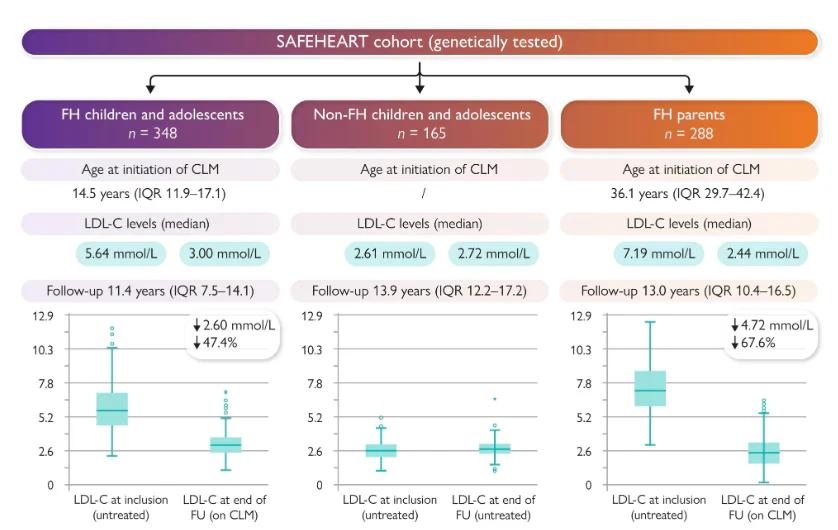
SAFEHEART enrolled 348 children/adolescents with FH, 165 unrelated non-affected children/adolescents, and 288 affected parents, with near-equal gender distribution. Median untreated LDL-C levels at baseline were substantially elevated in FH groups (5.46 mmol/L in FH-Ch, 7.19 mmol/L in FH-P), compared to non-FH controls (2.63 mmol/L).
Notably, 84.5% of FH children/adolescents were on cholesterol-lowering medication by the last follow-up, compared with 95.1% of FH parents and only 4.2% of non-FH children. The median therapy initiation age was substantially younger for FH children (14.5 years) versus their affected parents (36.1 years).
Longitudinal LDL-C reductions were substantial: median on-treatment LDL-C among FH children was 3.00 mmol/L, a 47.4% decrease, whereas FH parents experienced a 67.6% mean reduction to 2.44 mmol/L. Despite lower absolute LDL-C in adults, the earlier therapy start in children meant a much smaller cumulative lifetime LDL-C burden: approximately 5,909 mg/dL×years by age 30-40 years for FH children vs. 10,206.8 mg/dL×years in FH parents treated from adulthood.
Cardiovascular event rates by age 39 showed a stark difference: 0% in non-FH children, 0.3% in children with FH treated from adolescence, and 5.2% in their affected parents treated later in adulthood. This evidences the profound risk mitigation achieved by early intervention.
The LDL-C levels achieved in treated children approached those seen in non-FH relatives, highlighting the efficacy of early treatment strategies in normalizing cholesterol profiles.
Expert Commentary
The SAFEHEART study robustly confirms the pediatric nature of FH and underscores the necessity of prompt diagnosis and initiation of treatment during childhood or adolescence to prevent premature cardiovascular morbidity. By substantially reducing LDL-C exposure early, the progression of atherosclerotic disease can be delayed or prevented.
These findings align with current guideline recommendations by societies such as the European Atherosclerosis Society and American Heart Association urging cascade screening and early statin therapy in pediatric patients carrying FH mutations.
Limitations of the study include its observational design and potential confounding by treatment adherence and lifestyle factors. However, the large cohort size, genetic confirmation, and long-term follow-up support the reliability of findings.
Future directions include evaluating newer lipid-lowering agents such as PCSK9 inhibitors in pediatric FH and refining risk stratification to tailor treatment intensity further.
Conclusion
The SAFEHEART study provides compelling evidence that initiating cholesterol-lowering therapy from childhood in familial hypercholesterolaemia markedly reduces cumulative LDL-C burden and associated cardiovascular risk by young adulthood. These data firmly establish FH as a treatable pediatric condition where early detection and management are critical to improve lifelong cardiovascular outcomes.
For clinicians, these results emphasize the importance of familial screening, genetic confirmation, and proactive intervention well before adulthood to mitigate the profound risks of untreated FH. Ongoing surveillance and advances in lipid-lowering therapies will continue to enhance the prognosis for these patients.
Funding and Registration
The SAFEHEART study was registered under ClinicalTrials.gov identifier NCT02693548. Funding details were not specified in the abstract but would generally be disclosed in full publication disclosures.
References
Vallejo-Vaz AJ, Arroyo-Olivares R, Alonso R, et al. Cholesterol-lowering therapy from childhood/adolescence and long-term outcomes in familial hypercholesterolaemia: the SAFEHEART study. European Heart Journal. 2026;47(40):6021-6035. PMID: 42290618. https://pubmed.ncbi.nlm.nih.gov/42290618/