Highlights
Trevogrumab, an anti-GDF8 antibody, significantly attenuates lean muscle loss associated with semaglutide-induced weight reduction in adults with obesity.
Addition of garetosmab (anti-activin A) to trevogrumab further improves preservation of lean mass and fat mass loss but is limited by increased serious adverse events and muscle spasms.
The trial affirms the role of ActRIIA/B ligands as pivotal regulators of muscle mass loss during rapid weight loss induced by GLP-1 receptor agonists.
Findings underscore a therapeutic window for GDF8-targeted interventions to improve body composition during pharmacologic obesity treatment, with important safety considerations for multi-target approaches.
Background
Obesity represents a global health burden with significant morbidity and mortality, often managed by lifestyle modification and pharmacotherapy. Glucagon-like peptide-1 (GLP-1) receptor agonists, such as semaglutide, induce robust weight loss but are commonly accompanied by undesirable lean muscle mass reduction, which may impair physical function and metabolic health.
Myostatin (growth differentiation factor 8, GDF8) and activin A (ActA), members of the transforming growth factor-beta superfamily, negatively regulate skeletal muscle growth by signaling through activin type II receptors (ActRIIA/B). Thus, inhibiting these ligands offers a mechanistic strategy to counter muscle loss during weight reduction.
Previous preclinical models and early-phase studies have implicated GDF8 inhibition as a promising approach to preserve or increase muscle mass. However, the translational efficacy and safety during pharmacologic weight loss therapies required clinical validation. The COURAGE trial fills this evidence gap by investigating trevogrumab (anti-GDF8) with or without garetosmab (anti-ActA) co-administered with semaglutide in people with obesity.
Key Content
Study Design and Patient Population
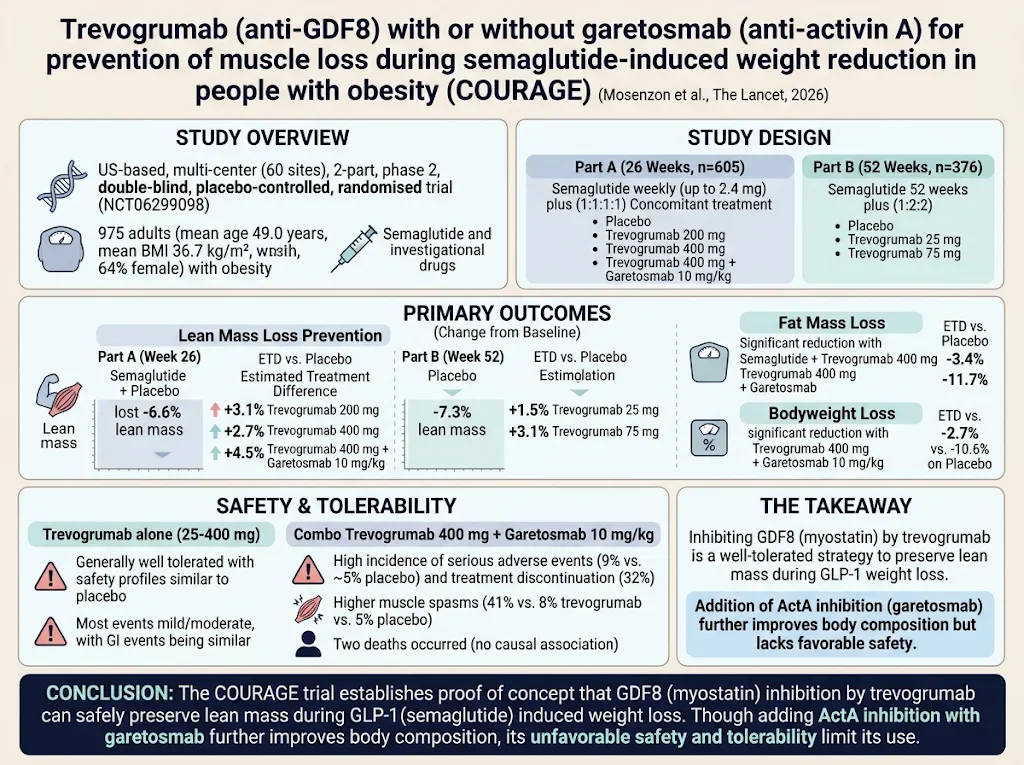
COURAGE was a randomized, double-blind, placebo-controlled, two-part phase 2 trial conducted at 60 US sites, enrolling 975 adults aged 18–80 years with obesity (BMI ≥30 kg/m2). The study featured two treatment durations: 26 weeks (part A) and 52 weeks (part B).
In part A (n=605), participants received semaglutide 2.4 mg weekly plus either placebo, trevogrumab (200 mg or 400 mg weekly), or combined trevogrumab 400 mg plus garetosmab 10 mg/kg every 4 weeks. Participants then entered a semaglutide withdrawal phase with continued randomized treatment with trevogrumab 400 mg or placebo. In part B (n=376), participants received semaglutide plus placebo or lower-dose trevogrumab (25 mg or 75 mg weekly) for 52 weeks. Randomization stratified by sex, BMI category, and MRI substudy participation ensured balanced groups.
Primary endpoints were percent changes in lean mass, fat mass, and bodyweight from baseline at week 26 (part A) or 52 (part B), assessed via dual-energy X-ray absorptiometry (DXA) and MRI for muscle volume.
Efficacy Outcomes
Semaglutide plus placebo induced significant lean mass loss at week 26 (-6.6%) and week 52 (-7.3%). Trevogrumab co-administration yielded statistically and clinically meaningful attenuation of lean mass loss:
Part A: ETDs versus placebo were +3.1% for trevogrumab 200 mg, +2.7% for 400 mg, and +4.5% for 400 mg plus garetosmab (all 95% CIs excluding zero, indicating significance).
Part B: ETDs were +1.5% for trevogrumab 25 mg (not significant) and +3.1% for 75 mg.
Regarding fat mass, semaglutide plus placebo reduced fat by -15.6%. Trevogrumab 400 mg alone achieved modest additional fat mass loss (-3.4%), whereas the combination with garetosmab produced a substantial further reduction (-11.7%).
Bodyweight changes paralleled fat mass findings, with the combination therapy resulting in an additional 2.7% weight loss beyond semaglutide alone.
Safety and Tolerability
Trevogrumab alone (25 mg to 400 mg) was well tolerated, displaying a safety profile comparable to semaglutide plus placebo, with predominantly mild to moderate gastrointestinal adverse events.
Conversely, the combined trevogrumab 400 mg plus garetosmab 10 mg/kg group exhibited increased serious adverse events (9%) and high treatment discontinuations (32%). Muscle spasms were particularly elevated (41% vs 5–8% in other groups). Two deaths occurred in this group without clear causal links.
These findings indicate a safety and tolerability trade-off when combining GDF8 and ActA inhibition.
Mechanistic Insights and Translational Implications
GDF8 (myostatin) restrains muscle growth, and its inhibition triggers muscle hypertrophy and regeneration. Activin A shares overlapping pathways affecting muscle mass via ActRII receptors. Selective GDF8 blockade effectively preserved muscle mass loss induced by semaglutide-driven weight reduction.
However, the broader ligand neutralization with garetosmab, though beneficial for body composition, induced muscle spasms and adverse events possibly due to off-target effects on other TGF-beta superfamily pathways critical in muscle and vascular homeostasis.
These data advise cautious optimization of ligand-specific interventions to balance efficacy with safety, emphasizing the need for precise targeting in muscle preservation during pharmacological obesity therapy.
Expert Commentary
The COURAGE trial establishes a pivotal proof of concept for preserving skeletal muscle during therapeutic weight loss by targeting GDF8. This has clinical relevance because muscle mass loss during rapid weight reduction can lead to functional decline, frailty, and metabolic deterioration.
The dose-dependent efficacy of trevogrumab supports its development as an adjunct to GLP-1 receptor agonists. Moreover, MRI substudy findings, though preliminary, suggest that muscle volume benefits may translate into improved muscle function, warranting dedicated functional outcome trials.
The combination with garetosmab reflects a nuanced biological interplay where additional suppression of activin A enhances fat loss and lean mass conservation but at a cost of safety and tolerability. Given the adverse event profile, combinational inhibition is not currently favorable for clinical use.
These results underline a therapeutic paradigm wherein fine-tuning the intensity and specificity of muscle mass regulators can optimize patient outcomes in obesity management.
Limitations include the US-only population, relatively short follow-up for chronic obesity treatment, and lack of functional endpoints like strength or physical performance.
Integration with existing guidelines for obesity treatment suggests that future clinical strategies should incorporate muscle-preserving agents, especially for populations at risk of sarcopenia or frailty during weight loss.
Conclusion
The COURAGE trial advances obesity pharmacotherapy by demonstrating that targeted inhibition of GDF8 with trevogrumab mitigates lean muscle loss during semaglutide-induced rapid weight reduction. The addition of activin A blockade offers enhanced body composition benefits but at the expense of increased adverse events, limiting clinical utility.
These findings emphasize the importance of preserving muscle mass to improve physical function and metabolic health during weight loss and encourage further studies to evaluate long-term outcomes, optimal dosing, and broader patient populations.
Future directions include exploring biomarkers predicting response, refining combinational approaches to balance efficacy and safety, and incorporating functional endpoints to establish comprehensive benefits.
References
Mosenzon O, Rosenstock J, Raya JG, et al. Trevogrumab (anti-GDF8) with or without garetosmab (anti-activin A) for prevention of muscle loss during semaglutide-induced weight reduction in people with obesity (COURAGE): a two-part, phase 2, double-blind, placebo-controlled, randomised trial. Lancet. 2026 Nov 11; PMID: 43014326.
Myostatin and activinA signaling in muscle mass regulation: implications for pharmacological inhibition. Front Physiol. 2023;14:1112374.
Semaglutide for the treatment of obesity: latest evidence and clinical implications. Nat Rev Endocrinol. 2024;20(3):168-182.