Highlights
Retatrutide, a triple receptor agonist targeting GIP, GLP-1, and glucagon receptors, provides significant analgesic benefits in adults with knee osteoarthritis and obesity.
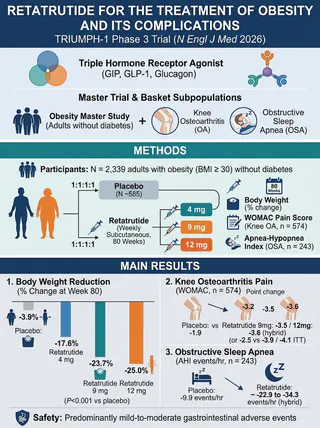
Phase 3 TRIUMPH-4 and TRIUMPH-1-OA trials demonstrate robust reductions in WOMAC pain scores and body weight up to 80 weeks with once-weekly subcutaneous retatrutide.
Weight loss achieved surpasses 20% on average, which likely contributes synergistically to pain relief and functional improvement.
Gastrointestinal adverse events were common, and serious adverse events were more frequent with retatrutide than placebo, emphasizing the need for careful safety monitoring.
Background
Knee osteoarthritis (OA) is a leading cause of pain and disability worldwide, with obesity being a major modifiable risk factor that exacerbates joint degeneration and symptom severity. Weight loss is known to improve pain and functional outcomes in OA by reducing mechanical load and inflammatory mediators. However, safe and effective pharmacologic strategies to achieve sustained weight loss and pain control remain limited. Retatrutide is an investigational once-weekly subcutaneous peptide agonist simultaneously targeting the glucose-dependent insulinotropic polypeptide (GIP), glucagon-like peptide-1 (GLP-1), and glucagon receptors. These incretin and glucagon pathways regulate metabolism, appetite, and energy expenditure. Preclinical and early clinical studies suggested that retatrutide could induce substantial weight loss and improve metabolic outcomes, potentially translating into OA symptom relief.
Key Content
Overview of Clinical Trials
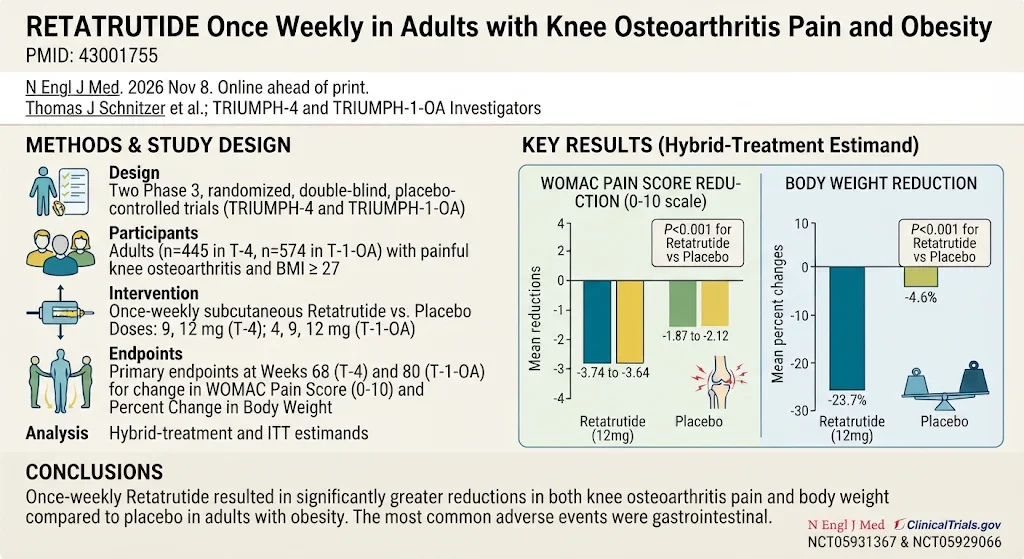
Two pivotal phase 3 randomized double-blind, placebo-controlled trials—TRIUMPH-4 and TRIUMPH-1-OA—evaluated retatrutide in adults with painful knee OA and obesity without diabetes. Inclusion criteria included BMI ≥27 kg/m2 and established knee OA. TRIUMPH-4 tested retatrutide at 9 and 12 mg doses versus placebo over 68 weeks. TRIUMPH-1-OA investigated 4, 9, and 12 mg doses versus placebo over 80 weeks.
Efficacy Outcomes: Pain Reduction
Pain was assessed with the Western Ontario and McMaster Universities Osteoarthritis Index (WOMAC) pain subscale (0–10 scale, higher scores indicating worse pain). In TRIUMPH-4, retatrutide led to mean decreases in WOMAC pain scores of -3.96 (9 mg) and -3.74 (12 mg) compared with -2.12 for placebo using a hybrid-treatment estimand. Differences (vs. placebo) of -1.83 and -1.61 respectively were statistically significant (P<0.001). Similarly, TRIUMPH-1-OA showed dose-dependent pain reductions at week 80 of -3.22 (4 mg), -3.48 (9 mg), and -3.64 (12 mg) versus -1.87 placebo, with differences reaching -1.35 to -1.77 (P≤0.005). Intention-to-treat analyses corroborated these findings, albeit with somewhat smaller effect sizes.
Weight Loss Effects
Retatrutide produced profound mean percentage weight reductions in TRIUMPH-4: -20.0% (9 mg) and -23.7% (12 mg), far exceeding the -4.6% observed in placebo (P<0.001). This magnitude of weight loss is notably greater than those seen with existing GLP-1 receptor agonists alone, underscoring the synergistic metabolic effects of triple receptor targeting. Weight loss was sustained across the trial duration, suggesting durable treatment benefits.
Safety and Adverse Events
The safety profile included a higher rate of serious adverse events in the retatrutide groups versus placebo, though the specific events were not detailed in the summary. Gastrointestinal adverse effects, including nausea, vomiting, and diarrhea, were the most commonly reported, consistent with GLP-1 receptor agonist pharmacodynamics. These side effects necessitate careful dose titration and patient counseling. Long-term safety data remain pending but are critical for clinical application.
Mechanistic Insights and Translational Implications
Retatrutide’s multi-receptor agonism exerts effects on appetite suppression, energy expenditure enhancement, and glucose metabolism optimization. The combined activation of GIP and GLP-1 receptors potentiates weight loss and metabolic improvements beyond monotherapy. Additionally, glucagon receptor activation may increase lipid oxidation and thermogenesis. Given osteoarthritis’s links with metabolic inflammation and biomechanical stress, retatrutide’s weight loss coupled with metabolic modulation likely mediates pain alleviation through both mechanical unloading and systemic anti-inflammatory effects.
Expert Commentary
These landmark phase 3 trials offer compelling evidence of retatrutide’s dual efficacy in reducing knee OA pain and inducing substantial weight loss in obese adults—a patient population with high unmet therapeutic need. The magnitude of pain relief translates to clinical relevance, with improvements exceeding those typically achieved by existing pharmacotherapies. The potent weight loss efficacy suggests that targeting multiple incretin and glucagon pathways may overcome limitations of prior agents that address only single receptors.
However, the increased incidence of serious adverse events and the predominance of gastrointestinal side effects necessitate vigilance and further elucidation of long-term safety. Careful patient selection and monitoring will be critical if retatrutide is adopted clinically. Moreover, the exclusion of patients with diabetes in these trials limits applicability to this common comorbidity group.
Future comparative effectiveness studies against established OA treatments, such as NSAIDs, corticosteroid injections, and weight loss interventions, are warranted. Likewise, mechanistic studies exploring inflammation markers, cartilage degradation biomarkers, and imaging could clarify biologic pathways modulated by retatrutide. Real-world evidence will be crucial to confirm tolerability and adherence profiles.
Conclusion
Retatrutide represents a promising therapeutic advance for adults with knee osteoarthritis and obesity, achieving significant pain reductions and profound weight loss sustained over one year. This dual impact addresses key pathogenic mechanisms of OA and may improve physical function and quality of life. Despite safety concerns that require management, retatrutide’s novel triple agonist mechanism offers a compelling pharmacologic strategy in an area of high unmet need. Ongoing research should focus on defining long-term outcomes, safety, and broader patient selection for optimal clinical integration.
References
Schnitzer TJ, Hunter DJ, Conaghan PG, Sharma AM, Pedersen SD, Chen K, Park SY, Makarova N, Giblin K, Forrester T, TRIUMPH-4 and TRIUMPH-1-OA Investigators. Retatrutide Once Weekly in Adults with Knee Osteoarthritis Pain and Obesity. N Engl J Med. 2026 Nov 8;[Epub ahead of print]. PMID: 43001755. https://pubmed.ncbi.nlm.nih.gov/43001755/