Today, more than 1 billion people worldwide are affected by obesity. Despite its prevalence, the lack of a clear clinical definition of its disease state has hindered the recognition of obesity as a standalone disease—leading to gaps in diagnosis and treatment, inconsistent prevention efforts, misallocation of resources, and persistent stigma.
Traditionally, obesity has been assessed using Body Mass Index (BMI), calculated as , with the World Health Organization (WHO) defining a as overweight and as obese. However, as a surrogate measure of body size, BMI fails to account for differences in body composition or fat distribution, both of which directly influence health risks.
To address these limitations, the Lancet Diabetes & Endocrinology Commission proposed a new diagnostic framework for obesity in 2025, dividing the condition into two categories: clinical obesity (excess adiposity that has already impaired organ function or daily activities) and preclinical obesity (increased adiposity and elevated health risks, while organ and systemic functions remain intact). Where feasible, the framework also recommends supplementing BMI with additional anthropometric measures—such as waist circumference (WC), waist-to-height ratio (WHtR), or dual-energy X-ray absorptiometry (DEXA) fat quantification—to improve the detection of excess adiposity. Although conceptually aligned with medical diagnostic principles, the clinical utility of this new framework remained uncertain.
On November 11, 2026, an international team of researchers published a study in Nature titled: "Validation of clinical and preclinical obesity across global cohorts."
The study demonstrates that compared with traditional BMI-based definitions, the new framework proposed by the Lancet Commission identifies and defines obesity more accurately. It pinpoints high-risk clinical obesity with greater precision while reducing the overtreatment of low-risk preclinical obesity—thereby transforming clinical management and potentially improving patient outcomes.
Previously, it was unclear to what extent incorporating the additional anthropometric measurements recommended by the Lancet Commission would alter obesity classification compared with using BMI alone, or whether the distinction between clinical and preclinical obesity reflects meaningfully different health states. The natural progression of preclinical obesity—including how often it remains stable versus progressing to clinical obesity over time—was also unknown. More broadly, whether these classifications consistently correlate with clinical prognosis across diverse populations and healthcare settings remained to be validated.
In this latest study, the research team analyzed data from 844,108 adults across four major international cohorts (including the UK Biobank, All of Us, and SIDIAP). They evaluated the Lancet Commission’s diagnostic framework across several dimensions, including obesity classification, the distribution and longitudinal progression of clinical and preclinical obesity, and their associations with mortality.
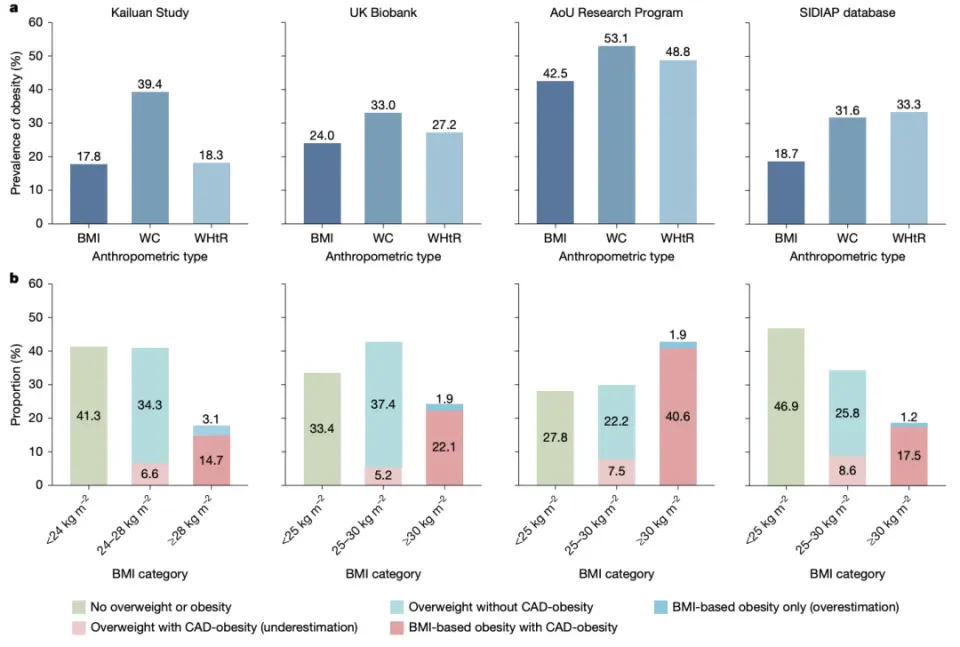
The results revealed that the new framework classifies obesity far more effectively than traditional BMI-based definitions. Specifically, compared with the new framework—which combines waist circumference (WC) and waist-to-height ratio (WHtR) with BMI—relying on BMI alone overestimated obesity in 1.2%–3.1% of participants and underestimated it in 5.2%–8.6%. Overall, the new definition increased the total prevalence of obesity by 3.3%–7.4% compared with BMI alone.
Furthermore, under the new framework, clinical obesity accounted for 22.7%–31.3% of all obesity cases, representing a prevalence of 5.6%–10.9% in the general population. Among individuals with preclinical obesity at baseline, only 8.7%–22.6% progressed to clinical obesity within 10 years.
The study also highlighted the critical importance of distinguishing between clinical and preclinical obesity, as the two categories exhibit distinct health profiles and patient outcomes. Increased mortality risk was associated with obesity defined under the new framework, whereas no such association was observed when obesity was defined by BMI alone. Moreover, clinical obesity was linked to a significantly higher risk of all-cause mortality (), while preclinical obesity carried only a modest risk ().
Overall, the study shows that relying solely on BMI misclassifies obesity in a substantial portion of the population—both overestimating and underestimating the clinical significance of excess adiposity—and fails to effectively stratify higher mortality risks. Integrating additional anthropometric metrics (such as waist-to-height ratio and waist circumference) alongside clinical criteria reflecting organ function improves obesity detection and aligns diagnosis more closely with true disease status. Clinical and preclinical obesity represent distinct, common subgroups with markedly different mortality risks. These findings validate the clinical utility and prognostic value of differentiating between clinical and preclinical obesity, supporting the global adoption of the Lancet Commission’s new diagnostic framework to improve obesity care and public health policy.
Paper Link: