We use cookies

Our website uses essential cookies and, with your consent, additional cookies to measure performance and improve our services. Cookie Policy.

You can change your choice at any time.

MMedXYNews
HomeVideos
MedXY AI/MedXY News/Section: Clinical Updates

Steatotic Liver Disease Risk Scores for Predicting Cirrhosis and Hepatocellular Carcinoma: A Comprehensive Clinical Review
MedXY Editorial Team•Sep 24, 2026•Clinical Updates
Non-invasive testscirrhosissteatotic liver diseaseRisk scoreshepatocellular carcinoma

Highlights

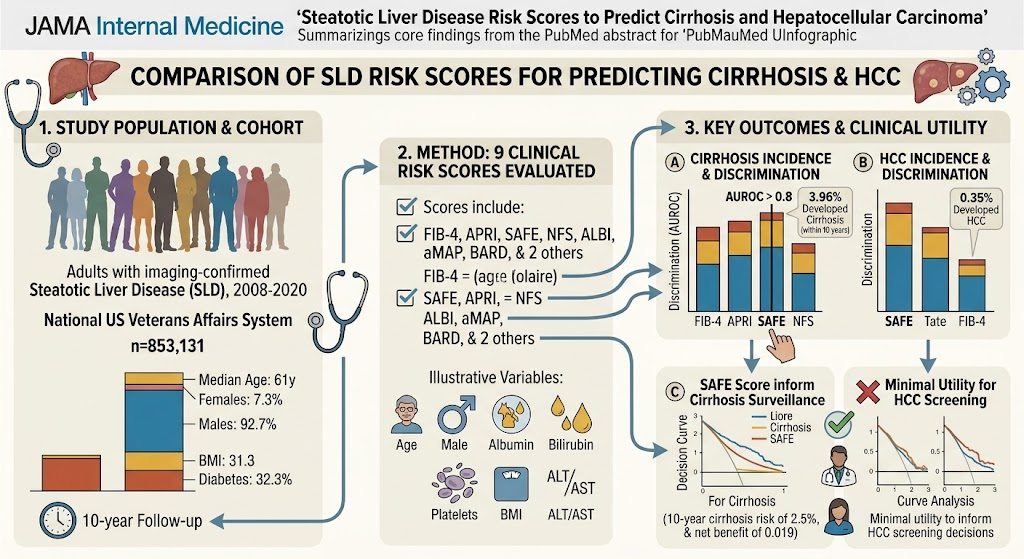
  • The SAFE score shows the greatest net clinical benefit in predicting 10-year cirrhosis risk among patients with noncirrhotic steatotic liver disease (SLD).
  • FIB-4 and APRI scores also demonstrate strong discrimination for cirrhosis, but SAFE outperforms others in net benefit analyses.
  • Risk scores for hepatocellular carcinoma (HCC) show limited clinical utility for surveillance decisions in noncirrhotic SLD.
  • Non-invasive fibrosis scoring and machine-learning models are emerging tools supplementing traditional risk scores, aiding early disease stratification.

Background

MedXY registered readers

Sign in free to continue reading

Create or use your MedXY account to unlock the complete article.

This article was created using several editorial tools, including AI, as part of the process. Human editors reviewed this content before publication.

Related articles

Open language-specific specialty feeds and department pages.

Distinct Gut Microbiome Signatures Predict Short-term Hospitalisation Risk in Cirrhosis: Insights from a Global Metagenomic StudyThis multinational study reveals that specific gut microbiome profiles significantly correlate with 90-day hospitalisation risk in cirrhosis, enhancing prognostic accuracy beyond clinical features alone.Sep 27, 2026Epidemiology and Outcomes of CRRT in Critically Ill Cirrhosis Patients: Insights from the HRS-HARMONY and CRRTnet RegistriesThis study analyzes the epidemiology, treatment processes, and outcomes of critically ill cirrhosis patients undergoing continuous renal replacement therapy, highlighting high mortality rates, anticoagulation practices, and implications ofSep 24, 2026Reevaluating Immune Tolerant Phase in Chronic Hepatitis B: High Transition Rates to Immune Active Disease and Clinical Implications from the RADICAL ConsortiumThe RADICAL consortium’s large-scale study reveals a high long-term transition rate from immune tolerant to immune active chronic hepatitis B, especially in patients with high-normal ALT, suggesting the need for closer monitoring andSep 23, 2026
Loading comments...
MedXY briefing

Get the free newsletter

Evidence-led clinical news, trends, and analysis—delivered to your inbox.

Ask MedXY AI

Most popular

Intimate Health
Five Benefits for Women Continuing Sexual Activity After Menopause
Intimate Health
Why Some Women Have a Strong Sex Drive—And Why Men Shouldn't Worry About It
Nursing & care
How often should a couple have sex?
General Surgery
Optimizing Postoperative Opioid Prescriptions After Intra-Abdominal Cancer Surgery: Comparing the 5x-Multiplier and 3-Tier Models
Intimate Health
Classic Intimacy Recommendations: How to Help Women Reach Orgasm and Enjoy Mutual Pleasure
© 2026 MedXY
Contact usAbout usPrivacy PolicyMedXY story
Sequential Lactulose and TeleTai-Chi to Prevent Falls in Cirrhosis: Insights from the LiveSMART TrialThe LiveSMART trial demonstrates that lactulose, with or without sequential TeleTai-Chi, significantly reduces fall risk and related harms in cirrhotic patients without prior overt hepatic encephalopathy.Sep 21, 2026
Dissecting Gut-Vascular Barrier Failures: Macrophage Dysfunction Drives Bacterial Translocation in CirrhosisThis study elucidates how intestinal blood vessel-associated macrophage dysfunction contributes to gut-vascular barrier breakdown and bacterial translocation in cirrhosis, revealing novel mechanisms that underlie systemic infection risks inSep 21, 2026
Unraveling the S1P-TREM2 Axis: A Novel Ferroptosis-Resistance Mechanism Driving Immunosuppressive Neutrophils and Tumour Progression in Hepatocellular CarcinomaThis study reveals how the S1P-TREM2-NRF2 signaling pathway protects tumor-associated neutrophils from ferroptosis, sustaining immunosuppression and promoting hepatocellular carcinoma progression, offering new therapeutic avenues.Sep 12, 2026