We use cookies

Our website uses essential cookies and, with your consent, additional cookies to measure performance and improve our services. Cookie Policy.

You can change your choice at any time.

MMedXYNews
HomeVideos
MedXY AI/MedXY News/Section: Hematology-Oncology

Targeting NSD2 Degradation: A Novel Therapeutic Avenue for High-Risk t(4;14) Multiple Myeloma
MedXY Editorial Team•Sep 30, 2026•Hematology-Oncology
Epigeneticsmultiple myelomatargeted therapy

Highlight

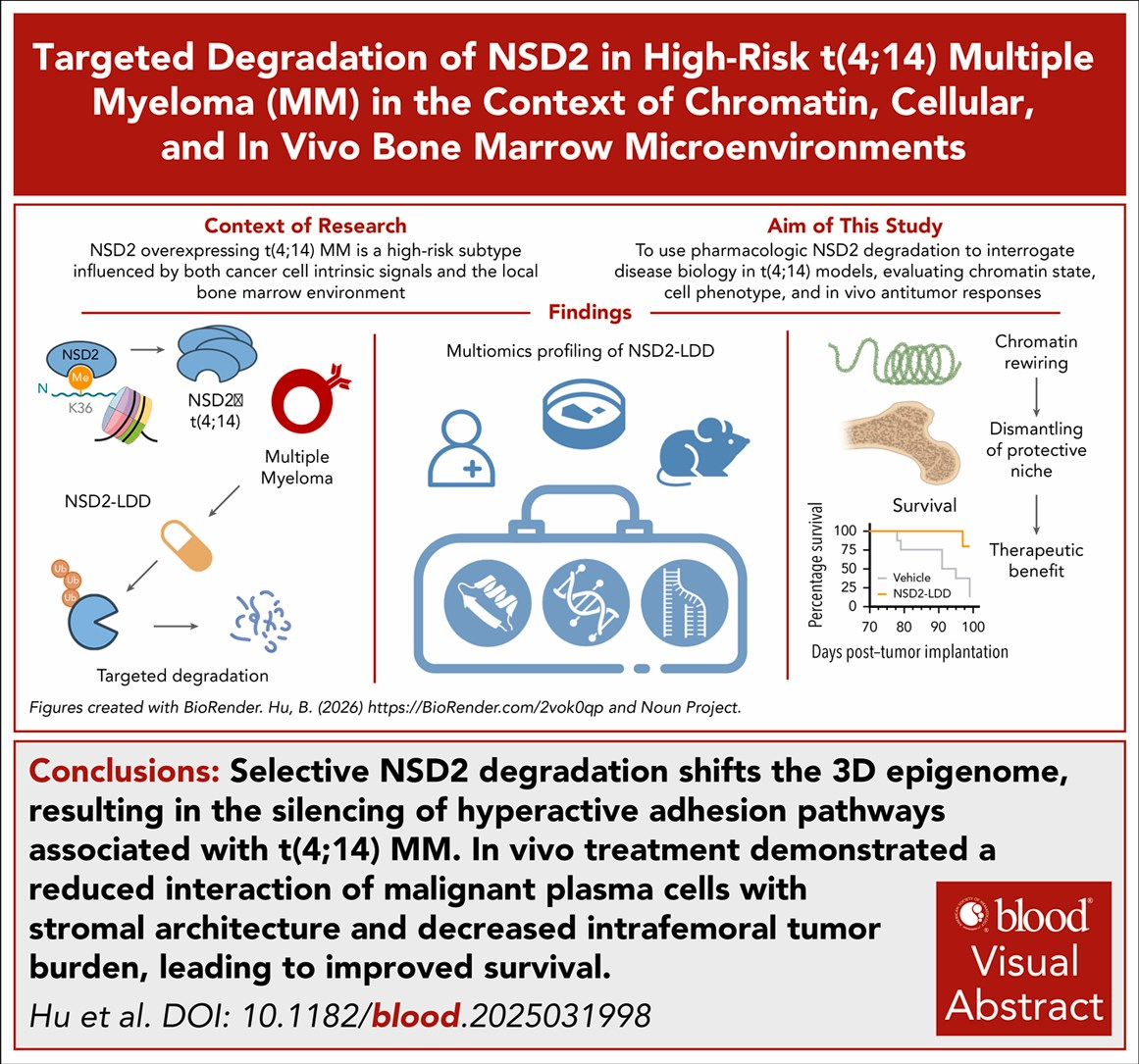
Multiple myeloma (MM) patients harboring the t(4;14) chromosomal translocation overexpress the histone methyltransferase NSD2, which drives a high-risk, aggressive disease phenotype. The discovery of a selective NSD2-ligand-directed degrader (NSD2-LDD) enables potent elimination of oncogenic NSD2 isoforms, reversing aberrant epigenomic programs. NSD2-LDD treatment disrupts MM-associated phenotypes including niche interactions and tumor growth, extending survival in preclinical t(4;14) models and representing a promising targeted therapeutic approach for this poor-prognosis subgroup.

Study Background

MedXY registered readers

Sign in free to continue reading

Create or use your MedXY account to unlock the complete article.

This article was created using several editorial tools, including AI, as part of the process. Human editors reviewed this content before publication.

Related articles

Open language-specific specialty feeds and department pages.

Targeting ROR1 in Chronic Lymphocytic Leukemia: Insights from the Zilovertamab and Ibrutinib Combination in High-Risk del(17p) DiseaseA phase 1b/2 study evaluating zilovertamab combined with ibrutinib in relapsed/refractory CLL reveals safety, mechanistic inhibition of ROR1 signaling pathways, and a potential efficacy signal in del(17p) patients warranting further studiesOct 6, 2026Exceptional and Durable Response to Selpercatinib in a Patient with Apparently RET-Negative, HRAS-, and NF1-Mutated Metastatic Medullary Thyroid CarcinomaA 50-year-old woman with metastatic medullary thyroid carcinoma (MTC) lacking RET alterations exhibited a remarkable sustained response to selpercatinib, suggesting potential efficacy beyond RET-mutated cases.Oct 5, 2026Unraveling Abdominal Aortic Aneurysm: Epigenetic Links to Inflammation and Lipid MetabolismAn epigenome-wide study reveals that DNA methylation markers linked to inflammatory pathways and blood lipid traits play a causal role in abdominal aortic aneurysm development, offering potential for improved risk prediction and therapeuticOct 3, 2026
Loading comments...
MedXY briefing

Get the free newsletter

Evidence-led clinical news, trends, and analysis—delivered to your inbox.

Ask MedXY AI

Most popular

Intimate Health
Five Benefits for Women Continuing Sexual Activity After Menopause
Intimate Health
Why Some Women Have a Strong Sex Drive—And Why Men Shouldn't Worry About It
Nursing & care
How often should a couple have sex?
Cardiology
Precision Medicine for Long QT Syndrome Type 2: Lumacaftor Corrects Trafficking Defects and Shortens QT Interval
General Surgery
Optimizing Postoperative Opioid Prescriptions After Intra-Abdominal Cancer Surgery: Comparing the 5x-Multiplier and 3-Tier Models
© 2026 MedXY
Contact usAbout usPrivacy PolicyMedXY story
Efficacy and Safety of BCMA-Targeted CAR T Therapy as Salvage Treatment in Multiple Myeloma Post-GPRC5D CAR T-Cell Failure
BCMA-targeted CAR T-cell therapy demonstrates substantial efficacy and an acceptable safety profile as a salvage option for relapsed/refractory multiple myeloma patients after failure of prior anti-GPRC5D CAR T-cell treatments.
Sep 30, 2026
Targeting TYK2: A Novel Therapeutic Vulnerability in CALR-Mutant Myeloproliferative NeoplasmsThis article highlights the discovery that TYK2 kinase is a selective therapeutic target in CALR-mutant myeloproliferative neoplasms, with combined TYK2 and JAK2 inhibition offering enhanced efficacy over JAK2 inhibition alone.Sep 29, 2026
Soluble BCMA as a Key Biomarker Defining Tumor Phenotypes and Prognosis in Newly Diagnosed Multiple MyelomaSoluble BCMA levels in newly diagnosed multiple myeloma patients reveal distinct tumor phenotypes and predict prognosis more strongly than tumor volume, enabling improved risk stratification and clinical decision-making.Sep 27, 2026