We use cookies

Our website uses essential cookies and, with your consent, additional cookies to measure performance and improve our services. Cookie Policy.

You can change your choice at any time.

MMedXYNews
HomeVideos
MedXY AI/MedXY News/Section: Hematology-Oncology

Targeting TYK2: A Novel Therapeutic Vulnerability in CALR-Mutant Myeloproliferative Neoplasms
MedXY Editorial Team•Sep 29, 2026•Hematology-Oncology
targeted therapyJAK/STAT pathwayCALR MutationTYK2 SignalingMyeloproliferative Neoplasms

Highlight

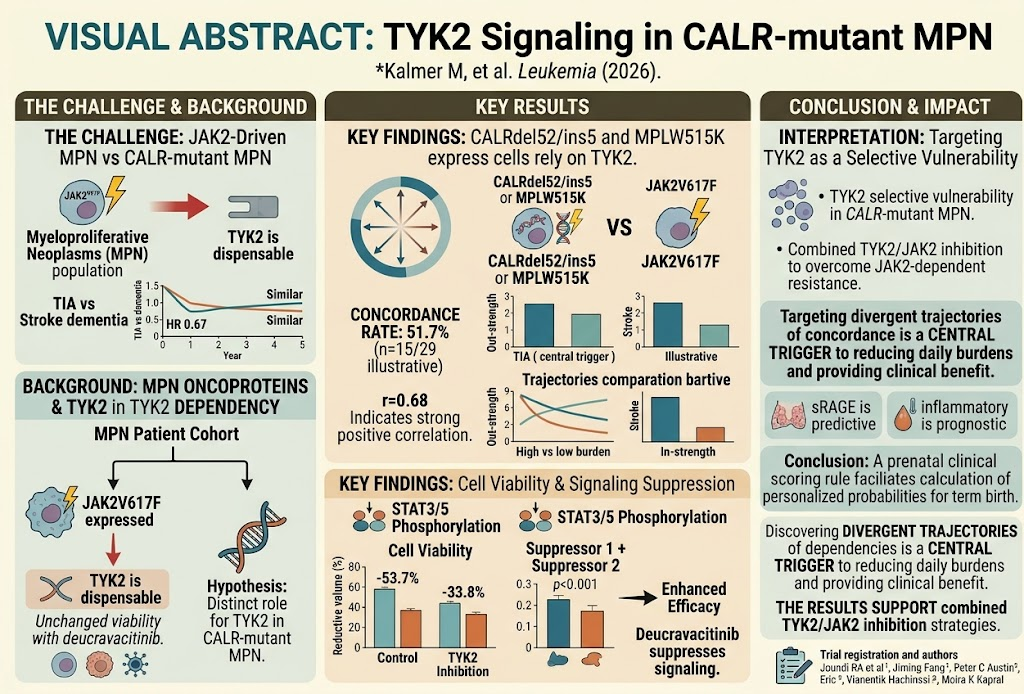
  • CALR-mutant myeloproliferative neoplasms (MPNs) exhibit constitutive activation of TYK2 signaling, distinct from JAK2V617F-driven MPNs where TYK2 is dispensable.
  • Selective TYK2 inhibition with deucravacitinib reduces cell viability and STAT3/5 phosphorylation in CALR-mutant and MPL-mutant cells but not in JAK2V617F-mutant cells.
  • Combined TYK2 and JAK2 inhibition enhances therapeutic efficacy, overcoming resistance associated with JAK2 protein abundance variability.
  • Primary patient samples and patient-derived iPSC models confirm the selective dependency of CALR-mutant MPNs on TYK2 signaling, supporting clinical translation.

Study Background

MedXY registered readers

Sign in free to continue reading

Create or use your MedXY account to unlock the complete article.

This article was created using several editorial tools, including AI, as part of the process. Human editors reviewed this content before publication.

Related articles

Open language-specific specialty feeds and department pages.

Targeting ROR1 in Chronic Lymphocytic Leukemia: Insights from the Zilovertamab and Ibrutinib Combination in High-Risk del(17p) DiseaseA phase 1b/2 study evaluating zilovertamab combined with ibrutinib in relapsed/refractory CLL reveals safety, mechanistic inhibition of ROR1 signaling pathways, and a potential efficacy signal in del(17p) patients warranting further studiesOct 6, 2026Exceptional and Durable Response to Selpercatinib in a Patient with Apparently RET-Negative, HRAS-, and NF1-Mutated Metastatic Medullary Thyroid CarcinomaA 50-year-old woman with metastatic medullary thyroid carcinoma (MTC) lacking RET alterations exhibited a remarkable sustained response to selpercatinib, suggesting potential efficacy beyond RET-mutated cases.Oct 5, 2026Targeting Galectin-1 to Mitigate Monocyte-Driven Hyperinflammation in Myeloproliferative NeoplasmsThis article explores the pivotal role of Galectin-1 in enhancing monocyte-mediated inflammation in myeloproliferative neoplasms (MPNs) and highlights its potential as a novel therapeutic target through the TLR4-NF-κB signaling axis.Sep 30, 2026
Loading comments...
MedXY briefing

Get the free newsletter

Evidence-led clinical news, trends, and analysis—delivered to your inbox.

Ask MedXY AI

Most popular

Intimate Health
Five Benefits for Women Continuing Sexual Activity After Menopause
Intimate Health
Why Some Women Have a Strong Sex Drive—And Why Men Shouldn't Worry About It
Nursing & care
How often should a couple have sex?
Cardiology
Precision Medicine for Long QT Syndrome Type 2: Lumacaftor Corrects Trafficking Defects and Shortens QT Interval
General Surgery
Optimizing Postoperative Opioid Prescriptions After Intra-Abdominal Cancer Surgery: Comparing the 5x-Multiplier and 3-Tier Models
© 2026 MedXY
Contact usAbout usPrivacy PolicyMedXY story
Targeting NSD2 Degradation: A Novel Therapeutic Avenue for High-Risk t(4;14) Multiple Myeloma
This article explores the discovery of NSD2-ligand-directed degrader (NSD2-LDD), a promising targeted therapy that degrades oncogenic NSD2 in t(4;14) multiple myeloma, reversing malignant epigenomic programs and improving disease outcomes i
Sep 30, 2026
Targeting IL-17A-Driven PTGS2/NLRP3 Inflammasome Activation: A Novel Therapeutic Approach in PTPN11-Mutant Juvenile Myelomonocytic LeukemiaThis study identifies an IL-17A/PTGS2/NLRP3 signaling axis as a key driver of immune suppression and myeloproliferation in PTPN11-mutant JMML, demonstrating that combined inflammasome and PTGS2 inhibition with MEK blockade improves survivalSep 22, 2026
Targeting PKMYT1: A Promising Therapeutic Strategy for High-Risk del(17p) Multiple MyelomaPKMYT1 inhibition emerges as a selective and effective therapeutic approach against del(17p) high-risk multiple myeloma by inducing lethal DNA damage and mitotic failure.Sep 22, 2026