Efficacy and Safety of BCMA-Targeted CAR T Therapy as Salvage Treatment in Multiple Myeloma Post-GPRC5D CAR T-Cell Failure
Highlight
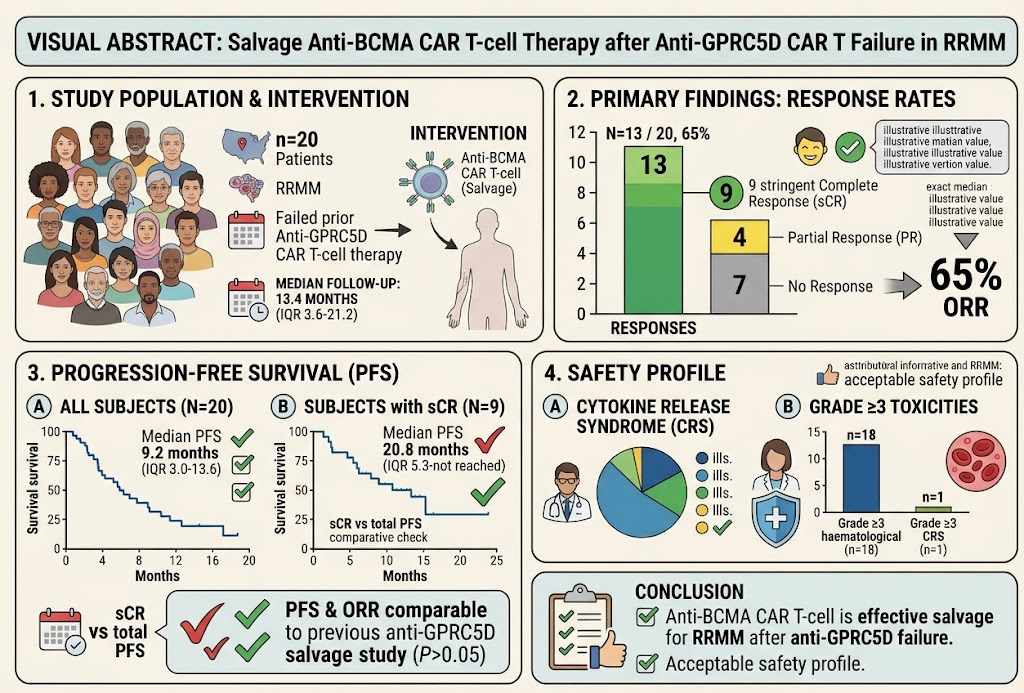
This study reports that BCMA-targeted CAR T-cell therapy as salvage treatment produces significant clinical responses in patients with relapsed or refractory multiple myeloma (RRMM) who progressed after anti-GPRC5D CAR T-cell therapy. The treatment yielded high rates of stringent complete response and durable progression-free survival, with manageable safety profiles predominantly marked by hematological toxicities and cytokine release syndrome.
Study Background
Multiple myeloma is a hematologic malignancy characterized by clonal proliferation of plasma cells within the bone marrow. Despite advances including proteasome inhibitors, immunomodulatory drugs, and monoclonal antibodies, relapsed/refractory cases (RRMM) continue to pose therapeutic challenges with poor prognosis. Chimeric antigen receptor (CAR) T-cell therapies targeting B-cell maturation antigen (BCMA) have emerged as promising options, given BCMA’s restricted expression on plasma cells and myeloma cells. Nevertheless, resistance or relapse after initial CAR T-cell therapy occurs, necessitating alternative or sequential CAR T-cell approaches.
Anti-G protein-coupled receptor, class C group 5 member D (GPRC5D) CAR T-cell therapy is a novel strategy targeting an alternative antigen on myeloma cells. However, the efficacy of sequential targeting—specifically BCMA CAR T-cells following relapse from anti-GPRC5D CAR T therapy—remains uncertain. Therefore, this study addresses an unmet need by evaluating the clinical outcomes and safety of BCMA-directed CAR T cells as a salvage treatment in patients with RRMM post anti-GPRC5D CAR T failure.
Study Design
This prospective study enrolled 20 patients with RRMM who had disease progression after prior anti-GPRC5D CAR T-cell treatment. Patients received BCMA-targeted CAR T-cell therapy as a salvage regimen. The median follow-up period was 13.4 months (interquartile range 3.6 to 21.2 months). Key efficacy endpoints included overall response rate (ORR), stringent complete response (sCR) rate, duration of response, and progression-free survival (PFS). Safety was assessed through adverse event monitoring, focusing on hematological toxicities and cytokine release syndrome (CRS).
Key Findings
Among the 20 subjects, 13 (65%) achieved treatment responses: 9 patients attained stringent complete response, and 4 achieved partial responses. The median duration of response was 10.2 months (95% confidence interval [CI], 2.6 months to not reached). Median PFS for all patients was 9.2 months (95% CI, 3.0 to 13.6 months), while the subset of patients achieving sCR exhibited a notably prolonged median PFS of 20.8 months (95% CI, 5.3 months to not reached).
Comparatively, no statistically significant differences were observed in overall response rate or median progression-free survival when compared to a prior cohort of 37 RRMM patients receiving anti-GPRC5D CAR T-cell therapy after failing anti-BCMA CAR T-cells (ORR: 65% vs 84%, P = 0.18; PFS: 9.2 vs 4.5 months, P = 0.93). This suggests reciprocal efficacy of sequential antigen-targeted CAR T approaches without significant compromise in treatment outcomes.
The safety profile was manageable, though grade ≥3 hematological toxicities occurred in 18 patients. CRS occurred in 78% of patients, mostly low-grade, with only one instance of grade ≥3 CRS.
Expert Commentary
This study contributes important clinical evidence supporting the feasibility of sequential CAR T-cell therapies targeting different antigens in refractory multiple myeloma. The consistent response rates and durable remissions underscore the potential of BCMA CAR T cells as a salvage modality after GPRC5D CAR T failure. The comparable outcomes between groups highlight a possible phenomenon of antigen escape or resistance with targeted therapy, which can be overcome by switching antigen targets.
Limitations include the relatively small sample size and single-arm design. Longer follow-up is needed to validate durability and overall survival benefits. Additionally, mechanistic studies investigating tumor antigen expression dynamics and CAR T-cell persistence could enhance understanding of resistance pathways and inform tailored sequencing strategies.
Conclusion
Anti-BCMA CAR T-cell therapy is an effective and tolerable salvage treatment for patients with progressive multiple myeloma following prior anti-GPRC5D CAR T-cell therapy. Its utilization in the treatment sequence provides a promising therapeutic option to overcome resistance and improve outcomes in RRMM. Future research should focus on optimized antigen-target sequencing and combinational strategies to maximize long-term disease control.
Reference
Zhang X, Xia F, Qi K, Xia J, Zhou D, Sun Q, Zhang H, Wang X, Sang W, Li D, Yan Z, Chang AH, Cao J, Pan B. B-cell maturation antigen-targeted CAR T cell as a salvage therapy for progressive multiple myeloma after anti-G proteincoupled receptor, class C group 5 member D CAR T-cell therapy. Haematologica. 2026 Sep 24. doi: 10.3324/haematol.2026.301282. Epub ahead of print. PMID: 42779309.
This article was created using several editorial tools, including AI, as part of the process. Human editors reviewed this content before publication.