We use cookies

Our website uses essential cookies and, with your consent, additional cookies to measure performance and improve our services. Cookie Policy.

You can change your choice at any time.

MMedXYNews
HomeVideos
MedXY AI/MedXY News/Section: Cardiology

Unraveling Abdominal Aortic Aneurysm: Epigenetic Links to Inflammation and Lipid Metabolism
MedXY Editorial Team•Oct 3, 2026•Cardiology
Abdominal Aortic AneurysmChuyển hóa mỡ máuDNA methylationEpigeneticsinflammation

Highlight

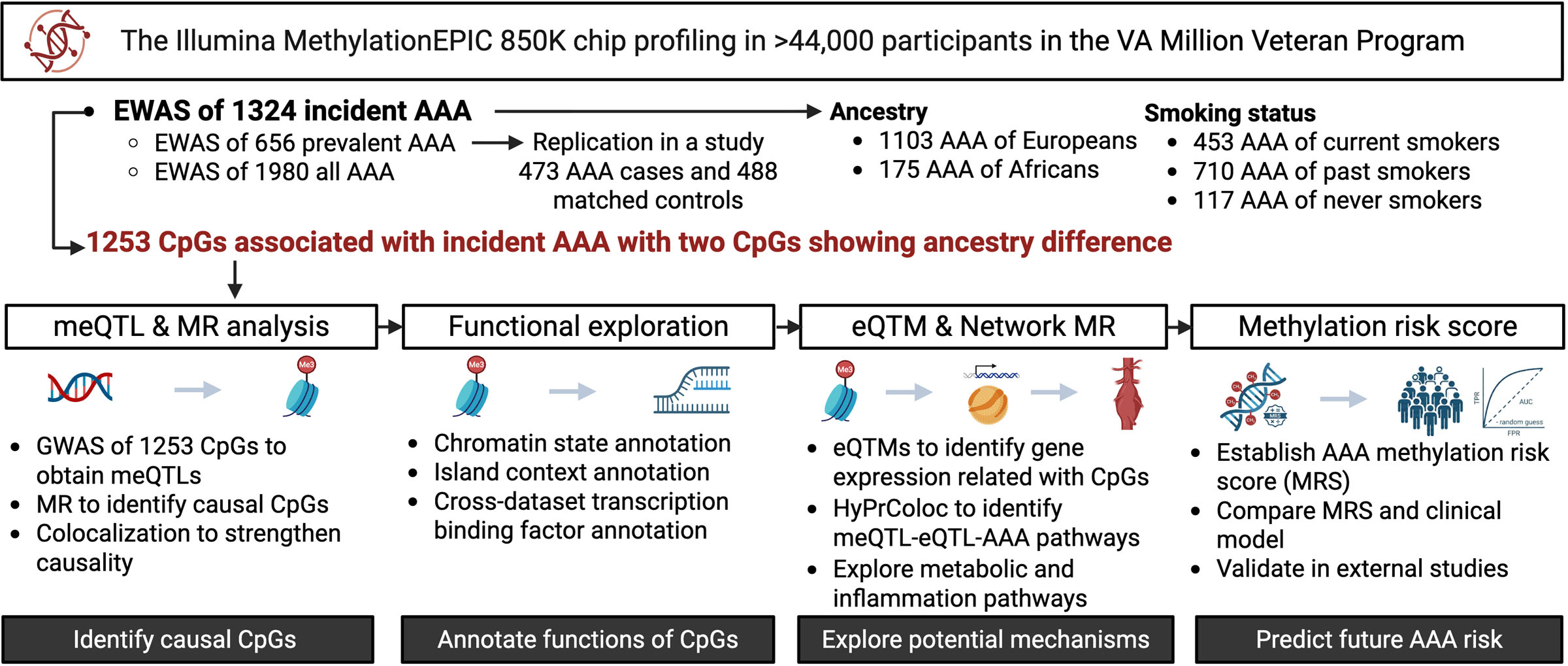
This large-scale epigenome-wide association study (EWAS) identifies 1253 CpG methylation sites linked to abdominal aortic aneurysm (AAA), with 143 supported as putative causal markers. Central inflammatory transcription factor pathways and blood lipid-related traits mediate these associations. A novel methylation risk score demonstrates robust AAA prediction across diverse cohorts beyond conventional clinical factors.

Study Background

MedXY registered readers

Sign in free to continue reading

Create or use your MedXY account to unlock the complete article.

This article was created using several editorial tools, including AI, as part of the process. Human editors reviewed this content before publication.

Related articles

Open language-specific specialty feeds and department pages.

Peripheral Parenteral Nutrition Reduces Inflammation and Enhances Nutritional Recovery After Colorectal Surgery: Insights from a Randomized TrialEarly postoperative peripheral parenteral nutrition after colorectal resection reduces inflammatory markers and improves nitrogen balance without increasing complications, suggesting a beneficial supportive strategy in surgical recovery manOct 5, 2026Targeting NSD2 Degradation: A Novel Therapeutic Avenue for High-Risk t(4;14) Multiple MyelomaThis article explores the discovery of NSD2-ligand-directed degrader (NSD2-LDD), a promising targeted therapy that degrades oncogenic NSD2 in t(4;14) multiple myeloma, reversing malignant epigenomic programs and improving disease outcomes iSep 30, 2026Genetically Mediated LDL Cholesterol Variations and Their Limited Impact on Venous Thromboembolism RiskThis study reveals that lifelong genetic differences in LDL cholesterol levels do not significantly affect the risk of venous thromboembolism (VTE), suggesting LDL-C may not be a major causal factor in VTE development.Sep 25, 2026
Loading comments...
MedXY briefing

Get the free newsletter

Evidence-led clinical news, trends, and analysis—delivered to your inbox.

Ask MedXY AI

Most popular

Intimate Health
Five Benefits for Women Continuing Sexual Activity After Menopause
Intimate Health
Why Some Women Have a Strong Sex Drive—And Why Men Shouldn't Worry About It
Nursing & care
How often should a couple have sex?
Cardiology
Precision Medicine for Long QT Syndrome Type 2: Lumacaftor Corrects Trafficking Defects and Shortens QT Interval
General Surgery
Optimizing Postoperative Opioid Prescriptions After Intra-Abdominal Cancer Surgery: Comparing the 5x-Multiplier and 3-Tier Models
© 2026 MedXY
Contact usAbout usPrivacy PolicyMedXY story
Unexpected Early Postoperative Lipid Deterioration in Cushing’s Syndrome: Implications for Cardiovascular Risk and Management
This study reveals that lipid profiles paradoxically worsen during the early remission phase after curative surgery for Cushing’s syndrome, highlighting a critical window for cardiovascular risk and targeted intervention.
Sep 22, 2026
HBV-Induced Immunosuppressive Macrophages: Metabolic and Epigenetic Pathways Driving Chronic Hepatitis B PersistenceThis article reviews recent evidence on how HBV manipulates monocyte-to-macrophage differentiation through metabolic and epigenetic reprogramming, facilitating immunosuppression and chronic infection.Sep 21, 2026
Targeting ACKR3/CXCR7 Enhances Platelet Anticoagulant Lipids and Modulates Procoagulant Function: Implications for Thrombosis ManagementPharmacological activation of CXCR7 regulates platelet lipid metabolism, preserves mitochondrial function, and reduces procoagulant activity, offering a novel therapeutic strategy to mitigate thrombotic risk in cardiovascular diseases.Sep 17, 2026