Highlight
IL-18 expression is elevated in pancreatic ductal adenocarcinoma and correlates with worse patient survival.
Genetic IL-18 depletion suppresses spontaneous pancreatic cancer progression and prolongs survival in mouse models.
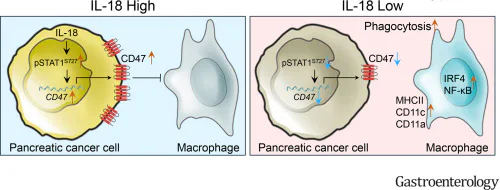
IL-18 promotes tumor immune evasion via STAT1-dependent upregulation of CD47, inhibiting macrophage phagocytosis.
IL-18 suppression reprograms macrophages toward a phagocytic, antigen-presenting phenotype, enhancing anti-tumor immunity.
IL-18 depletion enhances the efficacy of KRAS inhibitors by promoting macrophage-mediated clearance of treated cancer cells.
Study Background
Pancreatic ductal adenocarcinoma (PDAC) remains one of the most lethal malignancies, with a 5-year survival rate under 10%. Its aggressive nature and profound resistance to conventional therapies are largely attributed to a complex tumor microenvironment (TME) characterized by immunosuppressive stromal components and inflammatory mediators that facilitate tumor progression and immune evasion. KRAS mutations, especially oncogenic KRAS, are present in the vast majority of PDAC cases and drive its pathogenesis. Targeted KRAS inhibitors have recently emerged but demonstrate limited efficacy due to adaptive resistance mechanisms within the TME.
Interleukin-18 (IL-18), a member of the IL-1 cytokine family, is implicated in modulating immune responses, with elevated levels reported in PDAC patients and association with poor prognosis. However, IL-18’s precise functional role in PDAC progression, immune regulation, and therapy resistance has yet to be fully elucidated. This context highlights an unmet need to understand and target key immunoregulatory pathways such as IL-18 to improve therapeutic outcomes.
Study Design
The study by Sun et al. employed genetically engineered mouse models of spontaneous PDAC with specific depletion of endogenous IL-18 to investigate its role in tumor development and immune modulation. The experimental framework combined single-cell RNA sequencing to delineate changes in the TME cell populations, particularly macrophage phenotypes. Functional assays were conducted to evaluate cancer cell survival, macrophage-mediated phagocytosis, and cancer-immune cell interactions. Mechanistic insights centered on the downstream signaling pathways, including STAT1 activation and CD47 expression, were assessed. Additionally, the impact of IL-18 modulation on therapeutic response was evaluated using KRAS inhibitor treatment in these preclinical models.
Key Findings
Analysis of clinical PDAC samples demonstrated that elevated IL-18 expression correlated with poorer patient survival, affirming its potential as a prognostic biomarker.
In mouse models, IL-18 genetic depletion markedly suppressed spontaneous PDAC progression, resulting in significant prolongation of survival, demonstrating a direct oncogenic role of IL-18.
Mechanistic investigations revealed that IL-18 facilitates cancer cell survival by activating STAT1 signaling. This activation induces upregulation of CD47, a “don’t eat me” signal that inhibits macrophage-mediated phagocytosis. Thus, IL-18 sustains tumor immune evasion via shaping cancer cell immunogenicity.
IL-18 depletion reprogrammed the TME by enriching macrophage subsets exhibiting elevated antigen presentation (increased MHC class II) and phagocytic markers (CD11c). These macrophages showed enhanced capacity to recognize and clear tumor cells, reversing immunosuppression.
Interestingly, treatment with KRAS inhibitors led to increased IL-18 expression in PDAC cells, suggesting a feedback mechanism that may limit therapeutic efficacy. However, IL-18 depletion synergized with KRAS inhibition by promoting macrophage-mediated elimination of cancer cells post-KRASi treatment, substantially improving anti-tumor responses.
Expert Commentary
This study delineates a novel immunosuppressive axis mediated by IL-18 that sustains PDAC progression through cancer cell-macrophage crosstalk. By activating STAT1-dependent CD47 expression, IL-18 effectively shields tumor cells from innate immune clearance. Reprogramming macrophages toward a more pro-inflammatory, phagocytic state represents an important mechanism by which IL-18 depletion restores anti-tumor immunity. The observed upregulation of IL-18 following KRAS inhibitor therapy provides important insight into adaptive resistance pathways, underscoring the need for combination approaches.
Limitations include the use of murine models, which, while genetically relevant, may not fully capture human tumor complexity. Future studies should confirm these findings in clinical specimens and evaluate IL-18 targeting agents in clinical trials. Additionally, mechanistic details on IL-18’s regulation of STAT1 and cross-talk with other immune checkpoints warrant further exploration.
Conclusion
IL-18 plays a critical role in pancreatic cancer progression by promoting cancer cell survival and immune escape through macrophage reprogramming. Its inhibition effectively suppresses tumor development, reshapes the TME to enhance macrophage-mediated phagocytosis, and potentiates the therapeutic response to KRAS inhibitors. Targeting IL-18 represents a promising therapeutic strategy to overcome immunosuppression and improve outcomes in PDAC, a malignancy with urgent unmet clinical needs. Integration of IL-18 blockade with existing targeted therapies may pave the way for more durable and effective treatment modalities.
Funding and Clinical Trials
The original study by Sun et al. is published in Gastroenterology November 2026. Further details on funding sources or ongoing clinical trials targeting IL-18 in PDAC were not specified in the publication. Future clinical translation will benefit from trials evaluating IL-18 blockade combined with KRAS inhibitors.
References
1. Sun X, Ma Y, Wang L, et al. Depletion of Endogenous IL-18 Suppresses Pancreatic Cancer Progression, Reprograms the Tumor Microenvironment, and Enhances KRAS Inhibitor Efficacy. Gastroenterology. 2026 Nov 13; PMID: 43025768.
2. Ying H, Kimmelman AC, Lyssiotis CA, et al. Oncogenic Kras maintains pancreatic tumors through regulation of anabolic glucose metabolism. Cell. 2012;149(3):656-670.
3. Inoue H, Eguchi S, Ando Y, et al. Novel roles of IL-18 in inflammation and immune modulation in cancer. Front Immunol. 2019;10:2772.
4. Gordon SR, Maute RL, Dulken BW, et al. PD-1 expression by tumour-associated macrophages inhibits phagocytosis and tumour immunity. Nature. 2017;545(7655):495-499.