Highlight
Baveno VI criteria show suboptimal accuracy for ruling out varices in patients with hepatocellular carcinoma (HCC) and compensated advanced chronic liver disease (cACLD).
SAPHE-R, a new non-invasive rule incorporating liver stiffness measurement (LSM), ALBI grade, and platelet count, improves varices exclusion with fewer missed cases than Baveno VI.
SAPHE-R reduces the need for invasive upper gastrointestinal endoscopy (UGE), sparing approximately 18% of procedures without compromising safety.
External validation confirms SAPHE-R’s robustness, offering a reliable clinical tool for variceal risk stratification in HCC.
Study Background
Hepatocellular carcinoma (HCC) commonly arises in the setting of compensated advanced chronic liver disease (cACLD), often complicated by portal hypertension and esophagogastric varices, which predispose to life-threatening bleeding. Current clinical practice guidelines recommend upper gastrointestinal endoscopy (UGE) to identify varices that necessitate prophylactic therapy. However, systematic screening via endoscopy may be burdensome, invasive, and resource-intensive in HCC patients, especially since the prevalence and characteristics of varices differ from non-HCC cACLD populations.
The Baveno VI criteria, based primarily on liver stiffness measurement (LSM) and platelet count thresholds, provide a non-invasive approach to safely exclude varices needing treatment in cirrhotic patients. Yet, the applicability and accuracy of Baveno VI criteria in the HCC population remain uncertain, with potential risk of missed varices leading to adverse clinical outcomes.
Addressing this unmet need, rigorous evaluation and refinement of non-invasive tools tailored to HCC patients are essential to enable safe deferral of unnecessary endoscopies while maintaining vigilance for clinically significant varices.
Study Design and Methods
This study retrospectively analyzed data from the Italian Liver Cancer (ITA.LI.CA) database, including 598 patients diagnosed with Barcelona Clinic Liver Cancer (BCLC) stages 0-C HCC complicated by cACLD. Inclusion criteria mandated contemporaneous liver stiffness measurement (LSM), blood tests including platelet counts and ALBI score assessment, and upper gastrointestinal endoscopy (UGE) within six months of HCC diagnosis.
Varices identified on UGE were classified by grade, with distinction of high-risk varices (HRV) based on international standards. The Baveno VI criteria (LSM ≤20 kPa and platelet count ≥150×10⁹/L) were applied to evaluate their performance in ruling out varices and HRV.
Independent predictors of any-grade varices were determined using logistic regression. Using a grid search approach, these predictors—namely LSM, platelet count, and ALBI grade—were combined into a novel rule-out strategy named SAPHE-R (Stiffness, ALBI, Platelets, HEpatocellular carcinoma Rule). Robustness was assessed by bootstrap resampling and further externally validated in an independent Vienna cohort of 149 patients.
Key Findings
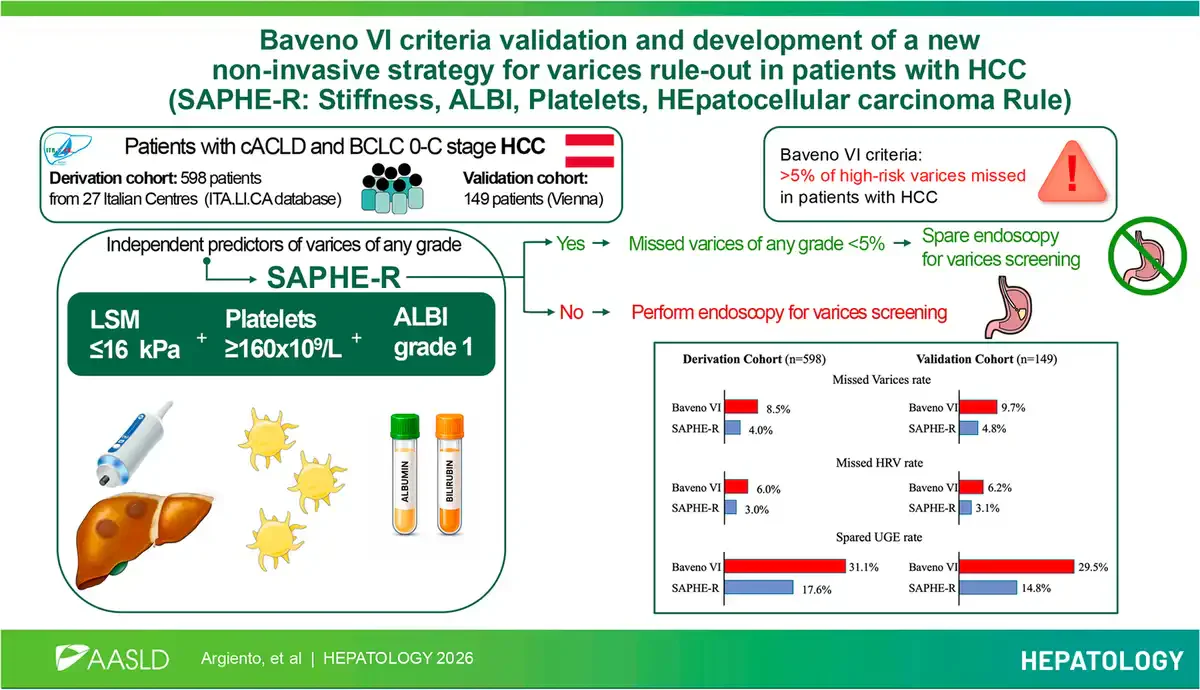
Performance of Baveno VI Criteria: Within the derivation cohort, varices were present in 33.4% of patients, with 11.2% classified as HRV. Applying Baveno VI criteria spared 31.1% of UGEs but missed 8.5% of varices and 6.0% of HRV, indicating a suboptimal negative predictive value for varices in the HCC setting.
Development and Validation of SAPHE-R: Logistic regression identified three independent predictors for varices: liver stiffness (LSM ≤16 kPa), platelet count (≥160×10⁹/L), and ALBI grade 1 (indicating better liver function). The SAPHE-R algorithm combined these parameters to safely rule out varices.
In the derivation cohort, SAPHE-R missed only 4.0% of varices and 3.0% of HRV while sparing 17.6% of UGEs, achieving better safety with a modest reduction in spared procedures compared to Baveno VI.
External validation confirmed these findings, with SAPHE-R missing 4.8% of varices and 3.1% of HRV, sparing 14.8% of UGEs. Sensitivity analyses demonstrated consistency across patient subgroups. An exploratory subanalysis including hepatic venous pressure gradient (HVPG) measurement found no clinically significant portal hypertension (CSPH) in SAPHE-R rule-out patients, supporting the pathophysiological plausibility of the rule.
Expert Commentary
The study addresses an important clinical gap—accurate, non-invasive risk stratification of varices in patients with HCC and cACLD. The conventional Baveno VI criteria, while validated in cirrhosis cohorts, appear insufficiently specific and sensitive in the oncologic setting, where tumor burden and liver function may alter portal hemodynamics and variceal risk.
Incorporating ALBI grade—a refined liver function index—alongside stringent liver stiffness and platelet count cutoffs, SAPHE-R targets comprehensive portal hypertension markers tailored for HCC patients. Although SAPHE-R modestly decreases the proportion of spared endoscopies compared to Baveno VI, the significant enhancement in safety (fewer missed varices) justifies its clinical value.
Limitations include retrospective design and reliance on cross-sectional data. Prospective validation and cost-effectiveness analyses are warranted. Moreover, SAPHE-R’s performance in diverse ethnic populations and different fibrosis etiologies requires confirmation. However, the external validation cohort supports generalizability.
Conclusions
This study demonstrates that Baveno VI criteria have suboptimal diagnostic performance to non-invasively rule out esophagogastric varices in patients with HCC and cACLD, potentially leading to unsafe omission of endoscopic screening.
The new SAPHE-R rule, combining liver stiffness, ALBI grade, and platelet count, offers a reliable and safer alternative to exclude varices and reduce unnecessary endoscopies in this high-risk population. Widespread adoption of SAPHE-R could streamline variceal surveillance, optimize resource utilization, and improve patient comfort in HCC care pathways.
Future research should explore prospective validation, integration with dynamic portal hypertension measures, and longitudinal outcomes to solidify SAPHE-R’s role in clinical guidelines.
Funding and Clinical Trial Registration
The study was supported by the Italian Liver Cancer (ITA.LI.CA) cooperative group. No clinical trial registration was reported.
References
Argiento L, Canova L, Alimenti E, et al. Baveno VI criteria validation and development of a new non-invasive strategy for varices rule-out in patients with HCC (SAPHE-R). Hepatology. 2026 Oct 22. PMID: 42911124.
European Association for the Study of the Liver. EASL Clinical Practice Guidelines for the management of patients with decompensated cirrhosis. J Hepatol. 2018;69(2):406-460.
Wong GL, Chan HL, Chim AM, et al. Cirrhosis is associated with higher portal pressure and a greater risk of gastropathy in HCC patients. Aliment Pharmacol Ther. 2017;45(6):787-796.