Highlight
ANGPTL4 is a key regulator that inhibits lipoprotein lipase, impacting triglyceride metabolism.
MAR001, a monoclonal antibody against ANGPTL4, significantly lowers fasting triglyceride levels in adults with elevated triglycerides.
The phase 2b trial showed dose-dependent reductions in triglycerides up to 45% at 12 weeks, with a favorable safety profile.
This therapeutic approach may address residual cardiovascular risk associated with hypertriglyceridemia.
Study Background
Elevated triglyceride levels are a well-established risk factor for cardiovascular disease, partly due to their role in atherogenic remnant lipoproteins. Despite established lipid-lowering therapies primarily targeting LDL cholesterol, residual cardiovascular risk persists in many patients with hypertriglyceridemia. Angiopoietin-like protein 4 (ANGPTL4) is an endogenous inhibitor of lipoprotein lipase (LPL), a critical enzyme responsible for hydrolyzing triglycerides from circulating triglyceride-rich lipoproteins. Inhibition of ANGPTL4 can enhance LPL activity, improving triglyceride clearance and potentially reducing cardiovascular risk. MAR001 is a novel monoclonal antibody designed to neutralize ANGPTL4 activity, thereby lowering plasma triglyceride levels.
Study Design
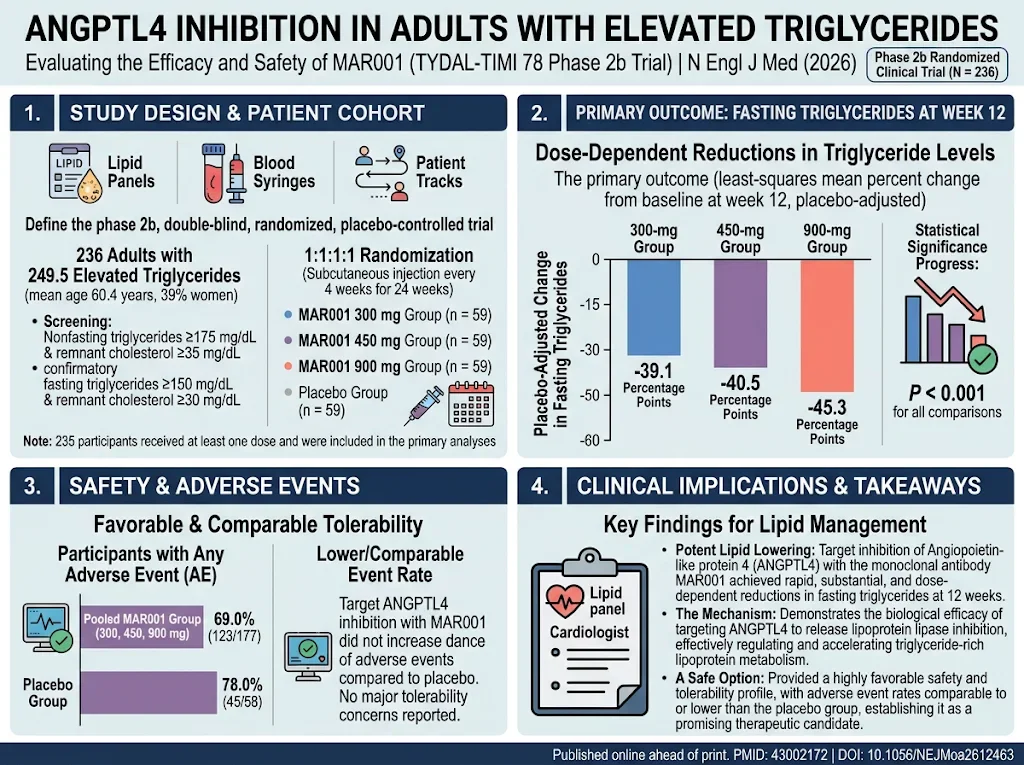
This was a two-part, phase 2b, randomized, double-blind, placebo-controlled trial investigating MAR001 in adults with elevated triglycerides. Presented here are data from part A, focused on participants selected based on stringent screening criteria: nonfasting triglycerides ≥175 mg/dL and remnant cholesterol ≥35 mg/dL initially, followed by fasting triglycerides ≥150 mg/dL and remnant cholesterol ≥30 mg/dL on confirmation. A total of 236 adults were enrolled and randomized in a 1:1:1:1 ratio to receive MAR001 subcutaneously every 4 weeks at doses of 300 mg, 450 mg, or 900 mg, or placebo, over 24 weeks. The primary endpoint was the percent change from baseline in fasting triglyceride levels at 12 weeks, comparing each MAR001 dose to placebo. Safety and adverse events were also monitored.
Key Findings
Among the 235 participants who received at least one dose of trial treatment, the median baseline triglyceride level was 249.5 mg/dL, reflecting a high-risk population. At 12 weeks, all MAR001 doses achieved statistically significant and clinically meaningful reductions in fasting triglycerides compared to placebo. The placebo-adjusted least-squares mean percent reductions were 39.1% at 300 mg, 40.5% at 450 mg, and 45.3% at 900 mg (P<0.001 for all). This dose-dependent triglyceride lowering indicates MAR001’s potent modulation of lipid metabolism.
Importantly, adverse events were comparable between MAR001 and placebo groups, with 69% of MAR001-treated participants reporting any adverse event vs. 78% in the placebo group, suggesting a favorable safety and tolerability profile over 24 weeks.
This robust triglyceride reduction holds potential to decrease atherogenic remnant particles, which are increasingly recognized contributors to residual cardiovascular risk. However, the trial did not report cardiovascular outcomes, so direct impact on morbidity or mortality remains to be established.
Expert Commentary
ANGPTL4 inhibition represents an innovative strategy in lipid management. By unleashing LPL activity, MAR001 facilitates catabolism of triglyceride-rich lipoproteins, a therapeutic mechanism complementary to existing LDL cholesterol-lowering therapies and fibrates. Current guidelines acknowledge elevated triglycerides as a modifiable risk factor; thus, agents like MAR001 could fill an important treatment gap.
Limitations of this study include the relatively short follow-up and lack of cardiovascular endpoints. Additionally, long-term safety, immunogenicity, and effects on other lipid parameters or glucose metabolism require further evaluation in phase 3 trials. The generalizability to diverse populations and patients with differing comorbidities also remains to be proven.
Mechanistically, ANGPTL4 modulation aligns with emerging biological insights into triglyceride regulation and atherosclerosis pathogenesis. Inhibiting ANGPTL4 may also impact energy metabolism, inflammation, and endothelial function, warranting comprehensive assessment.
Conclusion
The phase 2b trial demonstrates that MAR001, a monoclonal antibody targeting ANGPTL4, significantly and safely lowers fasting triglyceride levels in adults with elevated triglycerides. This novel lipid-lowering approach could complement current therapies, potentially reducing residual cardiovascular risk associated with hypertriglyceridemia. Further large-scale, long-term studies are needed to confirm cardiovascular benefits and establish MAR001’s role in clinical practice.
Funding and ClinicalTrials.gov
This study was funded by Marea Therapeutics. The trial is registered under ClinicalTrials.gov number NCT07028749, as part of the TYDAL-TIMI 78 Investigators’ efforts.
References
O’Donoghue ML, Juliano RA, Yi BA, et al. ANGPTL4 Inhibition in Adults with Elevated Triglyceride Levels. N Engl J Med. 2026 Nov 9; PMID: 43002172.
Nordestgaard BG. Triglyceride-Rich Lipoproteins and Atherosclerotic Cardiovascular Disease: New Insights from Epidemiology, Genetics, and Biology. Circ Res. 2016;118(4):547-563.
Li S, Brown JD, Goldstein JL. Bifurcation of insulin signaling pathway in rat liver: mTORC1 required for stimulation of lipogenesis, but not inhibition of gluconeogenesis. Proc Natl Acad Sci U S A. 2010;107(8):3441-3446.