Highlight
– The ISCHEMIA-CKD EXTEND study followed 777 patients with stable coronary disease and advanced chronic kidney disease (CKD) over a median of 8 years.
– No significant difference in all-cause or cardiovascular mortality was found between initial invasive (coronary angiography and revascularization plus medical therapy) versus conservative (medical therapy alone) strategies.
– Adjusted hazard ratios for all-cause mortality and cardiovascular mortality favored neither approach, indicating comparable long-term survival.
– High retention (95%) of vital status data supports robustness of findings in this high-risk population.
Study Background
Cardiovascular disease is a leading cause of morbidity and mortality among patients with advanced chronic kidney disease (CKD). These patients often present with stable coronary artery disease (CAD) accompanied by moderate to severe myocardial ischemia. Optimal management to improve survival in this vulnerable population remains uncertain. While an initial invasive strategy involving coronary angiography and revascularization may intuitively provide better ischemic control, concerns about procedural risks and kidney injury have led to equipoise regarding its benefit compared to conservative management with guideline-directed medical therapy alone.
The ISCHEMIA-CKD trial, originally designed to address this clinical question, showed no statistically significant difference at a median 2.2 years in the composite endpoint of death or nonfatal myocardial infarction. However, long-term survival outcomes beyond this period, crucial for chronic conditions, remained unknown.
Study Design
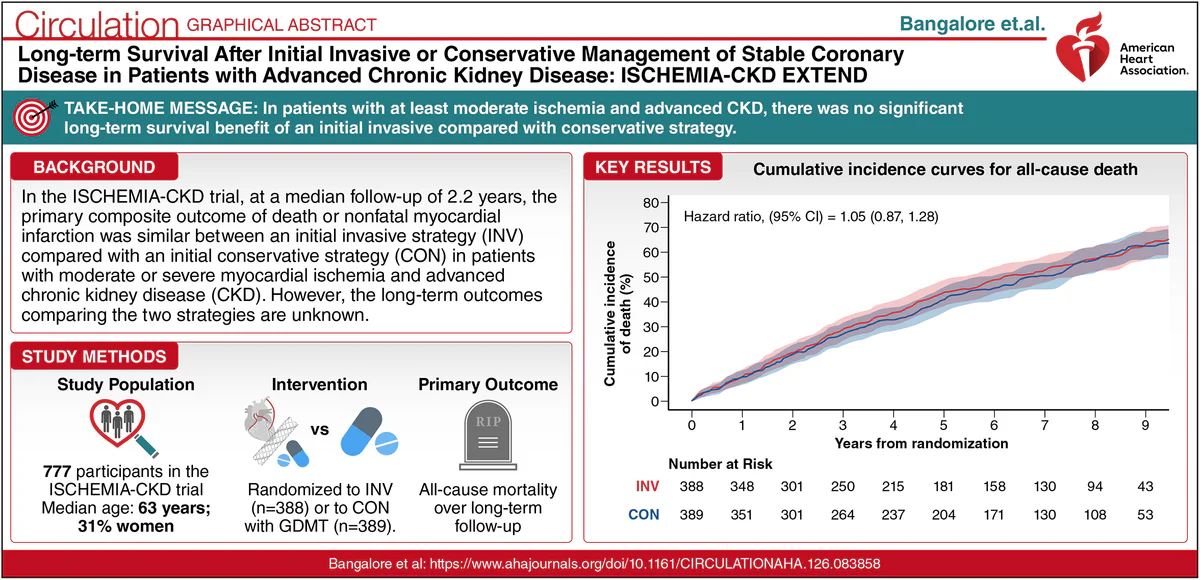
ISCHEMIA-CKD EXTEND is an extended follow-up of the ISCHEMIA-CKD randomized controlled trial (NCT01985360). The trial enrolled 777 patients with advanced CKD and at least moderate ischemia on stress testing. Participants were randomized to either:
An initial invasive (INV) strategy: coronary angiography followed by revascularization (percutaneous or surgical) if feasible, alongside guideline-directed medical therapy;
An initial conservative (CON) strategy: guideline-directed medical therapy alone, reserving invasive procedures for failure of medical therapy.
The primary outcome of the extended phase was all-cause mortality. Secondary outcomes included cause-specific mortality (cardiovascular vs. noncardiovascular). Follow-up employed participant contact, clinical records, and centralized death registries, achieving 95% vital status retention among survivors after a median of 8 years.
Key Findings
During the extended follow-up, 429 deaths (55%) were observed across both groups. The 8-year cumulative all-cause mortality was 57.4% in the INV group versus 56.8% in the CON group, with an adjusted hazard ratio (HR) of 1.05 (95% confidence interval [CI], 0.87 to 1.28), indicating no significant difference. Cardiovascular mortality at 8 years was similarly comparable: 40.3% INV versus 38.4% CON, adjusted HR 1.06 (95% CI, 0.84 to 1.34).
The restricted mean survival time (RMST) was 1941 days for INV versus 1990 days for CON, with an adjusted difference of -99 days (95% CI, -245 to 46), not statistically significant. Bayesian analysis yielded the posterior probability for at least a 1% absolute difference in all-cause mortality favoring INV as 28% (lower) and 52% (higher), emphasizing uncertainty and no clear superiority.
Notably, these findings replicate and extend the initial 2.2-year results, reinforcing equivalence of initial invasive and conservative strategies in this high-risk population. No subgroup demonstrated significant benefit with early invasive management. Procedural risks, including potential kidney injury or complications from revascularization, highlight the need for cautious patient selection.
Expert Commentary
The ISCHEMIA-CKD EXTEND trial offers high-quality, long-term evidence addressing a critical knowledge gap in managing coronary disease among patients with advanced CKD, a group historically excluded from many large cardiovascular trials. Its robust methodology and prolonged follow-up underscore the lack of survival advantage with upfront invasive management despite moderate or severe ischemia.
These findings align with the concept that optimizing medical therapy can provide comparable survival in advanced CKD, where procedural risks and comorbidities often complicate outcomes. Clinicians should weigh the risk-benefit ratio carefully, reserving invasive interventions primarily for symptom relief or refractory ischemia rather than survival benefit.
Limitations include the study’s focus on all-cause mortality without extensive data on health-related quality of life or nonfatal events in the extended phase, and potential heterogeneity in revascularization approaches and expertise across centers. Nevertheless, this landmark study informs guideline development and shared decision-making.
Conclusion
The ISCHEMIA-CKD EXTEND study demonstrates that for patients with stable coronary disease and advanced CKD, initial invasive management does not confer a long-term survival advantage over conservative management with guideline-directed medical therapy. These data emphasize that conservative therapy remains an effective initial approach, reserving invasive procedures for patients with clinical indications beyond survival improvement.
Future research should explore patient-centered outcomes, quality of life, and the role of newer revascularization techniques or pharmacotherapies in this high-risk population to refine individualized care strategies.
Funding and ClinicalTrials.gov Registration
The ISCHEMIA-CKD trial and its extended follow-up were supported by institutional and governmental research funding. The trial was registered at ClinicalTrials.gov, Identifier: NCT01985360.
References
Bangalore S, Maron DJ, Anthopolos R, et al. Long-Term Survival After Initial Invasive or Conservative Management of Stable Coronary Disease in Patients With Advanced Chronic Kidney Disease: ISCHEMIA-CKD EXTEND. Circulation. 2026 Nov 7. PMID: 42998238.
Bangalore S, Maron DJ, O’Brien SM, et al. Management of stable ischemic heart disease in patients with chronic kidney disease: insights from clinical trials. J Am Coll Cardiol. 2020;75(18):2166-2179.
Baigent C, Landray MJ. The effects of lowering LDL cholesterol with statin therapy in patients with chronic kidney disease: a meta-analysis. Kidney Int Suppl. 2019;9(1):9-14.