Highlight
Early treat-to-target (T2T) therapy in rheumatoid arthritis (RA) results in sustained remission in a majority of patients at 10 years.
Patients show limited radiographic progression and significant improvements in physical function and quality of life over a decade.
Sustained remission within the first 2 years strongly predicts favorable long-term clinical and functional outcomes.
Survival rates of RA patients in this cohort align with the general population, highlighting improved disease control.
Study Background
Rheumatoid arthritis (RA) is a chronic inflammatory autoimmune disorder characterized by joint inflammation, progressive structural damage, and functional impairment. Without adequate management, RA often leads to disability, reduced quality of life, and increased mortality risk. Early therapeutic intervention guided by treat-to-target (T2T) principles—focused on achieving and maintaining remission or low disease activity—has been advocated to improve long-term outcomes. However, evidence from long-term follow-up studies substantiating the durability of such strategies remains limited. The ARCTIC trial (Aiming for Remission in rheumatoid arthritis: a randomised trial examining the benefit of ultrasound in a Clinical TIght Control regimen) provides crucial longitudinal data on the clinical, structural, and functional trajectory of early RA patients treated under a strict T2T regimen.
Study Design
The ARCTIC trial enrolled 230 patients with early RA and employed a rigorous treat-to-target management approach over 2 years, incorporating clinical tight control supplemented by ultrasound assessment. After this initial intervention phase, patients were invited for a 10-year observational follow-up to assess sustained outcomes. The follow-up evaluations included measures of disease activity using the Disease Activity Score (DAS), radiographic damage assessed via the van der Heijde modified Sharp score, physical function, health-related quality of life, and survival. Participants were stratified based on achievement of sustained DAS remission during the initial 2-year period to examine associations with 10-year outcomes.
Key Findings
Survival and Retention: After 10 years, 218 of the original 230 patients (95%) were alive, with an 82% follow-up participation rate (179 patients). This demonstrates excellent retention and highlights the viability of long-term observational data within this cohort.
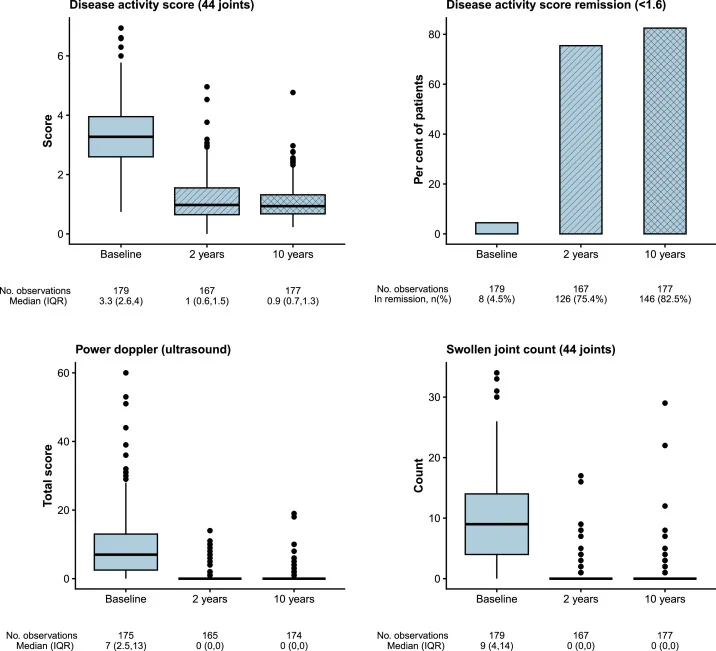
Disease Activity and Remission: Remarkably, 82% of patients remained in DAS remission a full decade after diagnosis, underscoring the durability of early T2T intervention. Patients who achieved sustained remission during the initial 2 years consistently exhibited lower disease activity at 10 years.
Radiographic Progression: Structural joint damage was minimal over the 10-year period. The median (interquartile range) increase in the van der Heijde modified Sharp score was 2.0 (0.5 to 4.5), indicating limited progression of joint erosions and narrowing — a key goal for RA therapy.
Physical Function and Quality of Life: Physical function showed substantial improvement, nearing population norms. Patients achieving sustained remission reported better functional status at 10 years, emphasizing the clinical relevance of early disease control. Additionally, health-related quality of life improved significantly, enhancing the overall patient experience.
Survival: The cohort’s survival matched that of the general population, reflecting the potential impact of effective disease management on mortality risk traditionally elevated in RA.
Clinical and Statistical Significance
The study’s results demonstrate both statistically and clinically meaningful outcomes. Sustained remission correlated with improved long-term function and less disease activity, supporting the treat-to-target paradigm’s therapeutic value. The low median radiographic progression reinforces that structural joint preservation is achievable with early aggressive management.
Expert Commentary
The ARCTIC 10-year follow-up provides high-quality evidence endorsing the sustained benefits of early T2T therapy in RA. The findings reinforce current treatment recommendations emphasizing early remission induction to alter disease trajectory. Notably, the study highlights that achieving remission within the first two years is a robust prognostic marker of successful long-term outcomes. This aligns with guideline advocacy from organizations such as the EULAR and ACR, which stress the importance of tight disease control.
Some limitations deserve mention. The study cohort represents patients managed within a clinical trial setting with stringent follow-up, which may not fully reflect routine clinical practice variability. Furthermore, advances in biologic and targeted synthetic DMARDs since study initiation might influence comparability to contemporary populations. Nevertheless, the enduring structural and functional benefits observed underscore the cornerstone role of treat-to-target strategies.
Mechanistically, sustained remission likely mitigates chronic inflammation-driven joint deterioration and systemic complications. Early inflammation control may prevent irreversible damage and deleterious immune activation, translating into preserved function and survival benefits.
Conclusion
This longitudinal study affirms that implementing a treat-to-target approach early in the course of rheumatoid arthritis yields favorable 10-year clinical, radiographic, and functional outcomes. Sustained remission achieved within the initial 2 years is a significant predictor of ongoing remission and better physical function a decade later. These findings support current clinical guidelines advocating early, aggressive disease management to optimize long-term patient outcomes. Moving forward, integrating ongoing treatment innovations and real-world data will further refine strategies to sustain remission and improve quality of life in RA.
Funding and Clinical Trials Registration: While the source abstract does not specify funding sources or clinical trial registry numbers beyond the ARCTIC trial itself, original publications and databases such as ClinicalTrials.gov may offer detailed insights.
Reference
Nordberg LB, Sundlisæter NP, Brinkmann GH, Mangseth H, Kjørholt KE, Ikdahl E, Kristianslund EK, Brodin E, Nag KEN, Haukeland H, Wierød A, Stevens DJ, Høili CA, Stray H, Noraas AL, Høiberg HK, Bakland G, Solomon DH, Sexton J, Aga AB, Haavardsholm EA, Lillegraven S. Ten-year outcomes after treat-to-target therapy in early rheumatoid arthritis. Ann Rheum Dis. 2026 Sep 22:S0003-4967(26)00553-4. doi: 10.1016/j.ard.2026.09.003. Epub ahead of print. PMID: 42881069.