Survival Without Glucocorticoid Treatment in Classic and Non-Classic 21-Hydroxylase Deficiency: A Retrospective Cohort Study
Congenital adrenal hyperplasia (CAH) due to 21-hydroxylase deficiency (21OHD) is a genetic disorder that impairs cortisol and aldosterone synthesis, leading to adrenal crises and hyperandrogenism. Standard care for classic forms—salt-wasting (SW) and simple-virilizing (SV)—includes lifelong glucocorticoid and often mineralocorticoid replacement. However, some patients go untreated due to delayed diagnosis or other reasons. This study describes a cohort of patients with classic and non-classic 21OHD who survived without glucocorticoid therapy, offering insights into disease variability and potential mechanisms that allow survival despite hormonal deficiencies.
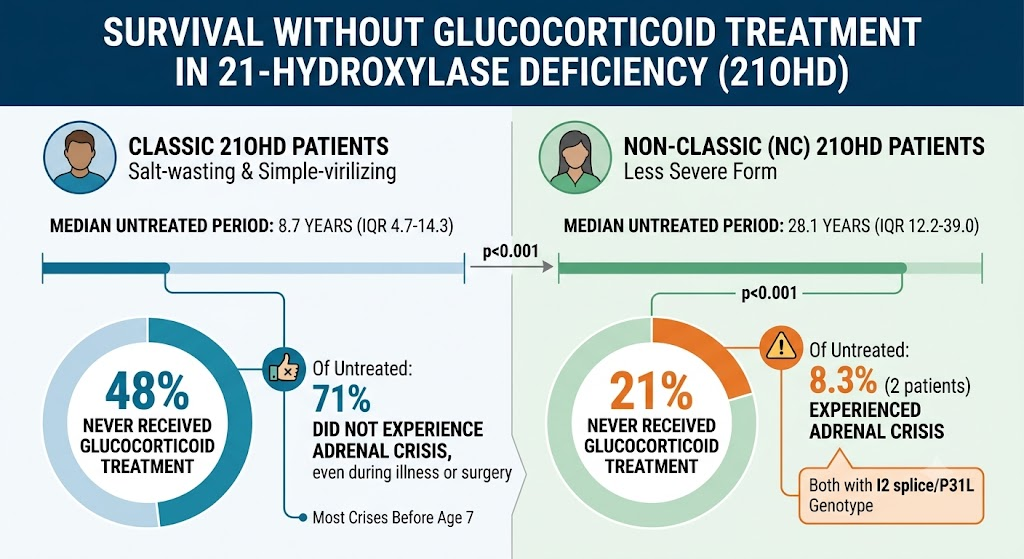
Of 52 patients with classic 21OHD, 48% never received glucocorticoid treatment.
During untreated periods, 71% of classic patients experienced no adrenal crises, even during illness or surgery.
Among 24 non-classic patients, 21% were never treated; only two had an adrenal crisis, both with a specific genotype.
The findings highlight that some patients can survive without hormone replacement, raising questions about disease modifiers.
Study Snapshot
Design: Multicenter retrospective open cohort study.
Setting: Multiple centers; international collaboration.
Population: 76 patients with 21OHD: 29 salt-wasting (classic), 23 simple-virilizing (classic), 24 non-classic.
Exposure: No glucocorticoid treatment (either never received or had a period without treatment).
Comparator: None; descriptive cohort.
Primary outcomes: Adrenal crises, surgical interventions, sickness events during untreated periods.
Key results: Classic: median untreated time 8.7 years; 71% no adrenal crises. Non-classic: median untreated time 28.1 years; 8.3% had adrenal crises.
Limitations: Retrospective, small sample, potential selection bias, lack of detailed adherence or genetic data.
How the Study Was Conducted
This was a multicenter retrospective open cohort study involving patients with genetically confirmed 21-hydroxylase deficiency. Researchers collected data from medical records of 76 individuals: 29 with salt-wasting (SW), 23 with simple-virilizing (SV), and 24 with non-classic (NC) 21OHD. The median age was 11.0 years for classic patients and 21.7 years for NC patients. The study focused on periods during which patients did not receive glucocorticoid therapy, whether because treatment was never started or because it was discontinued. The researchers documented adrenal crises, defined as acute adrenal insufficiency requiring medical intervention, as well as episodes of illness and surgical procedures that occurred while untreated.
What the Researchers Found
Patients with classic 21OHD were untreated for a median of 8.7 years (interquartile range 4.7–14.3 years), while those with NC 21OHD were untreated for a median of 28.1 years (IQR 12.2–39.0 years; p<0.001). Among classic patients, 48% had never received any glucocorticoid treatment. Remarkably, 71% of these untreated classic patients experienced no adrenal crises during their untreated period, even during intercurrent illnesses or surgical interventions. For NC patients, 21% never received glucocorticoid therapy; only two individuals (8.3%) had an adrenal crisis, and both carried the I2 splice/P31L genotype. All but one adrenal crisis across the entire cohort occurred before the age of 7 years.
What the Findings May Mean
The observation that many patients with classic 21OHD survive without glucocorticoid treatment and without adrenal crises challenges the assumption that lifelong replacement is universally required. It suggests that residual adrenal function, compensatory mechanisms, or environmental factors may protect some individuals from adrenal insufficiency. The genotype-specific finding in NC patients—that only those with the I2 splice/P31L genotype experienced crises—points to a potential genetic modifier. These results are hypothesis-generating and underscore the need to investigate glucocorticoid sensitivity, mineralocorticoid activity, and extra-adrenal cortisol production. The study does not imply that treatment can be safely withheld; rather, it opens avenues for understanding disease heterogeneity and personalizing therapy.
Strengths and Limitations
Strengths include a multicenter design, inclusion of both classic and non-classic forms, and a focus on a rarely studied population—untreated patients. The study provides real-world data on the natural history of 21OHD without intervention. Limitations are substantial: the retrospective design introduces potential selection bias, as patients who survived without treatment may represent milder cases. The sample size is small, especially for subgroup analyses. Information on treatment adherence, precise reasons for not treating, and complete genetic data may be incomplete. Adrenal crisis definitions and documentation may vary across centers. The abstract does not provide adjusted analyses or details on confounding factors such as age at diagnosis, sex, or mineralocorticoid use (if any). As an observational study, no causal conclusions can be drawn.
Implications for Practice and Research
For clinicians, these findings highlight the wide clinical spectrum of 21OHD and suggest that some patients may remain asymptomatic without glucocorticoid replacement, though routine withholding of treatment is not recommended. The data can inform counseling about disease variability and the importance of close monitoring. For researchers, the cohort offers a unique opportunity to study mechanisms that influence glucocorticoid activity, such as genetic modifiers, alternative cortisol synthesis pathways, or tissue-specific hormone sensitivity. Prospective studies with detailed biochemical, genetic, and long-term follow-up are needed to identify biomarkers that predict which patients can safely avoid treatment. The study also underscores the need for standardized definitions of adrenal crises and better cohort registries.
Funding, Disclosures, and Registration
Funding and disclosure information were not provided in the source material. The study does not mention a trial registry. Readers should refer to the full published article for complete details.
References
Adriaansen BPH, Utari A, Chandra EA, et al. Survival without treatment of patients with classic and non-classic 21-hydroxylase deficiency. J Clin Endocrinol Metab. 2026;111(7): e42517590. PMID: 42517590. https://pubmed.ncbi.nlm.nih.gov/42517590/