SGLT2 Inhibitors Linked to Lower Lung Cancer Risk in Patients With COPD and Type 2 Diabetes
In a nationwide Korean cohort of patients with COPD and type 2 diabetes, SGLT2 inhibitor initiation was associated with a 27% lower risk of developing lung cancer compared with sulfonylurea initiation.
SGLT2 inhibitor use was also linked to reduced risks of severe COPD exacerbation and all-cause mortality.
The study had a median follow-up of about 3 years; findings are observational and require confirmation in longer-term trials.
Study Snapshot
Design: Nationwide population-based cohort study
Population: Adults ≥40 years with COPD and type 2 diabetes
Exposure: Initiation of SGLT2 inhibitors (n=5,651) vs. sulfonylureas (n=9,276)
Primary outcome: Incident lung cancer
Median follow-up: 2.97 years
Key result: IPTW hazard ratio 0.73 (95% CI 0.60–0.90) for lung cancer; 0.77 (0.71–0.83) for severe COPD exacerbation; 0.81 (0.75–0.88) for all-cause mortality
Why This Study Matters
Patients with chronic obstructive pulmonary disease (COPD) face a significantly elevated risk of lung cancer, independent of smoking history. Type 2 diabetes often coexists with COPD and may further complicate management. Sodium-glucose cotransporter-2 (SGLT2) inhibitors, widely used for glycemic control, have demonstrated pleiotropic benefits beyond glucose lowering, including anti-inflammatory and antifibrotic effects. Whether these properties translate into reduced lung cancer risk in the high-risk COPD–diabetes population has been unclear. This study provides the first large-scale evidence from a real-world setting.
How the Study Was Conducted
Investigators from South Korea analyzed the National Health Insurance Database, which covers virtually the entire Korean population. They identified adults aged 40 years or older with both COPD and type 2 diabetes who initiated either an SGLT2 inhibitor or a sulfonylurea between September 2014 and December 2023. The primary outcome was incident lung cancer; secondary outcomes included severe COPD exacerbation and all-cause mortality. Inverse probability of treatment weighting (IPTW) was used to balance baseline characteristics between the two groups. The analysis included 14,927 patients overall.
What the Researchers Found
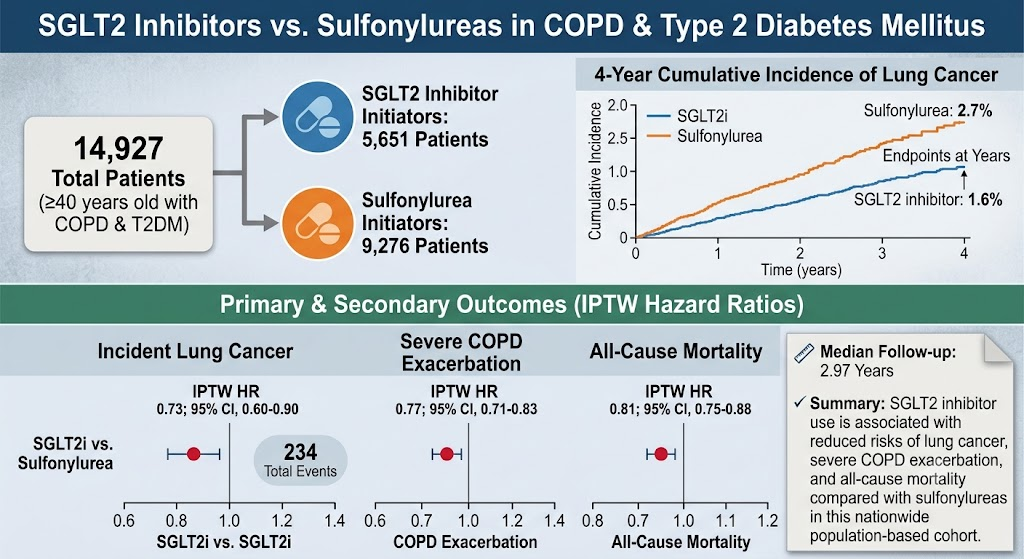
During a median follow-up of 2.97 years, 234 incident lung cancers occurred. The 4-year cumulative incidence was 1.6% in the SGLT2 inhibitor group versus 2.7% in the sulfonylurea group. After weighting, SGLT2 inhibitor initiation was associated with a 27% lower risk of lung cancer (IPTW HR 0.73; 95% CI 0.60–0.90). Risks of severe COPD exacerbation and all-cause mortality were also significantly lower (HR 0.77 and 0.81, respectively). The associations were consistent across prespecified subgroups, although the abstract does not specify all subgroup results in detail.
What the Findings May Mean
These results suggest that SGLT2 inhibitors may confer additional benefits for patients with COPD and type 2 diabetes beyond metabolic control. The pleiotropic effects of these drugs—potentially involving reduced systemic inflammation, improved endothelial function, and modulation of cellular energy metabolism—could plausibly contribute to lower lung cancer risk. However, the observational design precludes causal inference. Unmeasured confounders, such as smoking intensity, occupational exposures, and COPD severity (e.g., FEV1), could partly explain the association. The shorter follow-up also limits assessment of longer-term cancer risk.
Strengths and Limitations
Strengths include the large, nationwide population-based design, use of an active comparator (sulfonylureas) to reduce confounding by indication, and IPTW to adjust for measured covariates. The hard endpoints (lung cancer incidence, mortality) are reliably captured in the database. Limitations include the observational nature, potential residual confounding (including unmeasured smoking pack-years and lung function), lack of data on lung cancer screening or diagnostic workup, limited generalizability outside Korea, and relatively short median follow-up. The study also did not separate lung cancer subtypes or adjust for competing risks.
Implications for Practice and Research
For clinicians managing patients with COPD and type 2 diabetes, the findings add to the evidence base supporting SGLT2 inhibitors as a preferred glucose-lowering class, given signals of reduced lung cancer risk and improved COPD outcomes. However, because this is a single observational study, practice changes should be cautious. Prospective randomized trials or large-scale target-trial emulations with longer follow-up, standardized lung cancer ascertainment, and detailed smoking histories are needed to confirm these associations.
Funding, Disclosures, and Registration
The abstract does not report funding sources, author disclosures, or study registration. The original article in Chest may contain this information.
References
Kang D, Yoo JW, Lee M, et al. Reduced Risk of Lung Cancer Associated with Sodium-Glucose Cotransporter-2 Inhibitors in Patients with COPD and Type 2 Diabetes Mellitus. Chest. 2026 July 27. PMID: 42508725. PubMed
This article was created using several editorial tools, including AI, as part of the process. Human editors reviewed this content before publication.