Shorter Is Often Better: Expert Consensus on Antibiotic Duration in Sepsis and Severe Infections in the ICU
Introduction and Context
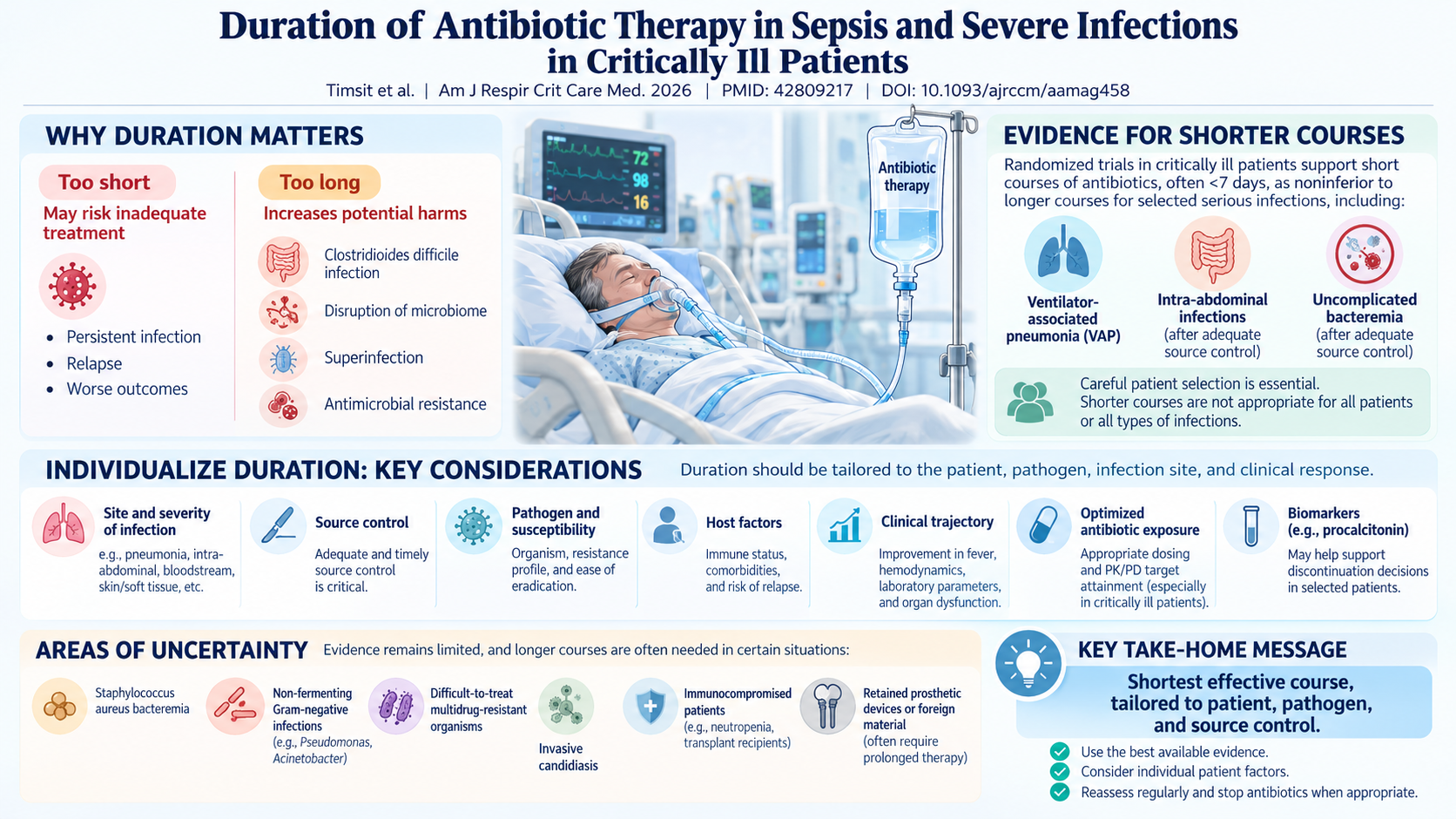
Antibiotic duration in critically ill patients has long been more art than science. For decades clinicians balanced fears that too-short courses could lead to treatment failure and resistance against mounting evidence that prolonged exposure increases harms—disrupted microbiomes, Clostridioides difficile infection, emergence of resistant organisms and drug toxicity. In September 2026, an international expert panel led by Timsit and colleagues published a comprehensive consensus statement in the American Journal of Respiratory and Critical Care Medicine addressing the optimal duration of antibiotic therapy in sepsis and severe infections in critically ill patients (Timsit et al., 2026). This article synthesizes the core recommendations, the rationale for changing practice, areas of uncertainty and practical approaches to implementation in ICUs.
Why this statement now
– New randomized trials across a range of severe infections have consistently shown noninferiority of shorter antibiotic courses (often ≤7 days) for many common ICU infections when source control is achieved and the patient is clinically improving. Examples include ventilator-associated pneumonia (VAP), intra-abdominal infection after adequate source control, and many cases of Gram-negative bacteremia.
– Mechanistic understanding—bacterial inoculum effects, biofilm biology, pharmacokinetics/pharmacodynamics (PK/PD) changes in critical illness—and modern PK-optimized dosing have created opportunities to accelerate pathogen eradication.
– Biomarker-guided strategies (especially procalcitonin-based algorithms) and rapid diagnostics enable individualized decision-making that can safely reduce exposure.
– Persistent clinical uncertainty remains for several high-risk syndromes (e.g., Staphylococcus aureus bacteremia, infections due to non-fermenting Gram‑negatives, invasive candidiasis, retained-device infections, and severely immunocompromised hosts), calling for explicit guidance.
New Guideline Highlights
Core themes and high-level recommendations
– Favor the shortest effective antibiotic duration consistent with clinical resolution, adequate source control, and microbiological data. Short-course therapy (commonly 4–7 days) is recommended for many severe infections in the ICU when these conditions are met.
– Exceptions requiring prolonged therapy (≥14 days or individualized prolonged regimens) include: Staphylococcus aureus bacteremia, deep-seated or metastatic infections, infections with retained prosthetic material or intravascular devices that are not removed, invasive candidiasis, and infections caused by difficult-to-treat multidrug-resistant (MDR) organisms or non-fermenting Gram-negatives where evidence is lacking.
– Use biomarkers (procalcitonin) and serial clinical assessment to guide early discontinuation in selected patients; do not rely on biomarkers alone.
– Prioritize source control, PK/PD-optimized dosing (including therapeutic drug monitoring where appropriate), and antimicrobial stewardship processes to safely shorten therapy.
Key takeaways for clinicians
– Reassess antibiotic need daily in the ICU; if fever has resolved, hemodynamics are stable without vasopressor support, organ dysfunction is improving, and source control is achieved, consider stopping or shortening therapy even for traditionally “severe” infections.
– Targeted durations: intra-abdominal infections with adequate source control — typically 4 days; ventilator-associated pneumonia — 7–8 days; many Gram-negative bacteremias — 7 days (if uncomplicated and source controlled); S. aureus bacteremia — at least 14 days for uncomplicated, longer for complicated disease.
– Biomarker guidance can reduce duration and antibiotic exposure without increasing harm when used within validated algorithms and combined with clinical judgment.
Updated Recommendations and Key Changes
What’s different from prior practice
– Shorter standardized durations: The consensus formalizes a shift toward shorter routine durations for many ICU infections, codifying evidence accumulated since earlier guidelines and trial data such as STOP-IT (intra-abdominal infection), Chastre et al. (VAP), and several procalcitonin-guided trials (Bouadma PRORATA, de Jong).
– Explicit exceptions: Previous guidance often left many syndromes without clear duration rules; the 2026 consensus clearly flags high-risk infections that still require prolonged or individualized therapy.
– Integration of PK/PD: The statement emphasizes using PK/PD optimization (extended/continuous β‑lactam infusions, higher initial dosing, therapeutic drug monitoring for some agents) as a means to achieve bacterial eradication faster and therefore shorten therapy.
– Biomarker use clarified: Rather than endorsing routine procalcitonin use for all patients, the panel recommends targeted use of validated algorithms to help discontinue antibiotics earlier in settings where trials have demonstrated benefit.
Evidence driving the updates
– Randomized trials have repeatedly found noninferiority of short courses for many infections when source control is effective and patients improve clinically. Notable examples: STOP-IT (source-controlled intra-abdominal infections), Chastre et al. VAP trial (8 vs 15 days), and multiple trials of procalcitonin-guided therapy showing reduced antibiotic exposure without outcome harm.
– Mechanistic and PK/PD data show that higher early antimicrobial exposure (optimized dosing) reduces bacterial burden quickly; this, combined with source control, lowers relapse risk and therefore supports shorter duration.
Topic-by-Topic Recommendations
Below are synthesized, practical recommendations drawn from the 2026 consensus and supporting trials. Where possible, suggested durations reflect the consensus panel’s standard approach; clinical judgment and individualized factors remain essential.
General principles (applies to all infections)
– Daily review of antimicrobial need is mandatory in ICU rounds.
– Always document indication, planned duration (or stopping criteria), and key timepoints for reassessment on the chart.
– Optimize source control as a precondition to stopping therapy early.
– Use microbiology results to de-escalate therapy and narrow spectrum as soon as feasible.
– Employ PK/PD optimization (dose, infusion strategy) and therapeutic drug monitoring for agents with narrow therapeutic windows (e.g., aminoglycosides, vancomycin) or altered PK in critical illness.
Specific syndromes and recommended durations
– Uncomplicated intra-abdominal infection with adequate source control: 4 days of systemic antibiotics after adequate source control is sufficient in most cases (STOP-IT results and consensus).
– Ventilator-associated pneumonia (VAP) and hospital-acquired pneumonia (HAP): 7–8 days is recommended for most episodes when the causative pathogen is not Pseudomonas aeruginosa or other non-fermenting Gram-negative bacilli and when clinical response is favorable (based on Chastre et al. and subsequent analyses). For non-fermenters or recurrent infection, consider longer courses individualized to response.
– Gram-negative bacteremia (Enterobacterales, community- or hospital-acquired), uncomplicated and source-controlled: 7 days may be sufficient when the patient is clinically improving, bacteremia clears rapidly, and no deep-seated focus is identified. For complicated bacteremia (endocarditis, persistent bacteremia, undrained abscess), therapy should be prolonged.
– Staphylococcus aureus bacteremia (SAB): Exception to short-course approach. Uncomplicated SAB typically requires at least 14 days of effective intravenous therapy after clearance of bacteremia and source control. Complicated SAB (e.g., endocarditis, osteomyelitis, metastatic abscesses, retained infected prostheses) requires prolonged therapy—often 4–6 weeks or longer per established IDSA guidance.
– Infections caused by non-fermenting Gram-negative bacilli (e.g., Pseudomonas aeruginosa, Acinetobacter spp.) or difficult-to-treat MDR organisms: Evidence is limited. The panel recommends individualized longer courses when clinical or microbiologic concerns (slow clearance, unstable course) exist; enrollment in trials is encouraged.
– Invasive candidiasis (candidemia): Standard guideline-based durations remain—generally 2 weeks of therapy after documented clearance of bloodstream infection and clinical resolution, with longer therapy for deep-seated disease or retained infected material.
– Device- and prosthesis-associated infections: Infections involving retained prosthetic material or intravascular devices often require prolonged therapy or chronic suppressive regimens if device removal is not possible. Early removal when feasible facilitates shorter antibiotic courses.
– Immunocompromised patients (e.g., neutropenia, transplant recipients): Evidence is sparse. The panel advises caution with short courses; individualized, often longer, therapy is recommended pending additional data.
Biomarker-guided algorithms
– Procalcitonin (PCT)-guided discontinuation: When used within validated algorithms (and combined with clinical assessment), PCT can safely reduce duration of therapy and cumulative antibiotic exposure in ICU patients. Algorithms generally recommend stopping antibiotics when PCT decreases by ≥80% from peak or falls below a low threshold and clinical improvement is evident.
– Avoid using PCT in isolation to make decisions; prominently consider clinical stability and source control.
Monitoring and follow-up
– Ensure documented clinical improvement (afebrile state, stable hemodynamics, reversal of organ dysfunction where possible) before stopping therapy.
– Obtain follow-up cultures only if clinically indicated (e.g., persistent or recurrent signs of infection), rather than routinely.
– Coordinate with antimicrobial stewardship teams for auditing, feedback and to monitor local outcomes after adopting shorter duration protocols.
Expert Commentary and Insights
Panel perspectives
– The consensus authors emphasize that the paradigm has shifted: duration is no longer fixed to a generous “one size fits all” number but should be an outcome of early, aggressive management (source control and PK/PD-optimized therapy) plus serial clinical assessment.
– Several panelists highlighted the importance of antimicrobial stewardship integrated into ICU workflows—daily review, standardized stop orders, and decision-support tools drive safe adoption of shorter courses.
Controversies and areas of disagreement
– S. aureus bacteremia and device-associated infections remain contentious. While some observational data suggest shorter courses may be safe in very selected uncomplicated cases, the panel retained conservative recommendations given the high risk of relapse and endovascular seeding.
– The role of PCT in immunocompromised patients and those with fungal or MDR infections is unresolved; the panel cautioned extrapolation.
– Heterogeneity in ICU populations and global differences in pathogen prevalence mean local adaptation of these recommendations is necessary.
Future research priorities identified by the panel
– Adequately powered randomized trials in key high-risk populations (S. aureus bacteremia, non-fermenters, MDR organisms, immunocompromised patients).
– Prospective studies integrating rapid molecular diagnostics, host-response profiling, and PK/PD-guided dosing to individualize duration decisions.
– Implementation science to determine best ways to incorporate these recommendations into diverse ICU settings and resource-limited environments.
Practical Implications
How practice should change now
– Adopt protocols that default to shorter durations for common ICU infections (e.g., 4 days after source control for intra-abdominal infection; 7–8 days for most VAP; 7 days for many uncomplicated Gram-negative bacteremias) with clear stopping rules tied to clinical criteria.
– Build PCT-guided algorithms into decision support where feasible, ensuring clinicians understand limitations and use it alongside clinical assessment.
– Strengthen daily antimicrobial review at ICU rounds; require documentation of indication and planned duration for every antibiotic order.
– Ensure rapid, aggressive source control and PK/PD-optimized dosing early in infection management—these are prerequisites for safe shortening of therapy.
A brief clinical vignette
John Martinez, a 62-year-old man with perforated diverticulitis, required emergent laparotomy with source control and ICU care. He was started on broad-spectrum antibiotics perioperatively. By post-op day 3 he was afebrile, vasopressors had been weaned, and cultures grew an Enterobacterales sensitive to narrower agents. Following the 2026 consensus approach: source control established, clinical improvement documented, antibiotic narrowed and stopped after 4 days total therapy. John recovered without relapse—an example of how shorter durations, when paired with source control and reassessment, can reduce exposure without compromising outcomes.
References
– Timsit JF, Roberts JA, Kanj S, Bassetti M, Canton R, Dark P, Fowler R, Huttner A, Kollef MH, Micek ST, Sawyer RG, Thy M, Yahav D, Daneman N. Duration of antibiotic therapy in sepsis and severe infections in critically ill patients. Am J Respir Crit Care Med. 2026 Sep 29. PMID: 42809217. https://pubmed.ncbi.nlm.nih.gov/42809217/
– Sawyer RG, Claridge JA, et al. Short-course antimicrobial therapy for intraabdominal infection after adequate source control (STOP-IT). N Engl J Med. 2015;372(14):1996–2005.
– Chastre J, Wolff M, Fagon JY, et al. Comparison of 8 vs 15 days of antibiotic therapy for ventilator-associated pneumonia. N Engl J Med. 2003; (Chastre et al. VAP trial).
– Bouadma L, Luyt CE, Tubach F, et al. Use of procalcitonin to reduce patients’ exposure to antibiotics in intensive care units (PRORATA): a multicentre randomized controlled trial. N Engl J Med. 2010;363: 1059–1068.
– de Jong E, van Oers JA, Beishuizen A, et al. Efficacy and safety of procalcitonin guidance in critically ill patients: a randomized clinical trial. JAMA. 2016;315: 1117–1126.
– IDSA Guidelines on the management of Staphylococcus aureus bacteremia and candidemia; and other specialty society guidance relevant to device-associated infections and invasive candidiasis (refer to current IDSA guidance for pathogen-specific durations).
Note: The 2026 consensus statement synthesizes an evolving evidence base. Clinicians should combine these recommendations with local epidemiology, resources, and patient-specific factors. For full methodology, evidence tables, and detailed graded recommendations, consult the original 2026 AJRCCM statement (Timsit et al., 2026).
Bottom line
Shorter antibiotic courses are now the rule rather than the exception for many severe infections in critically ill patients—provided prompt source control, PK/PD-optimized therapy and careful clinical reassessment. The 2026 consensus gives clinicians a practical, evidence-aligned framework to reduce unnecessary antibiotic exposure while preserving safety. Remaining gaps—particularly S. aureus bacteremia, non-fermenting Gram-negatives, MDR pathogens and immunocompromised hosts—require focused trials and stewardship vigilance as practice evolves.
This article was created using several editorial tools, including AI, as part of the process. Human editors reviewed this content before publication.