We use cookies

Our website uses essential cookies and, with your consent, additional cookies to measure performance and improve our services. Cookie Policy.

You can change your choice at any time.

MMedXYNews
HomeVideos
MedXY AI/MedXY News/Section: Critical Care

Optimizing Early Resuscitation in Septic Shock: Balancing Fluids and Vasopressors
MedXY Editorial Team•Oct 16, 2026•Critical Care
critical carefluid resuscitationseptic shockvasopressors

Highlight

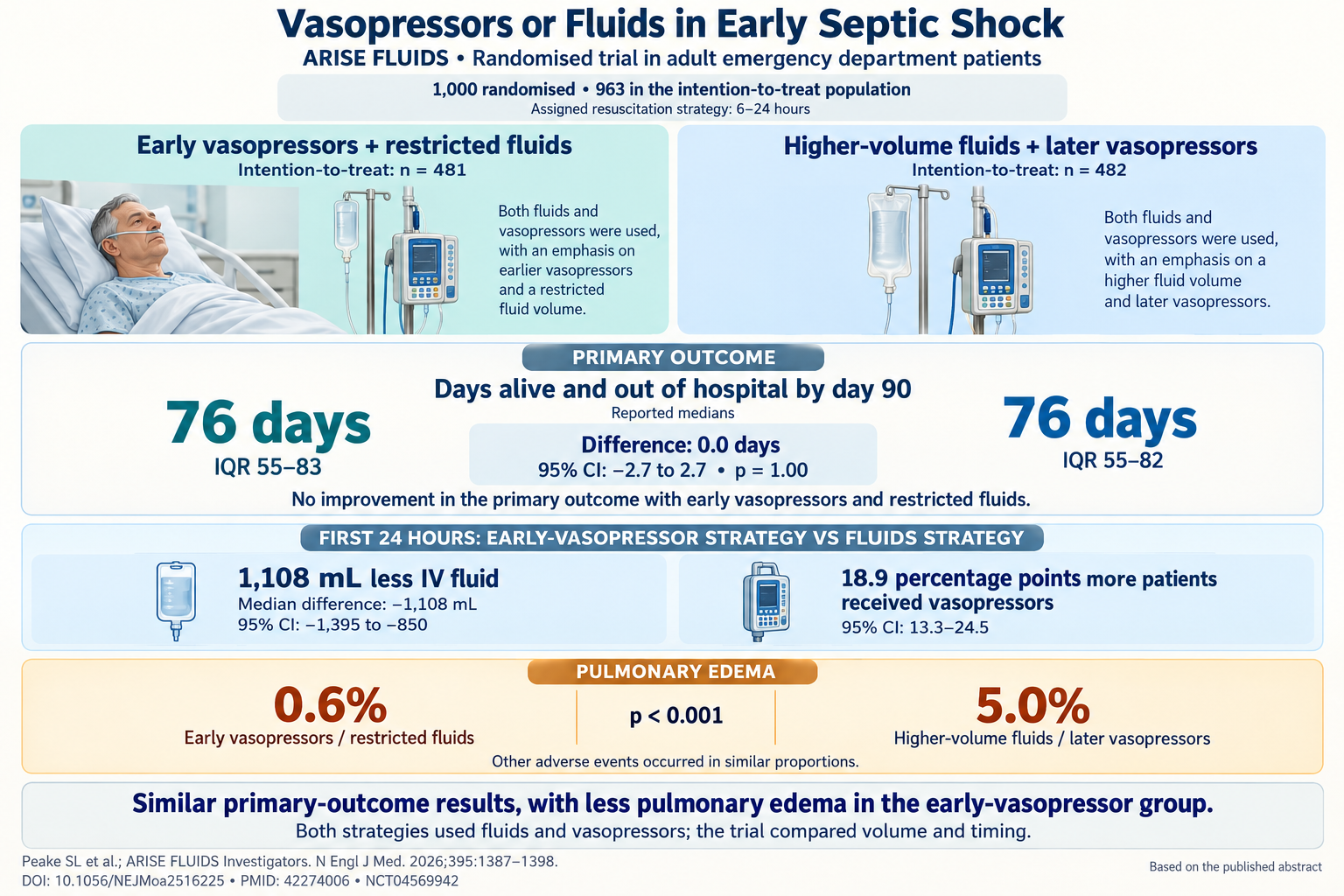
  • Early vasopressor initiation combined with restricted intravenous fluids did not improve 90-day survival or hospital-free days compared to standard higher fluid volume and later vasopressor use in septic shock.
  • The vasopressor-first strategy significantly reduced administered intravenous fluid volume within the first 24 hours.
  • Incidence of pulmonary edema was significantly lower in the vasopressor group, suggesting reduced fluid overload complications.
  • No significant differences in other adverse events were observed between fluid-restricted and fluid-liberal strategies.

Study Background

MedXY registered readers

Sign in free to continue reading

Create or use your MedXY account to unlock the complete article.

This article was created using several editorial tools, including AI, as part of the process. Human editors reviewed this content before publication.

Related articles

Open language-specific specialty feeds and department pages.

An Infant With Extreme Hypernatremia Treated With Peritoneal DialysisA 34-day-old male infant with serum sodium >200 mmol/L from accidental salt ingestion was successfully treated with peritoneal dialysis, leading to full recovery.Oct 16, 2026Evolving Patterns in Withdrawal of Life-Sustaining Treatment Among Traumatic Brain Injury Patients: Insights From a Decade of ACS Trauma DataA decade-long analysis reveals a modest decline and delayed timing in withdrawal of life-sustaining treatment among patients with traumatic brain injury, highlighting evolving prognostic attitudes and clinical decision-making.Oct 5, 2026Hospital Variation in Early Tracheostomy and Life-Sustaining Treatment Withdrawal in Severe TBI: Insights from a Nationwide StudyThis nationwide study reveals that hospitals with higher tendencies for early tracheostomy in severe TBI patients also show increased rates of withdrawal of life-sustaining treatment, highlighting significant practice variability and its poOct 1, 2026
Loading comments...
MedXY briefing

Get the free newsletter

Evidence-led clinical news, trends, and analysis—delivered to your inbox.

Ask MedXY AI

Most popular

Intimate Health
Five Benefits for Women Continuing Sexual Activity After Menopause
Intimate Health
Why Some Women Have a Strong Sex Drive—And Why Men Shouldn't Worry About It
Nursing & care
How often should a couple have sex?
Cardiology
Precision Medicine for Long QT Syndrome Type 2: Lumacaftor Corrects Trafficking Defects and Shortens QT Interval
General Surgery
Optimizing Postoperative Opioid Prescriptions After Intra-Abdominal Cancer Surgery: Comparing the 5x-Multiplier and 3-Tier Models
© 2026 MedXY
Contact usAbout usPrivacy PolicyMedXY story
Exploring ICU Staff Perspectives on Brain Death: Insights from a Swiss Multicenter Survey
A Swiss study reveals ICU professionals’ perceptions, knowledge, and ethical views on brain death, highlighting knowledge gaps and the positive impact of clinical experience on understanding.
Oct 1, 2026
Nonoperative Management of Colonic Fistulas in Necrotizing Pancreatitis: Identifying Candidates for Conservative CareColonic fistulas in necrotizing pancreatitis do not always require surgery. Low-risk patients with lower BISAP scores may be successfully managed nonoperatively, reducing ICU stays and hospital length without compromising survival.Sep 29, 2026
Evaluating ChatGPT-4o in Critical Care Board Review: High Accuracy but Risky Multimodal InterpretationsChatGPT-4o achieves high accuracy on critical care board questions but shows notable limitations in image interpretation and reasoning, posing potential clinical risks.Sep 27, 2026