Racial Disparities and Social Determinants in Cardiovascular Risk Among Women with Polyendocrine Metabolic Ovarian Syndrome
Highlight
– Women with polyendocrine metabolic ovarian syndrome (PMOS) exhibit racial disparities in risk for atherosclerotic cardiovascular disease (ASCVD).
– Asian women with PMOS have a lower risk of ASCVD compared to White women, while Black and Hispanic women have higher risks.
– After adjusting for social determinants of health (SDoH), increased ASCVD risk among Black women is no longer significant, indicating the strong influence of SDoH.
– The findings underscore the critical role of socioeconomic factors in cardiovascular risk stratification for women with PMOS.
Study Background
Polycystic ovary syndrome (PCOS), recently renamed polyendocrine metabolic ovarian syndrome (PMOS) to reflect its multifaceted metabolic and endocrine dysfunction, is a prevalent condition among reproductive-aged women. Women with PMOS often have increased cardiometabolic risk factors, including insulin resistance, dyslipidemia, hypertension, and obesity, all of which can elevate their risk for atherosclerotic cardiovascular disease (ASCVD). Despite this known risk, there has been limited investigation into racial and ethnic disparities in ASCVD outcomes within this population. Furthermore, the impact of social determinants of health (SDoH) such as education, income, and homeownership on these disparities remains poorly defined. Addressing these gaps is critical given rising cardiovascular morbidity and mortality in women and the increasing emphasis on health equity.
Study Design
This retrospective cohort study was conducted using Optum’s de-identified Clinformatics® Data Mart Database spanning 2000 to 2022. The cohort consisted of 413,450 women aged 18 to 50 years diagnosed with PMOS, identified via International Classification of Diseases (ICD) 9 and 10 codes for PCOS. Participants were categorized into racial/ethnic groups: White, Black, Asian, and Hispanic.
The primary outcome was incident composite ASCVD, encompassing coronary artery disease, cerebrovascular disease (stroke), and peripheral artery disease. Secondary outcomes involved these individual ASCVD components. Cox proportional hazards models estimated adjusted hazard ratios (aHRs) with 95% confidence intervals (CIs). Three models were employed: Model 1 unadjusted; Model 2 adjusted for medical comorbidities including diabetes, hypertension, and obesity; Model 3 further adjusted for SDoH variables—homeownership status, net worth, and educational attainment.
Key Findings
In this large, diverse cohort, racial and ethnic disparities in ASCVD risk were evident:
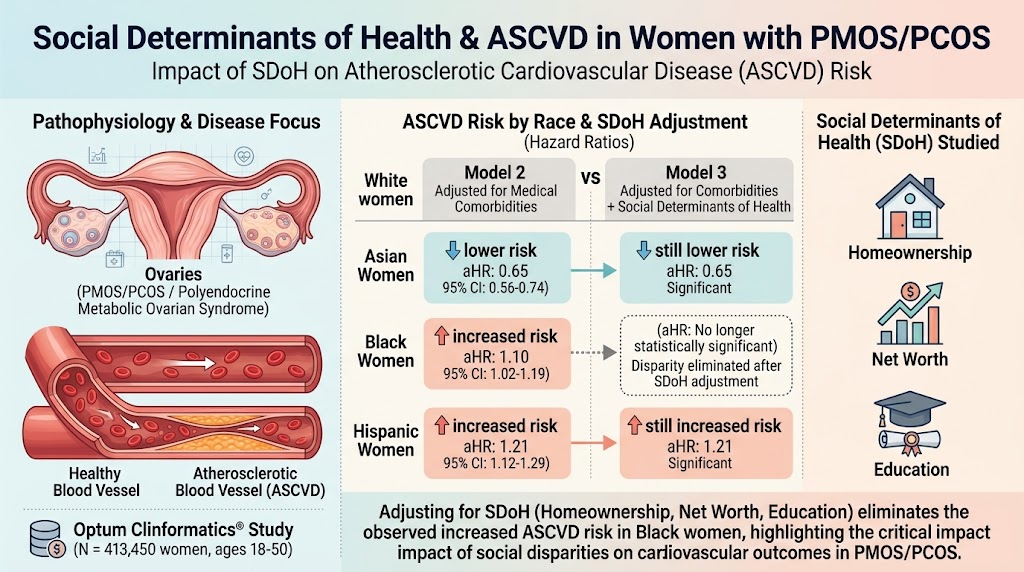
After controlling for medical comorbidities (Model 2), Asian women with PMOS had a significantly lower risk of ASCVD compared to White women (aHR 0.65; 95% CI 0.56–0.74).
Black women showed an elevated ASCVD risk compared to White women (aHR 1.10; 95% CI 1.02–1.19), as did Hispanic women (aHR 1.21; 95% CI 1.12–1.29).
When SDoH adjustments were incorporated (Model 3), the elevated ASCVD risk among Black women was no longer statistically significant, suggesting socioeconomic factors largely explained their increased risk.
The lower risk among Asian women and higher risk among Hispanic women persisted even after SDoH adjustment, indicating other factors may contribute to these disparities.
Analysis of ASCVD subtypes revealed that the higher risks for multiple components among Black women diminished after accounting for SDoH, highlighting socioeconomic mediators of cardiovascular risk.
Overall, these results emphasize that while biological and clinical factors affect ASCVD risk in PMOS, social determinants substantially modulate these associations, particularly among racial minorities.
Expert Commentary
This study by Alur-Gupta et al. addresses a significant knowledge gap regarding cardiovascular risk heterogeneity among women with PMOS and highlights the vital role of social context. The attenuation of ASCVD risk disparities in Black women after adjusting for SDoH echoes broader literature emphasizing social determinants as powerful drivers of health inequities. The persistent risk differences for Hispanic and Asian women warrant further research to elucidate genetic, cultural, lifestyle, or healthcare access factors.
Limitations include reliance on administrative codes which may introduce misclassification bias, potential residual confounding, and the observational design which precludes causal inference. The cohort’s insurance database origin may also limit generalizability to uninsured populations. Nevertheless, the large sample size and comprehensive adjustment models strengthen the validity of findings.
Clinicians should integrate SDoH screening and interventions when managing women with PMOS, particularly addressing socioeconomic barriers that magnify cardiovascular risk. Health policies tailored to social context may be key to reducing racial disparities in ASCVD.
Conclusion
This large cohort study demonstrates that racial disparities exist in ASCVD risk among women with PMOS, with social determinants of health playing a crucial role, especially in mitigating risk among Black women. Tailored approaches that incorporate socioeconomic interventions alongside medical management are imperative to advance cardiovascular health equity in this high-risk population. Future prospective and mechanistic studies are needed to clarify persistent risk disparities and optimize prevention strategies.
Funding and ClinicalTrials.gov
The study did not involve interventional treatments. Funding sources were not detailed in the publication. As a retrospective database analysis, this study was not registered on ClinicalTrials.gov.
References
Alur-Gupta S, DiTosto JD, Busse KR, Lewey J, Soffer DE, Liu Q, Brensinger C, Mumford SL, Dokras A. Social determinants of health and cardiovascular disease in women with polyendocrine metabolic ovarian syndrome (PCOS/PMOS). J Clin Endocrinol Metab. 2026 Oct 16;111(11):e2403-e2416. doi:10.1210/clinem/dgac632. PMID: 42530028.
Fauser BCJM, Tarlatzis BC, Rebar RW, et al. Consensus on women’s health aspects of polycystic ovary syndrome (PCOS): The Amsterdam ESHRE/ASRM-Sponsored 3rd PCOS Consensus Workshop Group. Fertil Steril. 2012;97(1):28-38.e25.
Yusuf S, et al. Effect of potentially modifiable risk factors associated with myocardial infarction in 52 countries (the INTERHEART study): case-control study. Lancet. 2004;364(9438):937-952.
Braveman PA, et al. Social determinants of health: coming of age. Annu Rev Public Health. 2011;32:381-398.
This article was created using several editorial tools, including AI, as part of the process. Human editors reviewed this content before publication.