Predicting Outcomes in Acutely Intoxicated ICU Patients: Integrating Toxicity Scores and Laboratory Data
Highlight
This multicenter cohort study evaluates prognostic models for predicting complicated outcomes in ICU patients admitted with acute intoxication.
The mean Lethality Risk Score (LRS) provides prognostic value in the absence of laboratory data but is superseded when lab results are available.
Two models were developed: a Laboratory Model with clinical and lab variables, and an Expo Model incorporating the mean LRS alongside clinical data, both showing good predictive performance.
These models can support clinical decision-making by helping identify high-risk patients for ICU complications or death.
Study Background
Acute intoxication is a common and potentially life-threatening reason for admission to intensive care units (ICUs) worldwide. Patients present with diverse toxic exposures—ranging from pharmaceuticals to illicit substances—leading to variable clinical manifestations and risks of complications. Early risk stratification is critical to guide management decisions, resource allocation, and to inform prognosis. However, predicting which acutely intoxicated patients will experience complicated ICU courses, defined by severe adverse events or death, remains challenging due to heterogeneous presentations and limited toxicity data availability. The Lethality Risk Score (LRS) was developed as a means to quantify inherent substance toxicity but its prognostic utility in critical care, particularly when combined with routine laboratory and clinical data, has not been fully investigated. This study addresses the unmet need for robust prediction models to enhance prognostication and clinical decision-making in this complex patient population.
Study Design
This was a prospective multicenter cohort study conducted from 2020 to 2023 across 78 ICUs spanning Europe, Australia, and the Eastern Mediterranean region. The study enrolled 2265 adult patients admitted to the ICU for at least four hours primarily due to acute intoxication. No interventions were applied as part of the study design.
Clinical data, including demographics, vital signs, Glasgow Coma Scale (GCS) scores, and laboratory test results, were collected using an electronic clinical capture system. Additional exposure-specific data included identification of toxicants involved, enabling calculation of the mean Lethality Risk Score (LRS) by averaging the individual LRS values assigned to each substance present in the patient’s exposure.
The primary composite outcome was the occurrence of ICU complications or death during the ICU stay, with a 22.5% event rate.
Two prediction models were developed:
– The Laboratory Model: incorporated clinical variables together with laboratory results.
– The Expo Model: incorporated clinical variables and the mean LRS score but without laboratory variables.
Model performance was assessed using discrimination metrics (AUROC), calibration plots, likelihood ratio tests, and decision curve analysis. Internal validation was conducted to evaluate model robustness and overfitting.
Key Findings
The cohort included a broad spectrum of intoxications and severity levels. Key predictors selected based on clinical relevance and statistical modelling included age, initial severity scores, systolic blood pressure, Glasgow Coma Scale score, and hospital type (reflecting resource and practice variation).
Performance metrics for the two models were as follows:
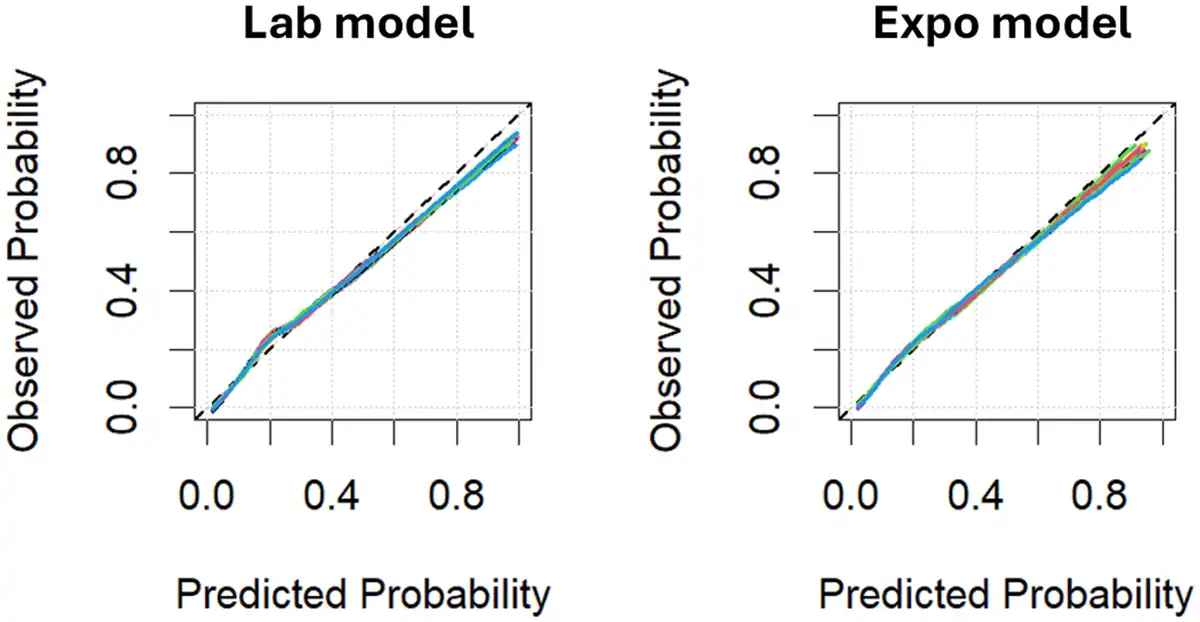
– Laboratory Model (with lab data): AUROC 0.79 (95% CI not specified), calibration slope 0.94, intercept -0.06.
– Expo Model (with mean LRS but no labs): AUROC 0.77, calibration slope 0.95, intercept -0.06.
Both models demonstrated minimal overfitting, indicating good internal validity. Importantly, the mean LRS contributed independent prognostic information only when laboratory variables were not available. When lab data were included, the mean LRS lost statistical significance, suggesting that objective biochemical parameters provide more precise risk assessment.
Decision curve analysis highlighted that the Laboratory Model offers net clinical benefit across risk thresholds up to 50%, whereas the Expo Model is beneficial up to a threshold of approximately 40%. This suggests that for initial evaluations without lab results, the Expo Model may guide early decisions, while the Laboratory Model is preferred once lab assessments are available.
These models hold potential to improve frontline clinical assessments by facilitating early identification of patients at high risk for complicated ICU courses, allowing timely escalation of care or targeted monitoring.
Expert Commentary
The integration of a toxicity-based metric (mean LRS) with clinical variables represents a novel approach to prognostication in acute intoxication. The finding that LRS is prognostically useful primarily in the absence of laboratory data aligns with the intuitive clinical notion that comprehensive lab assessments capture patient pathophysiologic status more accurately than toxicity scores alone.
Limitations include the lack of external validation, which is essential before widespread clinical implementation, and variability in lab testing and patient management across participating centers that may affect generalizability. Additionally, the LRS depends on accurate identification of all substances involved, which may be challenging in cases with unknown or multiple toxicants.
Future research should focus on external validation, refinement of toxicity scoring systems, and incorporation of dynamic clinical trajectory data to further enhance predictive accuracy.
Conclusion
This large multicenter study developed and internally validated two prognostic models to predict complicated ICU outcomes in patients with acute intoxication. The Laboratory Model, integrating clinical and lab data, showed superior prognostic performance, whereas the Expo Model using the mean LRS score provided useful risk information when lab data are unavailable. Implementing these models in clinical practice could facilitate better risk stratification, efficient resource utilization, and improved patient outcomes in intensive care settings dealing with acute intoxications.
Funding and Clinical Trial Registration
Details on funding sources and clinical trial registration were not specified in the available abstract. The study was conducted by the INTOXICATE Study Investigators Group involving multiple international institutions.
References
1. Zwaag SM, van Sabben N, van den Hengel-Koot IS, et al. Developing Models for Complicated Outcomes in Acutely Intoxicated ICU Patients With and Without Toxicity Information. Crit Care Med. 2026 Oct 15. PMID: 42878613.
This article was created using several editorial tools, including AI, as part of the process. Human editors reviewed this content before publication.