Similar 1-Year Outcomes After First Acute Myocardial Infarction in Adults With Congenital Heart Disease
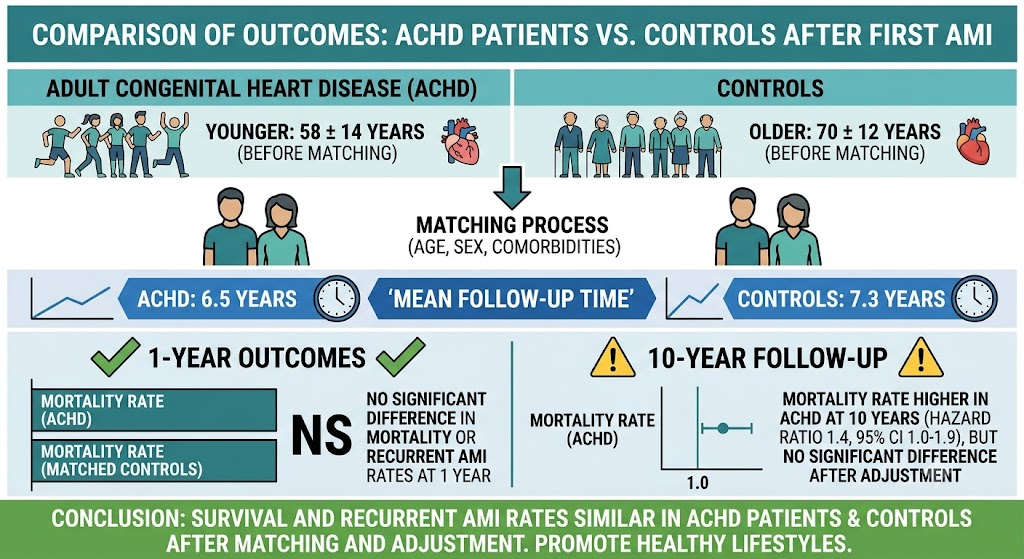
Adults with congenital heart disease (ACHD) and matched controls had similar 1-year mortality and recurrent acute myocardial infarction (AMI) rates after a first AMI.
Before matching, ACHD patients were younger than controls at the time of first AMI (mean age 58 vs 70 years).
A higher 10-year mortality rate in the ACHD group (hazard ratio 1.4, 95% CI 1.0-1.9) did not persist after adjustment.
The authors call for healthy lifestyles and proactive management of traditional cardiovascular risk factors in ACHD patients.
Study Snapshot
Design | Nationwide case-control study |
|---|---|
Study period | 2000-2022 |
Population | Adults with ACHD and controls who experienced a first acute myocardial infarction; 214 ACHD patients and 275,377 controls identified, with 213 ACHD patients matched to 2,092 controls |
Matching factors | Age, sex, hypertension, diabetes, hyperlipidaemia, and history of percutaneous coronary intervention or coronary artery bypass grafting |
Follow-up | Mean 6.5 years for ACHD patients and 7.3 years for controls |
Primary outcomes | All-cause mortality and recurrent acute myocardial infarction |
Main results | No significant difference in 1-year mortality or recurrent AMI; 10-year mortality HR 1.4 (95% CI 1.0-1.9), no longer significant after adjustment |
Limitations | Observational design; residual confounding possible; abstract-level data |
Why This Study Matters
Over the past decades, survival in congenital heart disease has improved substantially, and more patients are living to older ages. As a result, acquired cardiovascular conditions such as acute myocardial infarction (AMI) are becoming a more relevant part of their care. Whether outcomes after a first AMI differ between people with and without congenital heart disease has been unclear.
In a nationwide case-control study spanning 2000 to 2022, researchers compared all-cause mortality and recurrent AMI in adults with and without congenital heart disease after a first AMI. Their findings, published in the European Heart Journal, suggest that short-term outcomes are broadly similar once traditional risk factors are taken into account.
How the Study Was Conducted
The investigators identified 214 adults with congenital heart disease (ACHD) and 275,377 controls without congenital heart disease who had a first acute myocardial infarction. Because patients with ACHD were substantially younger, the researchers matched each ACHD patient to 10 controls on age, sex, hypertension, diabetes, hyperlipidaemia, and history of percutaneous coronary intervention (PCI) or coronary artery bypass grafting (CABG). This produced a matched sample of 213 ACHD patients and 2,092 controls.
All-cause mortality and recurrent AMI were assessed using Cox regression, a statistical method for time-to-event data. Analyses were run unadjusted and adjusted for the matching factors and other clinical covariates. A hazard ratio above 1 indicates a higher rate of the outcome over time; a confidence interval that includes 1 indicates that the estimate is not statistically significant.
What the Researchers Found
Before matching, patients with ACHD were significantly younger at first AMI than controls (mean 58 ± 14 years vs 70 ± 12 years; P < .001). Mean follow-up was 6.5 years for ACHD patients and 7.3 years for controls.
At 1 year, there was no significant difference in mortality or recurrent AMI between ACHD patients and matched controls.
At 10 years, the mortality rate was higher in the ACHD group (hazard ratio 1.4, 95% confidence interval 1.0-1.9), but this association did not remain after adjustment.
What the Findings May Mean
The results suggest that, within the matched cohort, ACHD was not associated with a statistically significant difference in 1-year death or recurrent AMI after a first AMI. The higher 10-year mortality estimate was attenuated after accounting for matching and clinical covariates, indicating that the apparent excess risk may reflect measured risk factors rather than congenital heart disease alone.
The authors concluded that survival rates and the incidence of recurrent AMI in ACHD patients are similar to those of controls. They also noted that patients with ACHD share similar cardiovascular risk factors with the general population, making healthy lifestyles and proactive risk management crucial to mitigate acquired heart disease.
Strengths and Limitations
Strengths of the study include its nationwide scope, long follow-up, and matching for key cardiovascular risk factors and prior revascularization.
Because this is an observational case-control study, the findings cannot prove causation. Matching can reduce but not eliminate confounding, and residual or unmeasured confounders are possible. The available abstract does not provide absolute event counts, detailed adjusted model results, or information about ACHD lesion types and severity, which may influence generalizability.
Implications for Practice and Research
For clinicians, the findings support a continued focus on traditional cardiovascular risk factor control in adults with congenital heart disease. ACHD status alone should not be assumed to determine post-AMI prognosis; age, hypertension, diabetes, lipid levels, and revascularization history remain important.
For researchers, the study highlights the need for more detailed investigations of long-term outcomes after AMI in ACHD, including larger cohorts, standardized classification of congenital heart disease, and longer follow-up for recurrent events.
Funding, Disclosures, and Registration
Funding sources, author disclosures, and registration details were not reported in the available abstract.
References
Holmgren L, von Koch S, Andell P, et al. Outcomes after a first acute myocardial infarction in patients with or without congenital heart disease. European Heart Journal. 2026;47(29):3951-3961. PMID: 42112702. PubMed
This article was created using several editorial tools, including AI, as part of the process. Human editors reviewed this content before publication.