We use cookies

Our website uses essential cookies and, with your consent, additional cookies to measure performance and improve our services. Cookie Policy.

You can change your choice at any time.

MMedXYNews
HomeVideos
MedXY AI/MedXY News/Section: Clinical Updates

Impact of Hospital Transfer-In Prevalence on Risk-Adjusted Outcomes: Insights from a National Retrospective Cohort Study
MedXY Editorial Team•Sep 21, 2026•Clinical Updates
health services researchRisk AdjustmentLength of Stayhospital transferMortality

Highlights

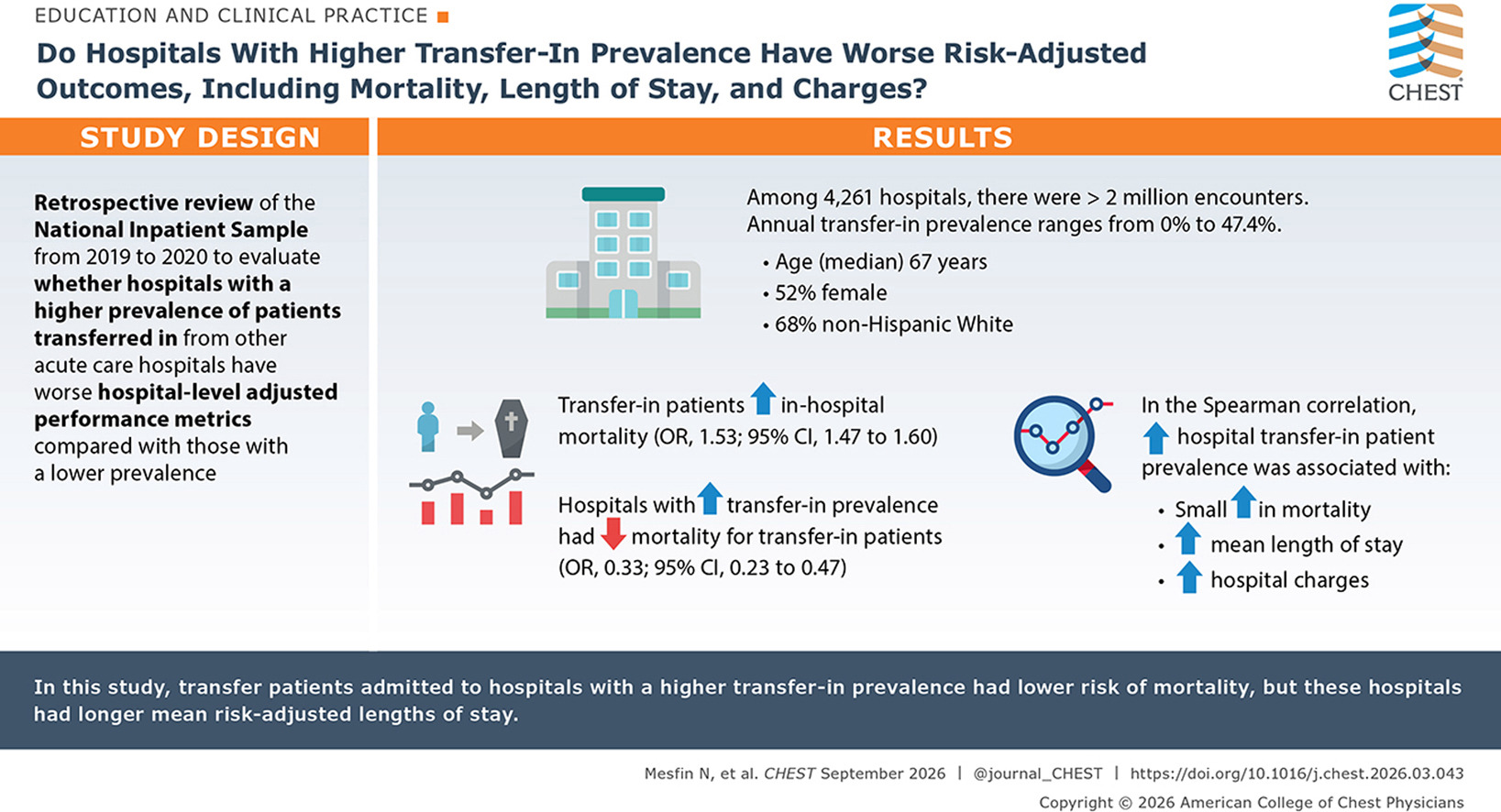
  • Transfer-in patients have higher individual risk-adjusted mortality compared to nontransfers, reflecting clinical complexity.
  • Hospitals with higher transfer-in patient prevalence exhibit lower mortality risk for those transferred in, suggesting specialized expertise or resources mitigate inherent patient risks.
  • Despite risk adjustment, higher transfer-in prevalence correlates with longer hospital stays and increased overall hospital charges, underscoring resource intensity.
  • Future research should explore repatriation strategies to optimize length of stay and resource utilization at high-transfer tertiary centers.

Background

MedXY registered readers

Sign in free to continue reading

Create or use your MedXY account to unlock the complete article.

This article was created using several editorial tools, including AI, as part of the process. Human editors reviewed this content before publication.

Related articles

Open language-specific specialty feeds and department pages.

Impact of Age at Type 1 Diabetes Onset on Mortality and Organ Complications: Insights from a Nationwide Swedish CohortYounger age at type 1 diabetes diagnosis significantly increases risks of mortality, cardiovascular, and kidney complications; each additional year delay in onset reduces these risks. This review synthesizes nationwide cohort findings and cSep 23, 2026Pre-ICU Balanced Crystalloids Reduce Mortality in Sepsis: Insights from a Large Multicenter Cohort StudyA large multicenter study shows that balanced crystalloids administered before ICU admission in sepsis patients reduce 30-day mortality compared to saline, supporting early fluid choice’s impact on sepsis outcomes.Sep 23, 2026Age, Anthracycline Use, and Mortality Outcomes in Classic Hodgkin Lymphoma: Insights from a Large Complete Population CohortThis review analyzes the impact of age and anthracycline-based chemotherapy on mortality in 28,000 classic Hodgkin lymphoma patients, highlighting poorer outcomes in the elderly and the therapeutic nuances influencing survival.Sep 21, 2026
Loading comments...
MedXY briefing

Get the free newsletter

Evidence-led clinical news, trends, and analysis—delivered to your inbox.

Ask MedXY AI

Most popular

Intimate Health
Five Benefits for Women Continuing Sexual Activity After Menopause
Intimate Health
Why Some Women Have a Strong Sex Drive—And Why Men Shouldn't Worry About It
Nursing & care
How often should a couple have sex?
General Surgery
Optimizing Postoperative Opioid Prescriptions After Intra-Abdominal Cancer Surgery: Comparing the 5x-Multiplier and 3-Tier Models
Intimate Health
Classic Intimacy Recommendations: How to Help Women Reach Orgasm and Enjoy Mutual Pleasure
© 2026 MedXY
Contact usAbout usPrivacy PolicyMedXY story
Reducing Mortality in Cardiogenic Shock: The Impact of Hospital Capability and Transfer Strategies
Higher hospital cardiac capability correlates with lower mortality in cardiogenic shock patients, and regionalized hub-and-spoke models mitigate the transfer penalty associated with patient instability.
Sep 19, 2026
Mortality and Morbidity After Below-Knee Amputation in Diabetes: Insights from a 25-Year English Cohort StudyThis large-scale England study reveals persistently high mortality after below-knee amputation in diabetes, with one-year mortality exceeding 23%, emphasizing the need for targeted interventions focused on older, female, and comorbid patienSep 17, 2026
Hemoglobin Levels and Mortality Risk: Insights from a Large UK Cohort StudyA UK prospective cohort study reveals a U-shaped association between hemoglobin concentration and mortality, with both low and high levels linked to increased death risk across age and sex groups.Sep 13, 2026